
AP Physics 2 - 10.6 Capacitors- Exam Style questions- MCQs
Capacitors AP Physics 2 MCQ
Unit 10: Electric Force, Field, and Potential
Weightage : 15–18%
Question
A parallel-plate capacitor is connected with wires of negligible resistance to a battery having emf \( \varepsilon \) until the capacitor is fully charged. The battery is then disconnected from the circuit, and the plates of the capacitor are moved to half of their original separation using insulated gloves. Let \(V_{\mathrm{new}}\) be the potential difference across the capacitor plates when the plates are moved together. Let \(V_{\mathrm{old}}\) be the potential difference across the capacitor plates when connected to the battery. What is the value of \( \dfrac{V_{\mathrm{new}}}{V_{\mathrm{old}}} \)?
(B) \(1\)
(C) \(2\)
(D) \(4\)
▶️ Answer/Explanation
Correct Answer: \( \boxed{\mathrm{A}} \)
After the battery is disconnected, the capacitor is isolated, so the charge remains constant.
\(Q=\mathrm{constant}\)
The capacitance of a parallel-plate capacitor is
\(C=\dfrac{\varepsilon_0A}{d}.\)
When the plate separation is reduced to one-half of its original value,
\(d_{\mathrm{new}}=\dfrac{d_{\mathrm{old}}}{2},\)
so the capacitance doubles:
\(C_{\mathrm{new}}=2C_{\mathrm{old}}.\)
Since \(Q=CV\) and the charge remains constant,
\(V=\dfrac{Q}{C}.\)
Therefore,
\(V_{\mathrm{new}}=\dfrac{Q}{2C_{\mathrm{old}}}=\dfrac{1}{2}V_{\mathrm{old}}.\)
Hence,
\(\dfrac{V_{\mathrm{new}}}{V_{\mathrm{old}}}=\dfrac{1}{2}.\)
Although the capacitance increases when the plates move closer together, the stored charge cannot change because the battery has been disconnected. As a result, the potential difference decreases by the same factor that the capacitance increases.
Therefore, the correct answer is (A).
Question
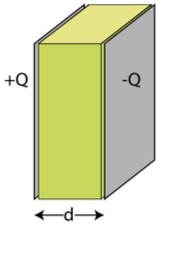
An air-gap parallel plate capacitor is attached to a source of constant potential difference as shown in the diagram above. Which of the following statements is true if a dielectric is inserted between the plates?
(B) Work must be done to insert the dielectric.
(C) Capacitance of the device is reduced.
(D) Electric field between the plates increases.
▶️ Answer/Explanation
Correct Answer: \( \boxed{\mathrm{B}} \)
Inserting a dielectric increases the capacitance of a parallel-plate capacitor:
\( C=\kappa C_0 \)
where \( \kappa>1 \) is the dielectric constant.
Since the capacitor remains connected to a battery, the potential difference remains constant:
\( V=\mathrm{constant} \)
As a result:
\( \bullet \) The capacitance increases.
\( \bullet \) The charge increases according to \( Q=CV \).
\( \bullet \) The electric field between the plates remains approximately constant because \( E=\frac{V}{d} \).
The dielectric is naturally pulled into the capacitor by the electric field. Therefore, an external agent must apply a force to control its insertion, meaning work must be done during the process.
Thus:
\( \times \) (A) is incorrect because the stored energy actually increases: \( U=\frac{1}{2}CV^2 \).
\( \checkmark \) (B) is correct.
\( \times \) (C) is incorrect because the capacitance increases.
\( \times \) (D) is incorrect because the electric field remains approximately constant for a fixed plate separation and constant voltage.
Therefore, the correct answer is (B).
Question
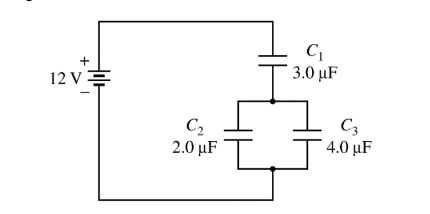
The circuit shown above has three capacitors and a \(12\ \mathrm{V}\) battery. The capacitors are charged to steady-state conditions.
What is the potential difference across capacitor \(C_1\)?
(B) \(4.0\ \mathrm{V}\)
(C) \(6.0\ \mathrm{V}\)
(D) \(8.0\ \mathrm{V}\)
(E) \(12\ \mathrm{V}\)
▶️ Answer/Explanation
Correct Answer: \( \boxed{\mathrm{D}} \)
First combine the capacitors \(C_2\) and \(C_3\), which are connected in parallel:
\( \displaystyle C_{23}=C_2+C_3=2.0+4.0=6.0\ \mu\mathrm{F} \)
The circuit is now a series combination of \(C_1=3.0\ \mu\mathrm{F}\) and \(C_{23}=6.0\ \mu\mathrm{F}\).
The equivalent capacitance is
\( \displaystyle C_{\mathrm{eq}}=\frac{(3.0)(6.0)}{3.0+6.0}=2.0\ \mu\mathrm{F} \)
The charge on each capacitor in a series combination is the same:
\( \displaystyle Q=C_{\mathrm{eq}}V=(2.0\ \mu\mathrm{F})(12\ \mathrm{V})=24\ \mu\mathrm{C} \)
The potential difference across \(C_1\) is
\( \displaystyle V_{C_1}=\frac{Q}{C_1}=\frac{24\ \mu\mathrm{C}}{3.0\ \mu\mathrm{F}}=8.0\ \mathrm{V} \)
Therefore, the correct answer is (D).