
AP Physics 2 - 11.5 Compound Direct Current (DC) Circuits- Exam Style questions- MCQs
Compound Direct Current (DC) Circuits AP Physics 2 MCQ
Unit 11: Electric Circuits
Weightage : 15–18%
Question
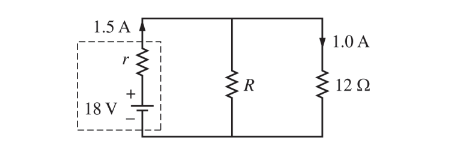
Two resistors of resistances \(R\) and \(12\,\Omega\) are connected to a battery of emf \(18\,\mathrm{V}\), as shown in the figure above. The battery has an internal resistance of \(r\). The current in the battery is \(1.5\,\mathrm{A}\), and the current in the \(12\,\Omega\) resistor is \(1.0\,\mathrm{A}\).
What is the resistance \(R\)?
(B) \(12\,\Omega\)
(C) \(18\,\Omega\)
(D) \(24\,\Omega\)
(E) \(45\,\Omega\)
▶️ Answer/Explanation
Correct Answer: \( \boxed{\mathrm{D}} \)
The two resistors are connected in parallel, so they have the same potential difference across them.
The total current supplied by the battery is \(1.5\,\mathrm{A}\), while the current through the \(12\,\Omega\) resistor is \(1.0\,\mathrm{A}\).
Therefore, the current through resistor \(R\) is
\( I_R = 1.5-1.0 = 0.5\,\mathrm{A} \)
The voltage across the \(12\,\Omega\) resistor is
\( V = (1.0\,\mathrm{A})(12\,\Omega)=12\,\mathrm{V} \)
Since \(R\) is in parallel with the \(12\,\Omega\) resistor, it also has a potential difference of \(12\,\mathrm{V}\).
Applying Ohm’s law,
\( R=\dfrac{V}{I_R}=\dfrac{12\,\mathrm{V}}{0.5\,\mathrm{A}}=24\,\Omega \)
The battery’s internal resistance affects the terminal voltage but is not needed because the voltage across both parallel branches is determined directly from the known branch current and resistance.
Therefore, the resistance is \( \boxed{24\,\Omega} \).
Answer: (D)
Question
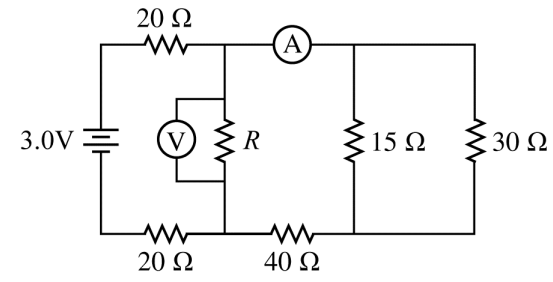
In the circuit shown above, the current through the ammeter is \(20\,\mathrm{mA}\) and the voltmeter indicates \(1.0\,\mathrm{V}\). What is the current through the \(40\,\Omega\) resistor?
(B) \(10\,\mathrm{mA}\)
(C) \(20\,\mathrm{mA}\)
(D) \(40\,\mathrm{mA}\)
▶️ Answer/Explanation
Correct Answer: \( \boxed{\mathrm{C}} \)
The ammeter and the \(40\,\Omega\) resistor lie between the same pair of junctions in the circuit.
Any current passing through the ammeter splits between the \(15\,\Omega\) and \(30\,\Omega\) branches and then recombines before flowing through the \(40\,\Omega\) resistor.
By Kirchhoff’s Junction Rule, the total current entering a junction equals the total current leaving the junction.
Therefore, the current through the \(40\,\Omega\) resistor must equal the current measured by the ammeter.
\( I_{40}=I_{\mathrm{ammeter}}=20\,\mathrm{mA} \)
Hence, the current through the \(40\,\Omega\) resistor is \( \boxed{20\,\mathrm{mA}} \).
Answer: (C)
Question
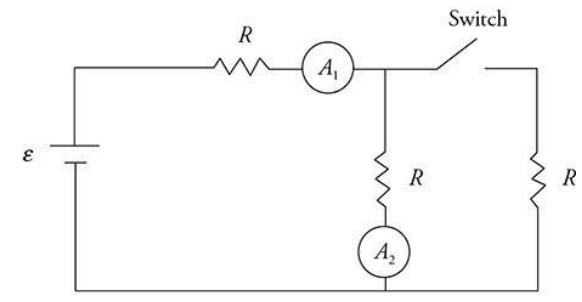
The circuit shown has a battery of emf \( \varepsilon \); three identical resistors, \(R\); two ammeters, \(A_{1}\) and \(A_{2}\); and a switch that is initially in the open position as shown in the figure. When the switch is closed, what happens to the current reading in the two ammeters?
| Choice | \(A_{1}\) | \(A_{2}\) |
|---|---|---|
| (A) | Increases | Increases |
| (B) | Increases | Stays the same |
| (C) | Increases | Decreases |
| (D) | Decreases | Stays the same |
▶️ Answer/Explanation
Correct Answer: \( \boxed{\mathrm{C}} \)
With the switch open: The circuit contains two identical resistors in series, so the equivalent resistance is
\( R_{\mathrm{eq}}=2R \)
Therefore, the current through both ammeters is
\( I=\dfrac{\varepsilon}{2R} \)
With the switch closed: The two right-hand resistors are connected in parallel, giving an equivalent resistance of
\( R_{\mathrm{parallel}}=\dfrac{R}{2} \)
This is in series with the left-hand resistor, so the total resistance becomes
\( R_{\mathrm{eq}}=R+\dfrac{R}{2}=\dfrac{3R}{2} \)
The total current supplied by the battery, and therefore measured by ammeter \(A_{1}\), is
\( I_{A_1}=\dfrac{\varepsilon}{\frac{3R}{2}}=\dfrac{2\varepsilon}{3R} \)
Since \( \dfrac{2\varepsilon}{3R}>\dfrac{\varepsilon}{2R} \), the reading of \(A_{1}\) increases.
The total current then splits equally between the two identical parallel branches, so the current through ammeter \(A_{2}\) is
\( I_{A_2}=\dfrac{1}{2}I_{A_1}=\dfrac{1}{2}\left(\dfrac{2\varepsilon}{3R}\right)=\dfrac{\varepsilon}{3R} \)
Since \( \dfrac{\varepsilon}{3R}<\dfrac{\varepsilon}{2R} \), the reading of \(A_{2}\) decreases.
Therefore, the correct choice is (C): \(A_{1}\) increases, while \(A_{2}\) decreases.