
AP Physics 2 - 10.2 Conservation of Electric Charge and the Process of Charging- Exam Style questions- MCQs
Conservation of Electric Charge and the Process of Charging AP Physics 2 MCQ
Unit 10: Electric Force, Field, and Potential
Weightage : 15–18%
Question
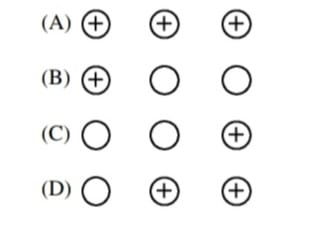
Three identical conducting spheres, \(S_1\), \(S_2\), and \(S_3\), are supported by insulating thread, as shown below. Initially, sphere \(S_1\) has a net positive charge and the other two spheres are uncharged. Spheres \(S_1\) and \(S_2\) are brought into contact and then separated. Next, spheres \(S_2\) and \(S_3\) are brought into contact and then separated. Which of the following shows the signs of the final net charges on the spheres?
▶️ Answer/Explanation
Correct Answer: \( \boxed{\mathrm{A}} \)
When two identical conducting spheres touch, charge redistributes until both spheres are at the same electric potential. Since the spheres are identical, they share the total charge equally.
Initially, only sphere \(S_1\) has a positive charge, while \(S_2\) and \(S_3\) are neutral.
Step 1: \(S_1\) touches \(S_2\).
The positive charge is shared equally between the two spheres, so both \(S_1\) and \(S_2\) become positively charged.
Step 2: \(S_2\) touches \(S_3\).
Sphere \(S_2\) shares part of its positive charge with the initially neutral sphere \(S_3\). After separation, both \(S_2\) and \(S_3\) have positive charge.
Thus, all three spheres have a positive net charge at the end of the process.
(Equivalently, electrons flow from the neutral sphere to the positively charged sphere whenever they touch, leaving both spheres positively charged after charge redistribution.)
Therefore, the correct answer is (A).
Question
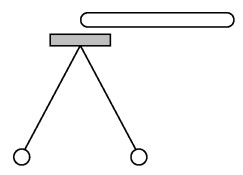
An initially uncharged electroscope consists of two thin, \(50\,\mathrm{cm}\) long conducting wires attached to a cap, with a \(25\,\mathrm{g}\) conducting sphere attached to the other end of each wire. When a charged rod is brought close to but not touching the cap, as shown above, the spheres separate a distance of \(30\,\mathrm{cm}\). What can be determined about the induced charge on each sphere from this information?
(B) The sign but not the magnitude
(C) Both the magnitude and the sign
(D) Nothing can be determined about the induced charges
▶️ Answer/Explanation
Correct Answer: \( \boxed{\mathrm{A}} \)
The two identical conducting spheres acquire equal induced charges and repel each other. At equilibrium, the electrostatic repulsion is balanced by the horizontal components of the tension in the wires, while the vertical components balance the weight of each sphere.
Using the given mass, wire length, and separation, the angle of deflection can be determined. This allows the electrostatic force between the spheres to be calculated from equilibrium:
\( T\sin\theta=F_e,\qquad T\cos\theta=mg \)
Therefore,
\( F_e=mg\tan\theta \)
Applying Coulomb’s law,
\( F_e=\dfrac{kq^2}{r^2} \)
the magnitude of the induced charge \(q\) on each sphere can be determined.
However, because the sign of the external charged rod is not given, it is impossible to determine whether the induced charges on the spheres are positive or negative. Only their magnitude can be found.
Answer: (A)
Question
A charged rod attracts a suspended pith ball. The ball remains in contact with the rod for a few seconds and then is visibly repelled. Which of the following statements must be correct?
(B) The rod is negatively charged.
(C) The pith ball remained neutral throughout the process.
(D) The rod has less charge on it at the end of the process than at the beginning.
▶️ Answer/Explanation
Correct Answer: \( \boxed{\mathrm{D}} \)
Initially, the pith ball is attracted to the charged rod. This attraction could occur because the pith ball is neutral and becomes polarized, or because it initially carries a charge opposite to that of the rod.
When the pith ball touches the rod, charge is transferred by conduction until both objects acquire the same sign of charge.
Since like charges repel, the pith ball is repelled after remaining in contact with the rod.
Because charge has been transferred from the rod to the pith ball, the rod must have less net charge at the end of the process than it had initially.
The sign of the rod cannot be determined, so options (A) and (B) are not necessarily true. Option (C) is incorrect because the pith ball becomes charged after contact.
Therefore, the correct answer is (D).