
AP Physics 2- 14.8 Double-Slit Interference and Diffraction Gratings- FRQs- New Syllabus
Double-Slit Interference and Diffraction Gratings AP Physics 2 FRQ
Unit 14: Waves , Sound , and Physical Optics
Weightage : 15–18%
Question
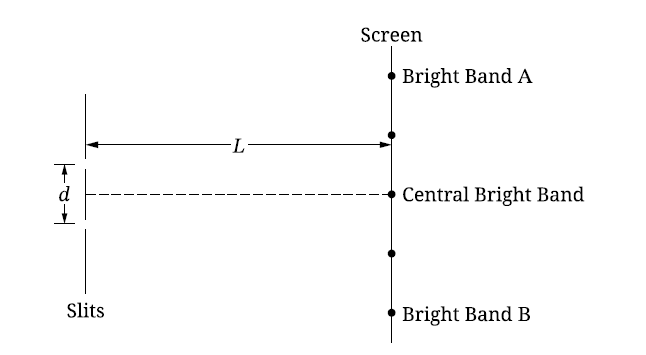
Most-appropriate topic codes (AP Physics 2):
▶️ Answer/Explanation
A.
The student’s claim is correct.
Violet light has a shorter wavelength than red light. For a bright fringe, the path-length difference between light from the two slits must equal an integer multiple of the wavelength.
Since Band \( A \) corresponds to a fixed bright-fringe order, the required path-length difference for violet light is smaller than for red light.
A smaller path-length difference means the point on the screen must be closer to the central bright band. Therefore, the distance from Band \( A \) to the central bright band is smaller for violet light.
B.
For double-slit interference, constructive interference occurs when
\( d\sin\theta = m\lambda \)
Because there are three bright bands between \( A \) and \( B \), including the central bright band, bands \( A \) and \( B \) must be the second-order bright fringes:
\( m = 2 \)
For small angles,
\( \sin\theta \approx \tan\theta \approx \dfrac{y}{L} \)
so
\( d\left(\dfrac{y}{L}\right)=m\lambda \)
\( y=\dfrac{m\lambda L}{d} \)
For Band \( A \),
\( y_A=\dfrac{2\lambda L}{d} \)
Band \( B \) is the same distance below the center, so the distance between \( A \) and \( B \) is
\( \Delta y = 2y_A = 2\left(\dfrac{2\lambda L}{d}\right) \)
\( \Delta y = \dfrac{4\lambda L}{d} \)
Using \( \lambda=\dfrac{c}{f} \),
\( \boxed{\Delta y = \dfrac{4cL}{fd}} \)
C.
Yes, the expression from part \( \mathrm{B} \) is consistent with the answer in part \( \mathrm{A} \).
Since \( \Delta y = \dfrac{4cL}{fd} \), the spacing between the two second-order bright bands is inversely proportional to frequency.
Violet light has a greater frequency than red light, so \( \Delta y \) is smaller for violet light. That means each bright band is closer to the central bright band, which matches the claim in part \( \mathrm{A} \).