
AP Physics 2- 10.1 Electric Charge and Electric Force- FRQs- New Syllabus
Electric Charge and Electric ForcE AP Physics 2 FRQ
Unit 10: Electric Force, Field, and Potential
Weightage : 15–18%
Question
Most-appropriate topic codes (AP Physics 2):
• Topic \(10.3\) — Electric Fields (Part \( \mathrm{(a)(i)} \), Part \( \mathrm{(a)(iii)} \), Part \( \mathrm{(b)} \))
• Topic \(12.2\) — Magnetism and Moving Charges (Part \( \mathrm{(a)(ii)} \), Part \( \mathrm{(b)} \))
▶️ Answer/Explanation
(a)(i)
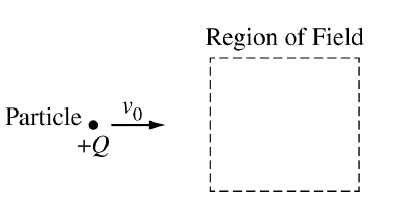
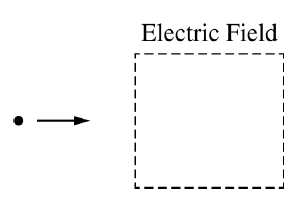
The particle has positive charge \(+Q\), so the electric force on the particle is in the same direction as the electric field.
Since the electric field is directed toward the bottom of the page, the electric force is also directed toward the bottom of the page.
The particle enters the region moving horizontally to the right. The electric force gives the particle a downward acceleration while its horizontal motion continues.
Therefore, the path should be curved downward. The path should initially be horizontal and then bend more and more toward the bottom of the page.
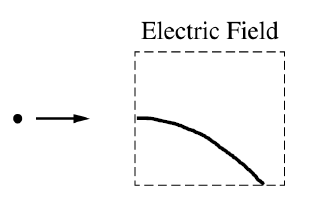
\(\boxed{\text{The path curves downward, like a projectile path.}}\)
(a)(ii)
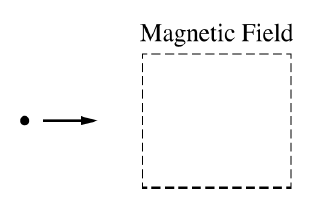
The magnetic force on a moving charged particle is given by \(F_B=qvB\), and the direction is determined by the right-hand rule.
The particle has positive charge \(+Q\), the velocity is to the right, and the magnetic field is directed out of the page.
For a positive charge, using the right-hand rule, \(\vec{v}\) to the right crossed with \(\vec{B}\) out of the page gives a force toward the bottom of the page.
The magnetic force is always perpendicular to the velocity. Therefore, the force changes direction as the particle’s velocity changes direction, producing circular motion.
The path should curve downward, but it should be part of a circular arc rather than a parabolic path.
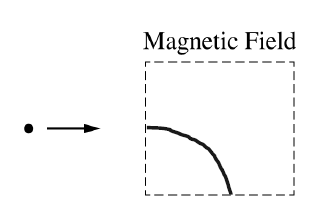
\(\boxed{\text{The path curves downward as part of a circular arc.}}\)
(a)(iii)
The motion in the electric field is more similar to projectile motion in a gravitational field near Earth’s surface.
In projectile motion near Earth’s surface, the force of gravity is approximately constant and directed downward. This produces a constant downward acceleration.
In the electric-field situation, the electric field is uniform, so the electric force \(F_E=qE\) is constant in magnitude and direction. Since the particle has positive charge \(+Q\), the force is constantly downward.
Thus, the particle has constant downward acceleration while continuing to move horizontally, giving a projectile-like curved path.
In the magnetic-field situation, the magnetic force is always perpendicular to the velocity, so the direction of the force changes as the particle moves. This produces circular motion rather than projectile motion.
\(\boxed{\text{The electric-field situation is more similar to projectile motion.}}\)
(b)
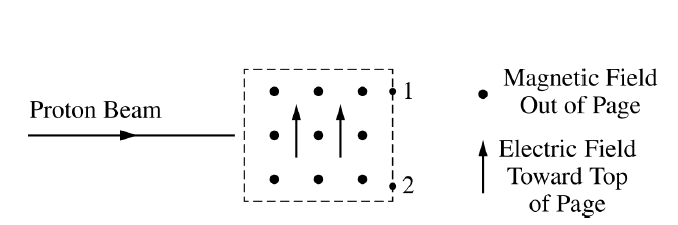
For each proton, the electric force and magnetic force act in opposite vertical directions. The electric field is directed toward the top of the page, so the electric force on a proton is upward because the proton has positive charge. The magnitude of the electric force is \(F_E=qE\), which does not depend on the speed of the proton.
The magnetic field is directed out of the page, and the protons initially move to the right. Using the right-hand rule for a positive charge, the magnetic force is directed toward the bottom of the page. The magnitude of the magnetic force is \(F_B=qvB\), so it depends on the speed \(v\) of the proton.
For a proton to travel through the region without being deflected, the net force must be \(0\), so the upward electric force and downward magnetic force must be equal in magnitude. This condition is \(qE=qvB\), or \(v=\dfrac{E}{B}\).
If a proton is moving faster than this particular speed, then \(qvB\) is greater than \(qE\). The downward magnetic force is larger than the upward electric force, so the net force is downward. Faster protons are deflected downward and exit closer to point \(2\).
If a proton is moving slower than this particular speed, then \(qvB\) is less than \(qE\). The upward electric force is larger than the downward magnetic force, so the net force is upward. Slower protons are deflected upward and exit closer to point \(1\).
Therefore, different protons exit at different points because they have different speeds, and the magnetic force depends on speed while the electric force does not.
\(\boxed{\text{Slower protons exit higher, near point }1\text{, and faster protons exit lower, near point }2.}\)