
AP Physics 2 - 10.3 Electric Fields- Exam Style questions- MCQs
Electric Fields AP Physics 2 MCQ
Unit 10: Electric Force, Field, and Potential
Weightage : 15–18%
Question
A positively charged particle enters a region between the plates of a parallel-plate capacitor. The particle is moving initially parallel to the plates.
What is the correct description of the trajectory of the particle in the region between the plates?
(B) The particle will move toward the negative plate along a straight-line path.
(C) The particle will move toward the negative plate along a curved path.
(D) The particle will move toward the positive plate along a curved path.
▶️ Answer/Explanation
Correct Answer: \( \boxed{\mathrm{C}} \)
The electric field between the plates of an ideal parallel-plate capacitor is uniform and directed from the positive plate toward the negative plate.
A positively charged particle experiences an electric force given by
\( \vec{F}=q\vec{E}. \)
Since the particle is positively charged, the force acts in the same direction as the electric field, causing the particle to accelerate toward the negative plate.
The particle’s initial velocity is parallel to the plates, so its horizontal velocity remains constant while it accelerates vertically due to the constant electric force. This combination of constant horizontal velocity and constant vertical acceleration produces a parabolic (curved) trajectory, similar to projectile motion.
Therefore, the particle moves toward the negative plate along a curved path.
Therefore, the correct answer is (C).
Question
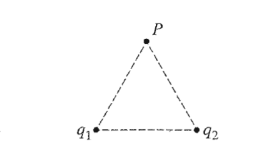
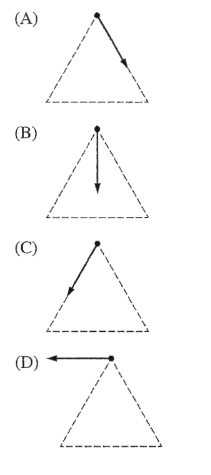
Two point charges, \(q_1\) and \(q_2\), of equal magnitude are at the vertices of an equilateral triangle, as shown above. The sign of each of the charges is unknown. A positive point charge is placed at vertex \(P\) and released from rest. Which of the following shows a possible direction of the initial acceleration of the positive point charge due to the net force exerted on it by \(q_1\) and \(q_2\)? Select two answers.
▶️ Answer/Explanation
Correct Answers: \( \boxed{\mathrm{B \; and \; D}} \)
The electric force between charges acts along the line joining them.
\(F_{\mathrm{E}}=\dfrac{k|qQ|}{r^2}\)
Since \(q_1\) and \(q_2\) have equal magnitudes and are the same distance from the positive charge at \(P\), the forces they exert have equal magnitudes. The direction of the net force depends only on the signs of \(q_1\) and \(q_2\).
Case 1: If both \(q_1\) and \(q_2\) are positive, each repels the positive charge at \(P\). The horizontal components cancel, while the vertical components add downward. This corresponds to option (B).
Case 2: If one charge is positive and the other is negative, one force is attractive and the other is repulsive. The vertical components cancel, while the horizontal components add, producing a net force to the left or right. One possible direction is shown in option (D).
Case 3: If both charges are negative, the net force would be vertically upward, which is not one of the choices shown.
Therefore, the only possible directions shown are (B) and (D).
Question
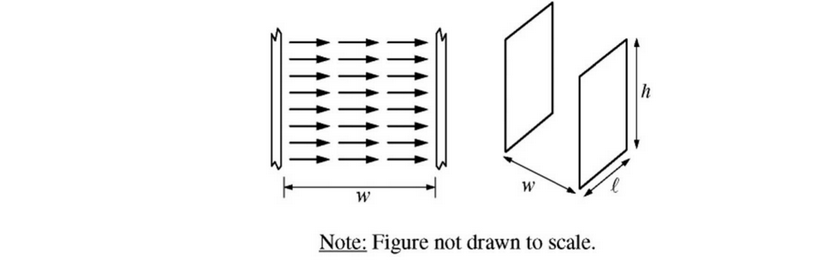
The figure above on the left represents the horizontal electric field near the center of two large, vertical parallel plates near Earth’s surface. The plates have height \(h\) and length \(\ell\), and they are separated by a distance \(w\), as shown on the right. The electric field has magnitude \(E\). A small object with mass \(m\) and charge \(+q\), where \(m=\dfrac{qE}{g}\), is released from rest at a point midway between the plates.
Under which of the following new conditions could the gravitational force on the object be neglected?
(B) \(q \gg m\)
(C) \(qE \gg mg\)
(D) \(Eh \gg Ew\)
▶️ Answer/Explanation
Correct Answer: \( \boxed{\mathrm{C}} \)
The gravitational force on the object is
\(F_g=mg\)
and the electric force is
\(F_E=qE\).
Gravity can be neglected only when the electric force is much larger than the gravitational force:
\(qE \gg mg\).
Option (A) changes only the plate dimensions and does not affect the relative magnitudes of the forces. Option (B) compares quantities with different units and is not physically meaningful. Option (D) simplifies to \(h \gg w\) and does not compare the electric and gravitational forces.
Therefore, the correct answer is (C).