
AP Physics 2 - 10.4 Electric Potential Energy- Exam Style questions- MCQs
Electric Potential Energy AP Physics 2 MCQ
Unit 10: Electric Force, Field, and Potential
Weightage : 15–18%
Question
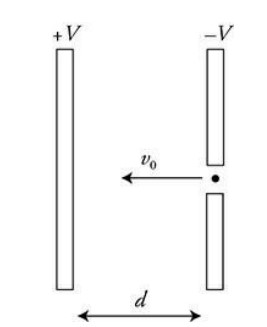
An electron of charge \(-e\) and mass \(m\) is launched with a velocity of \(v_0\) through a small hole in the right plate of a parallel-plate capacitor toward the opposite plate, a distance \(d\) away. The electric potentials of the two plates are equal in magnitude but opposite in sign, \(\pm V\), as shown in the figure.
What is the kinetic energy of the electron as it reaches the left plate?
(B) \( \dfrac{1}{2}mv_0^2 \)
(C) \( \dfrac{1}{2}mv_0^2+Ve \)
(D) \( \dfrac{1}{2}mv_0^2+2Ve \)
▶️ Answer/Explanation
Correct Answer: \( \boxed{\mathrm{D}} \)
Use conservation of mechanical energy:
\( K_i+U_i=K_f+U_f. \)
The electron moves from the right plate at potential \(-V\) to the left plate at potential \(+V\).
The potential difference is
\( \Delta V=V_f-V_i=(+V)-(-V)=2V. \)
The change in electric potential energy is
\( \Delta U=q\Delta V=(-e)(2V)=-2Ve. \)
Since the electric potential energy decreases by \(2Ve\), the kinetic energy increases by the same amount:
\( K_f=K_i-\Delta U=\dfrac{1}{2}mv_0^2-(-2Ve). \)
Therefore,
\( K_f=\dfrac{1}{2}mv_0^2+2Ve. \)
The electron gains kinetic energy because it moves toward a region of higher electric potential while carrying a negative charge.
Therefore, the correct answer is (D).
Question
Two parallel metal plates carry opposite electrical charges each with a magnitude of \(Q\). The plates are separated by a distance \(d\) and each plate has an area \(A\). Consider the following:
I. Increasing \(Q\)
II. Increasing \(d\)
III. Increasing \(A\)
Which of the following would have the effect of reducing the potential difference between the plates?
(B) II only
(C) III only
(D) II and III
▶️ Answer/Explanation
Correct Answer: \( \boxed{\mathrm{C}} \)
For a parallel-plate capacitor,
\(Q=CV,\)
where the capacitance is
\(C=\dfrac{\varepsilon_0A}{d}.\)
Therefore,
\(V=\dfrac{Q}{C}=\dfrac{Qd}{\varepsilon_0A}.\)
From this expression:
• Increasing \(Q\) increases the potential difference.
• Increasing \(d\) increases the potential difference.
• Increasing \(A\) increases the capacitance, thereby decreasing the potential difference.
Thus, only increasing the plate area \(A\) reduces the potential difference between the plates.
Therefore, the correct answer is (C).
Question
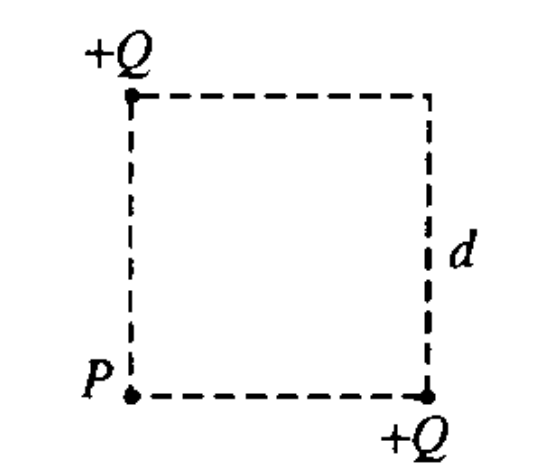
The figure above shows two particles, each with a charge of \(+Q\), that are located at opposite corners of a square of side \(d\).
What is the potential energy of a particle of charge \(+q\) that is held at point \(P\)?
(B) \( \dfrac{\sqrt{2}}{4\pi\varepsilon_0}\dfrac{qQ}{d} \)
(C) \( \dfrac{2}{4\pi\varepsilon_0}\dfrac{qQ}{d} \)
(D) \( \dfrac{2\sqrt{2}}{4\pi\varepsilon_0}\dfrac{qQ}{d} \)
▶️ Answer/Explanation
Correct Answer: \( \boxed{\mathrm{C}} \)
The electric potential due to a point charge is
\( V=\dfrac{1}{4\pi\varepsilon_0}\dfrac{Q}{r} \)
Point \(P\) is a distance \(d\) from each of the two charges. Since electric potential is a scalar, the potentials add directly:
\( V_P=\dfrac{1}{4\pi\varepsilon_0}\dfrac{Q}{d}+\dfrac{1}{4\pi\varepsilon_0}\dfrac{Q}{d}=\dfrac{2}{4\pi\varepsilon_0}\dfrac{Q}{d} \)
The potential energy of a charge \(+q\) placed at point \(P\) is
\( U=qV_P \)
Therefore,
\( U=\dfrac{2}{4\pi\varepsilon_0}\dfrac{qQ}{d} \)
Hence, the correct answer is (C).