
AP Physics 2- 12.4 Electromagnetic Induction and Faraday’s Law- Exam Style questions - FRQs- New Syllabus
Electromagnetic Induction and Faraday’s Law AP Physics 2 FRQ
Unit 12: Magnetism and Electromagnetic Induction
Weightage : 15–18%
Question
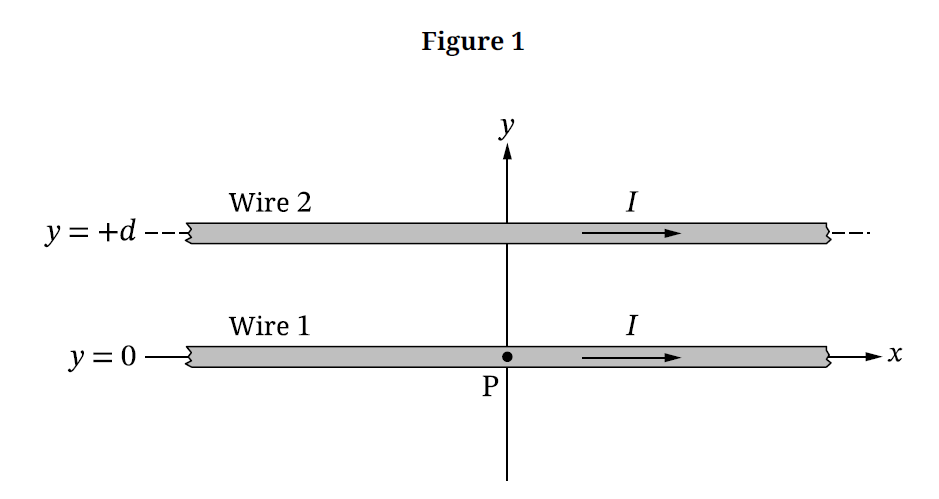
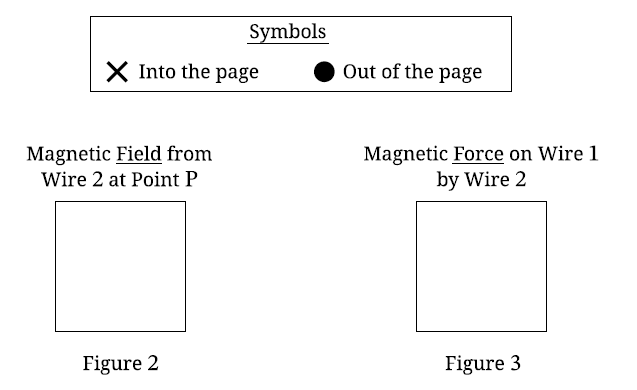
• Indicate the direction of the magnetic force that is exerted on Wire \( 1 \) by Wire \( 2 \) in Figure \( 3 \).
_____ Counterclockwise
_____ There is no induced current in the loop.
Most-appropriate topic codes (AP Physics 2):
• Topic \( 12.4 \) — Electromagnetic Induction and Faraday’s Law (Part \( \mathrm{B} \))
• Skill \( 1.A \) — Create diagrams, tables, charts, or schematics to represent physical situations (Part \( \mathrm{A(i)} \))
• Skill \( 2.A \) — Derive a symbolic expression from known quantities by selecting and following a logical mathematical pathway (Part \( \mathrm{A(ii)} \))
• Skill \( 2.B \) — Calculate or estimate an unknown quantity with units from known quantities, by selecting and following a logical computational pathway (Part \( \mathrm{A(ii)} \))
• Skill \( 3.C \) — Justify or support a claim using evidence from experimental data, physical representations, or physical principles or laws (Part \( \mathrm{B} \))
▶️ Answer/Explanation
A(i)
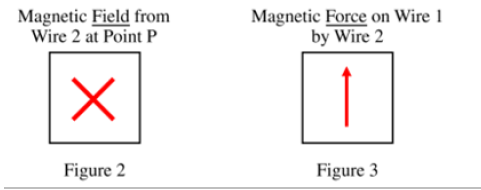
At Point \( P \), the magnetic field due to Wire \( 2 \) is into the page.
Using the right-hand rule for a current in the \( +x \)-direction, the field circles around Wire \( 2 \). Since Point \( P \) is below Wire \( 2 \), the field there points into the page.
The magnetic force on Wire \( 1 \) due to Wire \( 2 \) is in the \( +y \)-direction \( (\text{upward}) \).
Parallel currents in the same direction attract, so Wire \( 1 \) is pulled upward toward Wire \( 2 \).
A(ii)
Start with the magnetic field of a very long straight wire:
\( B=\dfrac{\mu_0 I}{2\pi r} \)
For Wire \( 2 \), the distance from Wire \( 1 \) is \( d \), so the magnetic field magnitude at Wire \( 1 \) is
\( B_2=\dfrac{\mu_0 I}{2\pi d} \)
For Wire \( 3 \), the current is \( 2I \), so at distance \( |y_3| \) from Wire \( 1 \),
\( B_3=\dfrac{\mu_0 (2I)}{2\pi |y_3|} \) \( =\dfrac{\mu_0 I}{\pi |y_3|} \)
Since the net magnetic force on Wire \( 1 \) is zero, the magnetic fields from wires \( 2 \) and \( 3 \) at Wire \( 1 \) must have equal magnitudes and opposite directions. Therefore,
\( \dfrac{\mu_0 I}{2\pi d}=\dfrac{\mu_0 (2I)}{2\pi |y_3|} \)
Canceling common factors gives
\( \dfrac{1}{2d}=\dfrac{1}{|y_3|} \)
so
\( |y_3|=2d \)
To oppose the force from Wire \( 2 \), Wire \( 3 \) must be placed below Wire \( 1 \), so
\( \boxed{y_3=-2d} \)
The sign matters here: placing Wire \( 3 \) above Wire \( 1 \) would make the forces add instead of cancel.
B.
\( \boxed{\text{Clockwise}} \)
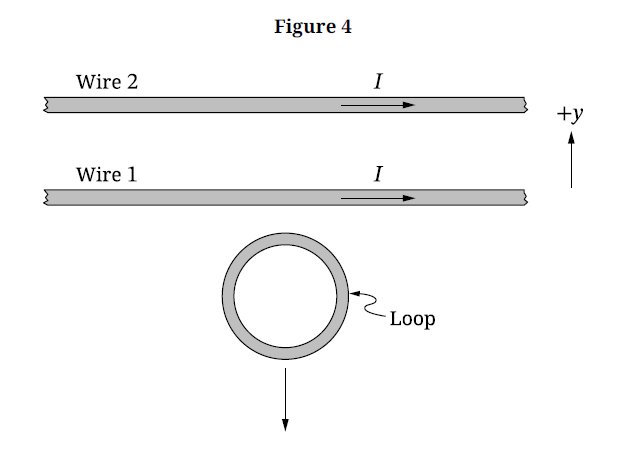
Below both wires, the magnetic field from Wire \( 1 \) and Wire \( 2 \) points into the page. As the loop moves farther downward, it moves farther from the wires, so the magnetic field through the loop becomes weaker. Therefore, the magnetic flux into the page decreases.
By Lenz’s law, the induced current must produce a magnetic field that opposes this decrease. So the induced field must also be into the page.
A clockwise current produces a magnetic field into the page, so the induced current is clockwise.