
AP Physics 2 - 12.4 Electromagnetic Induction and Faraday’s Law- Exam Style questions- MCQs
Electromagnetic Induction and Faraday’s Law AP Physics 2 MCQ
Unit 12: Magnetism and Electromagnetic Induction
Weightage : 15–18%
Question
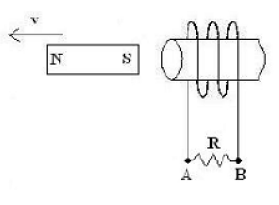
A strong bar magnet is held very close to the opening of a solenoid as shown in the diagram. As the magnet is moved away from the solenoid at constant speed, what is the direction of conventional current through the resistor shown and what is the direction of the force on the magnet because of the induced current?
| Current through resistor | Force on Magnet | |
| (A) | From A to B | To the left |
| (B) | From B to A | To the left |
| (C) | From A to B | To the right |
| (D) | From B to A | To the right |
▶️ Answer/Explanation
Correct Answer: \( \boxed{\mathrm{B}} \)
As the south pole of the magnet moves away from the solenoid, the leftward magnetic flux through the solenoid decreases.
By Lenz’s law, the induced current must produce a magnetic field that opposes this decrease. Therefore, the solenoid produces a magnetic field directed to the left.
Applying the right-hand rule for a solenoid, the induced conventional current flows upward on the front side of the coil, causing the current through the resistor to flow from B to A.
The left end of the solenoid becomes a north pole, which attracts the nearby south pole of the magnet. Hence, the magnetic force on the magnet is directed to the left, opposing its motion.
Therefore, the correct answer is (B).
Question
In each of the following situations, a bar magnet is aligned along the axis of a conducting loop. The magnet and the loop move with the indicated velocities. In which situation will the bar magnet NOT induce a current in the conducting loop?

▶️ Answer/Explanation
Correct Answer: \( \boxed{\mathrm{B}} \)
According to Faraday’s law, an induced current is produced only when the magnetic flux through the conducting loop changes.
\( \varepsilon=-\dfrac{d\Phi_B}{dt}. \)
The magnetic flux remains constant if the relative position of the magnet and the loop does not change.
Option (B): The magnet and the loop move in the same direction with the same speed (\(\tfrac{1}{2}v_0\)). Their separation remains constant, so the magnetic flux through the loop does not change. Therefore, no emf and no induced current are produced.
In the other situations, the relative motion between the magnet and the loop changes the magnetic flux through the loop, producing an induced current.
Hence, the correct answer is (B).
Question
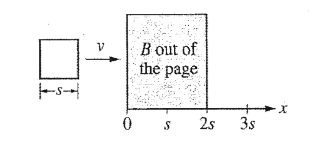
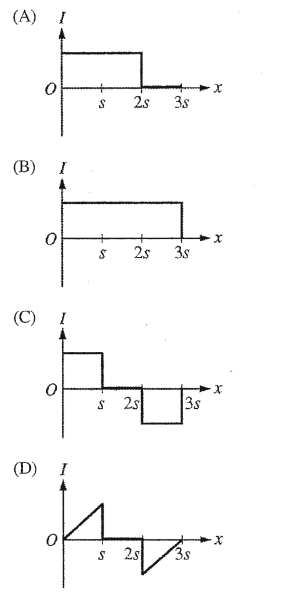
The gray rectangle in the figure above represents a region of uniform magnetic field directed out of the page. A square loop of wire of side \(s\) is in the plane of the page and is pulled at constant speed \(v\) through the field. Which of the following could show the current \(I\) in the loop as a function of the position of the right edge of the loop?
▶️ Answer/Explanation
Correct Answer: \( \boxed{\mathrm{C}} \)
As the loop enters the magnetic field, the magnetic flux through the loop increases. By Faraday’s law,
\( \mathcal{E} = -\dfrac{d\Phi_B}{dt} \)
Since the loop moves at constant speed \(v\), the rate of change of area inside the field is constant while entering. Therefore, the induced emf and the induced current have a constant magnitude during this interval.
When the loop is completely inside the magnetic field, the magnetic flux is constant, so
\( \dfrac{d\Phi_B}{dt}=0 \),
and the induced current is zero.
As the loop leaves the field, the magnetic flux decreases at the same constant rate. The induced current reverses direction according to Lenz’s law, giving a constant current of equal magnitude but opposite sign.
Thus, the graph must show:
• Constant positive current while entering the field.
• Zero current while the loop is entirely inside the field.
• Constant negative current while leaving the field.
Therefore, the correct choice is (C).