
AP Physics 2- 13.4 Images Formed by Lenses- FRQs- New Syllabus
Images Formed by Lenses AP Physics 2 FRQ
Unit 13: Geometric and Physical Optics
Weightage : 15–18%
Question
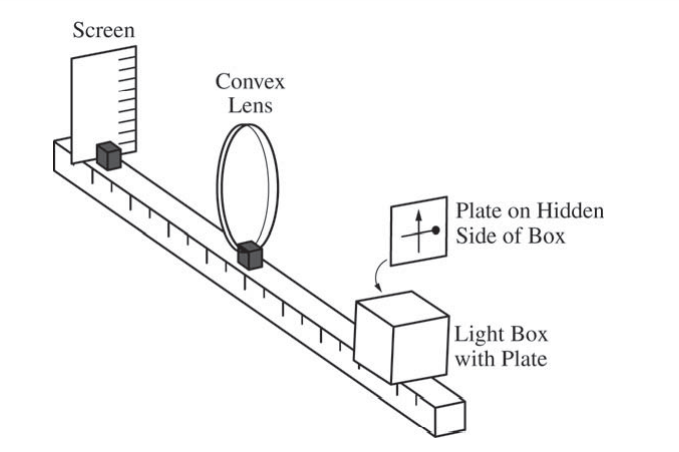

Most-appropriate topic codes (AP Physics 2):
• Topic \(13.4\) — Images Formed by Lenses (Part \( \mathrm{(a)} \), Part \( \mathrm{(b)} \), Part \( \mathrm{(c)} \), Part \( \mathrm{(d)} \))
▶️ Answer/Explanation
(a)
The image formed on the screen is a real image, so it is inverted. The arrow should point downward, and the bar-circle shape should be reversed left-to-right compared with the object.
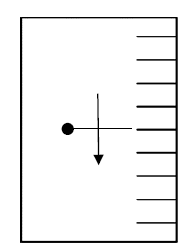
\(\boxed{\text{The image is inverted: arrow down and left-right reversed.}}\)
(b)(i)
Use the thin-lens equation:
\(\dfrac{1}{f}=\dfrac{1}{d_o}+\dfrac{1}{d_i}\)
Substitute \(d_o=20\,\text{cm}\) and \(d_i=30\,\text{cm}\):
\(\dfrac{1}{f}=\dfrac{1}{20\,\text{cm}}+\dfrac{1}{30\,\text{cm}}\)
\(\dfrac{1}{f}=\dfrac{3}{60}+\dfrac{2}{60}=\dfrac{5}{60}\)
\(f=12\,\text{cm}\)
\(\boxed{f=12\,\text{cm}}\)
(b)(ii)
The magnitude of magnification is
\(|M|=\dfrac{d_i}{d_o}\)
\(|M|=\dfrac{30\,\text{cm}}{20\,\text{cm}}=1.5\)
\(\boxed{|M|=1.5}\)
(c)(i)
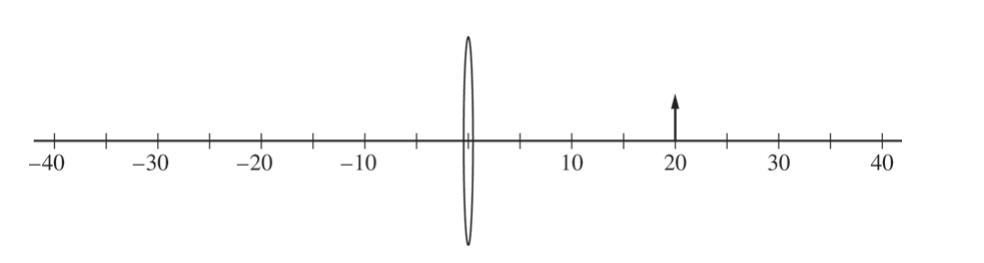
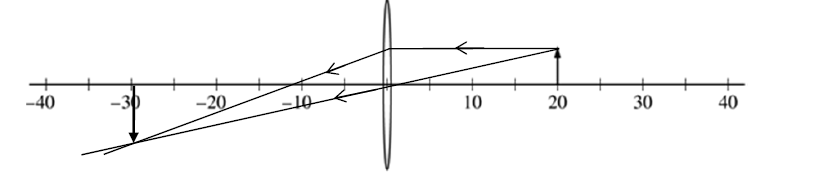
A correct ray diagram should show the object \(20\,\text{cm}\) from the lens and the image \(30\,\text{cm}\) on the opposite side. The image should be inverted and about \(1.5\) times as tall as the object.
(c)(ii)
The diagram is consistent with \(f=12\,\text{cm}\) because a ray parallel to the principal axis refracts through the focal point \(12\,\text{cm}\) from the lens.
The image is \(30\,\text{cm}\) from the lens, while the object is \(20\,\text{cm}\) from the lens, so \(|M|=\dfrac{30}{20}=1.5\). Therefore, the image should be inverted and \(1.5\) times larger than the object.
(d)(i)
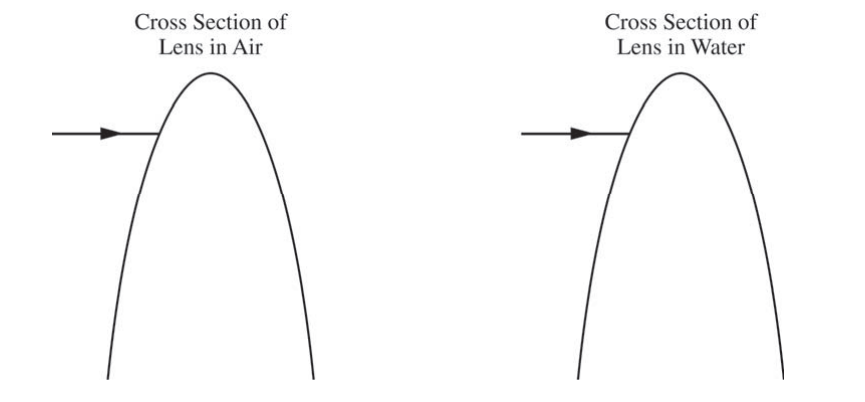
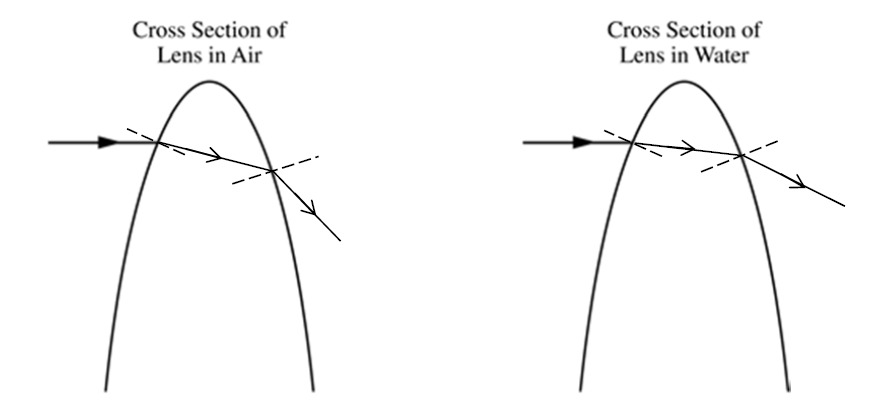
In air, the lens bends the ray more strongly because the difference between the index of refraction of the lens and the surrounding medium is larger.
In water, the ray still bends toward the normal when entering the lens and away from the normal when leaving the lens, but it bends less than it does in air.
(d)(ii)
When the lens is in water, the focal length is greater than when the lens is in air.
This is because the index difference between the lens and water is smaller than the index difference between the lens and air. Therefore, rays bend less in water and converge farther from the lens.
Since the rays converge farther away, the image distance increases. For the same object distance, the image is also larger because \(|M|=\dfrac{d_i}{d_o}\), and \(d_i\) is larger.
\(\boxed{\text{In water, the focal length is larger, the image forms farther away, and the image is larger.}}\)