
AP Physics 2 - 11.7 Kirchhoff’s Junction Rule- Exam Style questions- MCQs
Kirchhoff’s Junction Rule AP Physics 2 MCQ
Unit 11: Electric Circuits
Weightage : 15–18%
Question
Four identical resistors of resistance \(R\) are connected to a battery, as shown in the figure. Ammeters \(A_{1}\) and \(A_{2}\) measure currents of \(1.2\,\mathrm{A}\) and \(0.4\,\mathrm{A}\), respectively.
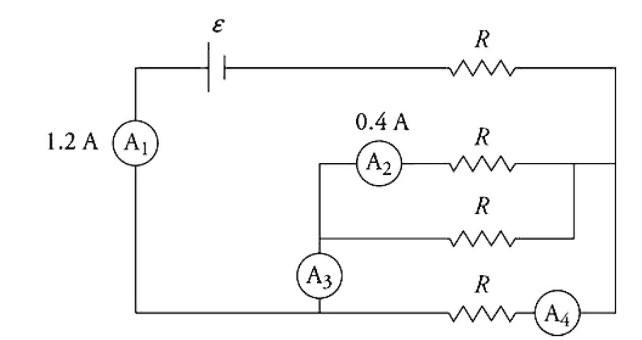
What are the currents measured by ammeters \(A_{3}\) and \(A_{4}\)?
| Choice | \(A_{3}\) | \(A_{4}\) |
|---|---|---|
| (A) | \(0.4\,\mathrm{A}\) | \(0.4\,\mathrm{A}\) |
| (B) | \(0.8\,\mathrm{A}\) | \(0.4\,\mathrm{A}\) |
| (C) | \(0.4\,\mathrm{A}\) | \(1.2\,\mathrm{A}\) |
| (D) | \(0.8\,\mathrm{A}\) | \(1.2\,\mathrm{A}\) |
▶️ Answer/Explanation
Correct Answer: \( \boxed{\mathrm{B}} \)
The three resistors in the lower-right portion of the circuit are connected in parallel. Since they are identical, each branch has the same resistance and the same potential difference across it.
Therefore, the current through each parallel branch is the same.
Ammeter \(A_{2}\) measures the current through the upper parallel branch:
\( I_{A_2}=0.4\,\mathrm{A} \)
Hence, the current through each of the other two parallel branches is also
\( 0.4\,\mathrm{A} \)
Ammeter \(A_{4}\) measures the current through the bottom branch, so
\( I_{A_4}=0.4\,\mathrm{A} \)
Ammeter \(A_{3}\) is located before the current splits into the lower two branches, so it measures the sum of the currents through those branches:
\( I_{A_3}=0.4\,\mathrm{A}+0.4\,\mathrm{A}=0.8\,\mathrm{A} \)
This is also consistent with Kirchhoff’s Junction Rule since
\( 1.2\,\mathrm{A}=0.4\,\mathrm{A}+0.4\,\mathrm{A}+0.4\,\mathrm{A} \)
Therefore,
\( \boxed{A_{3}=0.8\,\mathrm{A},\quad A_{4}=0.4\,\mathrm{A}} \)
Answer: (B)
Question
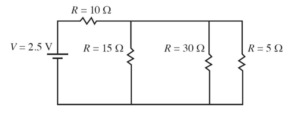
A fifth resistor is placed in the circuit. It is connected in parallel with the \(5\,\Omega\) resistor. The voltage drop across this resistor is found to be \(V=0.50\,\mathrm{V}\).
What is the resistance of the additional resistor?
(B) \(10\,\Omega\)
(C) \(15\,\Omega\)
(D) \(30\,\Omega\)
▶️ Answer/Explanation
Correct Answer: \( \boxed{\mathrm{B}} \)
All resistors in parallel have the same voltage drop, so each parallel branch has
\( V_{\mathrm{parallel}}=0.50\,\mathrm{V} \)
Using Kirchhoff’s loop rule, the remaining voltage across the \(10\,\Omega\) series resistor is
\( V_{10}=2.5-0.5=2.0\,\mathrm{V} \)
The current through the \(10\,\Omega\) resistor, which is also the total current supplied by the battery, is
\( I_{\mathrm{total}}=\dfrac{2.0}{10}=0.20\,\mathrm{A} \)
Using Ohm’s law, the currents in the known parallel branches are
\( I_{15}=\dfrac{0.50}{15}=0.033\,\mathrm{A} \)
\( I_{30}=\dfrac{0.50}{30}=0.017\,\mathrm{A} \)
\( I_{5}=\dfrac{0.50}{5}=0.10\,\mathrm{A} \)
Applying Kirchhoff’s junction rule, the current through the unknown resistor is
\( I_x=0.20-0.033-0.017-0.10=0.05\,\mathrm{A} \)
Therefore, its resistance is
\( R_x=\dfrac{V}{I_x}=\dfrac{0.50}{0.05}=10\,\Omega \)
Therefore, the correct answer is (B).
Question
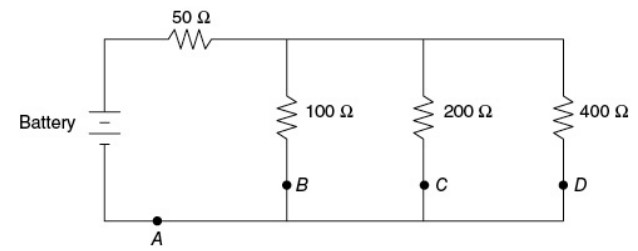
At which position in the above circuit will the charge passing that position in one second be largest?
(B) B
(C) C
(D) D
▶️ Answer/Explanation
Correct Answer: \( \boxed{\mathrm{A}} \)
Current is defined as the rate of flow of electric charge:
\( I=\dfrac{\Delta Q}{\Delta t} \)
Therefore, the amount of charge passing a point in one second is directly proportional to the current at that point.
Point A is located before the circuit divides into the three parallel branches. By Kirchhoff’s junction rule, the current entering a junction equals the total current leaving the junction:
\( I_A=I_B+I_C+I_D \)
Since the current at point \(A\) is the sum of the currents in all three branches, it is greater than the current at any individual branch.
Thus, the greatest amount of charge passes point \(A\) in one second.
Therefore, the correct answer is (A).