
AP Physics 2 - 12.1 Magnetic Fields- Exam Style questions- MCQs
Magnetic Fields AP Physics 2 MCQ
Unit 12: Magnetism and Electromagnetic Induction
Weightage : 15–18%
Question

A child playing with two magnets places them close together and holds them in place to keep them from moving, as shown in the figure. Magnet A has a larger magnetic field and a larger mass than magnet B. What will happen when the magnets are released and free to move?
(B) Magnet A will accelerate away more slowly than magnet B because magnet B exerts a smaller force on magnet A.
(C) Magnet A will accelerate away more slowly than magnet B because magnet A has a larger mass.
(D) Both magnets will accelerate away at the same rate because the force between them will be the same magnitude.
▶️ Answer/Explanation
Correct Answer: \( \boxed{\mathrm{C}} \)
By Newton’s Third Law, the two magnets exert forces on each other that are equal in magnitude and opposite in direction:
\( \vec{F}_{AB}=-\vec{F}_{BA} \)
Although magnet A has a stronger magnetic field, the interaction force between the two magnets is the same on each magnet.
Their accelerations are determined by Newton’s Second Law,
\( a=\dfrac{F}{m} \)
Since magnet A has the larger mass, it experiences a smaller acceleration than magnet B, even though the forces are equal.
Therefore, magnet A accelerates away more slowly than magnet B.
Therefore, the correct answer is (C).
Question
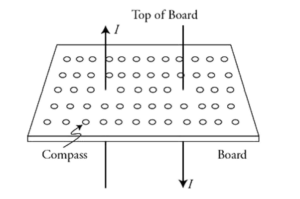
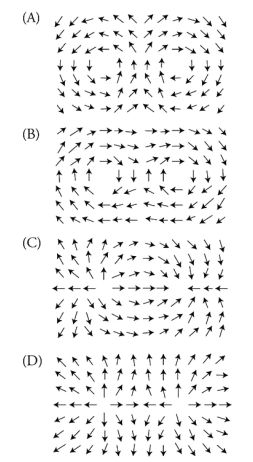
Two long wires pass vertically through a horizontal board that is covered with an array of small compasses placed in a rectangular grid pattern as seen in the figure. The wire on the left has a current passing upward through the board, while the wire on the right has a current passing downward through the board. Both currents are identical in magnitude. Each compass has an arrow that points in the direction of north. Looking at the board from above, which of the following diagrams best depicts the directions that the array of compasses are pointing?
▶️ Answer/Explanation
Correct Answer: \( \boxed{\mathrm{A}} \)
The magnetic field around a long straight current-carrying wire forms concentric circles. The direction of the field is determined using the right-hand rule: point your right thumb in the direction of the current, and your fingers curl in the direction of the magnetic field.
Looking down on the board:
• The left wire carries current out of the board, producing a counterclockwise magnetic field.
• The right wire carries current into the board, producing a clockwise magnetic field.
Each compass aligns with the local magnetic field, with its north end pointing in the field direction. Therefore, the compasses circulate counterclockwise around the left wire and clockwise around the right wire.
Diagram (A) correctly represents this field pattern. Diagram (B) incorrectly shows both fields circulating clockwise, while (C) and (D) show radial fields instead of circular magnetic field lines.
Therefore, the correct answer is (A).
Question
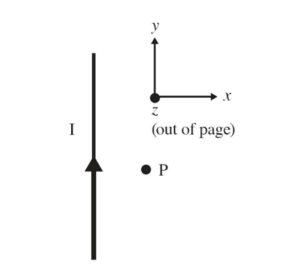
A current-carrying wire and coordinate system are shown above. Initially, the wire carries a current \(I\) toward the top of the page. The current is steadily decreased until it reaches \(0\,\mathrm{A}\), then steadily increased until it reaches a value of \(I\) in the downward direction. This change in current takes time \(t\).
The magnetic field versus time at the observation point \(P\), from \(t=0\) until \(t\), is graphed. Which statement is true concerning the graph if \(+z\) is above the horizontal axis and \(-z\) is below the horizontal axis?
(B) The graph is piecewise linear with a negative slope for the first half and a positive slope for the second half.
(C) The graph is piecewise linear with a positive slope for the first half and a negative slope for the second half.
(D) The graph is a curve showing an inverse relationship.
▶️ Answer/Explanation
Correct Answer: \( \boxed{\mathrm{B}} \)
The magnetic field produced by a long straight current-carrying wire is
\( B=\dfrac{\mu_{0}I}{2\pi r} \),
where \(r\) is the fixed distance from the wire to point \(P\). Therefore, the magnetic field is directly proportional to the current:
\( B\propto I \).
Using the right-hand rule, the magnetic field at point \(P\) initially points in the \(-z\) direction. As the current steadily decreases to zero, the magnitude of the magnetic field decreases linearly, producing a straight line with a negative slope.
After the current reverses direction and increases steadily to \(I\), the magnetic field reverses to the \(+z\) direction and increases linearly from zero, producing a straight line with a positive slope.
Thus, the graph consists of two straight-line segments: a negative slope followed by a positive slope.
Therefore, the correct answer is (B).