
AP Physics 2- 14.2 Periodic Waves - Exam Style questions - FRQs- New Syllabus
Periodic Waves AP Physics 2 FRQ
Unit 14: Waves , Sound , and Physical Optics
Weightage : 15–18%
Question
Most-appropriate topic codes (AP Physics \(2\)):
• Topic \(14.2\) — Wave Properties (Part \( \mathrm{(a)} \), Part \( \mathrm{(b)} \), Part \( \mathrm{(c)} \))
▶️ Answer/Explanation
(a)(i)
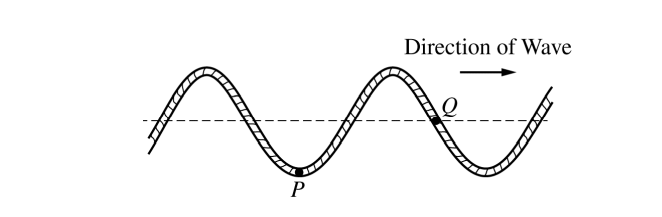
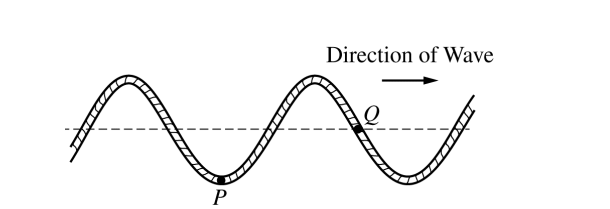
Dot \(P\) is at maximum displacement, so its instantaneous vertical velocity is zero.
\(\boxed{v_P=0}\)
For a wave traveling to the right, the string’s vertical velocity is opposite in sign to the local slope of the wave. At \(Q\), the wave is sloping downward as \(x\) increases, so dot \(Q\) is moving upward.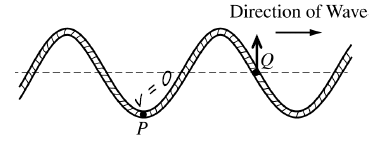
\(\boxed{\text{At }Q\text{, draw an upward velocity arrow.}}\)
(a)(ii)
For transverse wave motion, each point on the string accelerates toward the equilibrium position. Dot \(P\) is below equilibrium at maximum displacement, so its acceleration is upward.
\(\boxed{\text{At }P\text{, draw an upward acceleration arrow.}}\)
Dot \(Q\) is at the equilibrium position, so its instantaneous acceleration is zero.
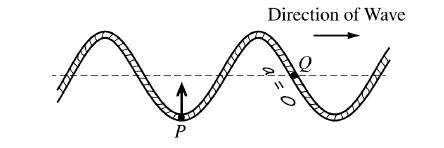
\(\boxed{a_Q=0}\)
(b)(i)
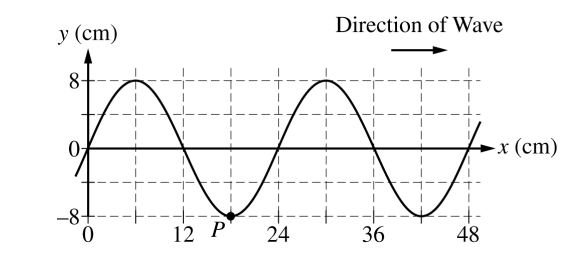
In a time \(T/4\), a wave traveling to the right moves horizontally by one-fourth of a wavelength.
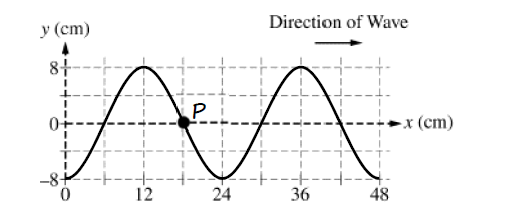
From the graph, one wavelength is approximately \(24\,\text{cm}\). Therefore, the wave shifts to the right by
\(\dfrac{\lambda}{4}=\dfrac{24\,\text{cm}}{4}=6\,\text{cm}\)
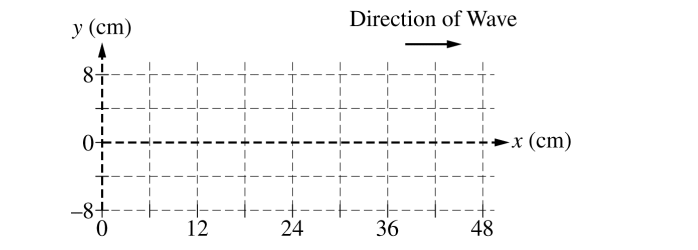
So the sketch at \(t=T/4\) should have the same shape and amplitude as the original wave, but shifted \(6\,\text{cm}\) to the right.
\(\boxed{\text{Draw the original wave shifted right by }\lambda/4.}\)
(b)(ii)
Dot \(P\) is a point on the string, not a point that travels horizontally with the wave shape. At \(t=0\), dot \(P\) is at a maximum downward displacement. After one-fourth period, that dot reaches equilibrium.
Therefore, dot \(P\) should be placed at the same horizontal location as before, but on the equilibrium line. From the graph, this is at about \(x=18\,\text{cm}\).
\(\boxed{\text{Place }P\text{ at }x\approx18\,\text{cm}\text{ on }y=0.}\)
(c)
The amplitude of the wave is \(8\,\text{cm}\). Dot \(P\) starts at maximum downward displacement, moves to equilibrium, then maximum upward displacement, then back to equilibrium, and finally returns to maximum downward displacement after one full period.
The total distance traveled by dot \(P\) in one full cycle is four amplitudes:
\(d=4A\)
\(d=4\left(8\,\text{cm}\right)\)
\(\boxed{d=32\,\text{cm}}\)