
AP Physics 2 - 14.1 Properties of Wave Pulses and Waves- Exam Style questions- MCQs
Properties of Wave Pulses and Waves AP Physics 2 MCQ
Unit 14: Waves , Sound , and Physical Optics
Weightage : 15–18%
Question
A longitudinal wave is travelling through a medium. The variation with distance \(d\) of the displacement \(x\) of the particles in the medium at time \(t\) is shown.

Which point is at the centre of a compression?
▶️ Answer/Explanation
Correct Answer: \( \boxed{\mathrm{A}} \)
In a longitudinal wave, a compression is a region where the particles are closest together, while a rarefaction is a region where the particles are farthest apart.
A compression occurs where the displacement changes from positive to negative with increasing distance, giving the greatest particle density. This corresponds to a point where the slope of the displacement-versus-distance graph is negative.
At point A, the graph crosses the equilibrium position with a negative slope, indicating that neighboring particles are moving toward one another and are most closely packed.
By comparison:
• B and D are points of maximum displacement, not maximum density.
• C is the center of a rarefaction, where the particles are farthest apart.
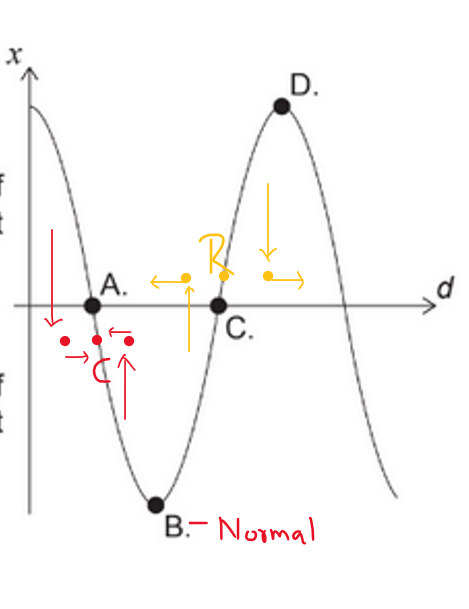
Therefore, the centre of a compression is at point A.
Question

Which of the following correctly describes the motion of particles when a single transverse mechanical wave passes through a medium?
(B) The particles vibrate back and forth along a single direction that is perpendicular to the direction of propagation of the wave.
(C) Each particle vibrates back and forth along a single direction that is perpendicular to the direction of propagation of the wave, but each particle’s direction is different.
(D) The particles vibrate back and forth without any energy being carried along with the wave as it propagates.
▶️ Answer/Explanation
Correct Answer: \( \boxed{\mathrm{B}} \)
In a transverse mechanical wave, the particles of the medium oscillate perpendicular to the direction in which the wave travels.
The defining characteristic of a transverse wave is
\( \vec{v}_{\mathrm{particle}} \perp \vec{v}_{\mathrm{wave}} \)
Thus, all particles vibrate back and forth along the same direction, which is perpendicular to the direction of wave propagation, while the wave transports energy through the medium.
Option (A) describes a longitudinal wave, (C) is incorrect because all particles oscillate parallel to one another, and (D) is incorrect because mechanical waves transfer energy as they propagate.
Therefore, the correct answer is (B).
Question
A rock drops onto a pond with a smooth surface. A few moments later, the wave produced by the rock’s impact arrives at the shore, touching the ankles of a wading child. Which of the following observations provides evidence that the portion of the wave hitting the child’s ankles carries less energy than the wave did when it was first created by the rock’s impact?
(B) The wave pulse’s width has become greater.
(C) The wave pulse’s width has become smaller.
(D) The wave’s height has become smaller.
▶️ Answer/Explanation
Correct Answer: \( \boxed{\mathrm{D}} \)
The energy carried by a mechanical wave is proportional to the square of its amplitude:
\( E \propto A^2 \).
As the wave travels across the pond, energy is spread over a larger area and some is lost due to damping. As a result, the wave’s amplitude (height) decreases.
A smaller wave height indicates that the wave carries less energy. The wave speed depends primarily on the properties of the medium, while the pulse width does not directly determine the energy transported.
Therefore, the correct answer is (D).