
AP Physics 2 - 11.2 Simple Circuits- Exam Style questions- MCQs
Simple Circuits AP Physics 2 MCQ
Unit 11: Electric Circuits
Weightage : 15–18%
Question
The diagram shows a circuit that contains a battery with a potential difference of \(V_{B}\) and negligible internal resistance; five resistors of identical resistance; three ammeters \(A_{1}\), \(A_{2}\), \(A_{3}\); and a voltmeter.
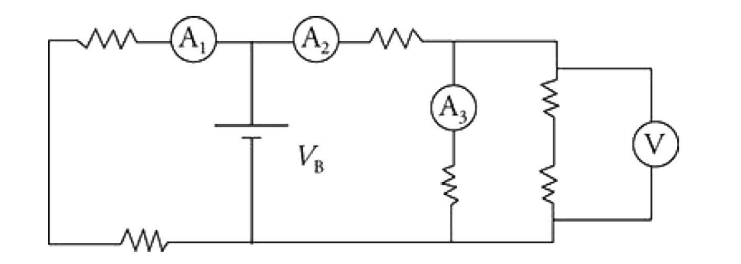
What will be the reading of the voltmeter?
(B) \( \frac{1}{3}V_{B} \)
(C) \( \frac{2}{5}V_{B} \)
(D) \( \frac{3}{5}V_{B} \)
▶️ Answer/Explanation
Correct Answer: \( \boxed{\mathrm{C}} \)
From the previous question, the equivalent resistance of the circuit to the right of the battery is
\(R_{\mathrm{right}}=\dfrac{5R}{3}\).
Therefore, the current measured by ammeter \(A_{2}\) is
$ I=\frac{V_{B}}{\frac{5R}{3}}=\frac{3V_{B}}{5R}. $
This current first passes through the resistor immediately to the right of ammeter \(A_{2}\), so the voltage drop across that resistor is
$ \Delta V=IR=\left(\frac{3V_{B}}{5R}\right)R=\frac{3V_{B}}{5}. $
The voltmeter is connected across the remaining parallel section of the circuit, so it measures the remaining potential difference:
$ V_{\mathrm{meter}}=V_{B}-\frac{3V_{B}}{5}=\frac{2V_{B}}{5}. $
Thus, the voltmeter reads
$ \boxed{\frac{2}{5}V_{B}}. $
Answer: (C)
Question
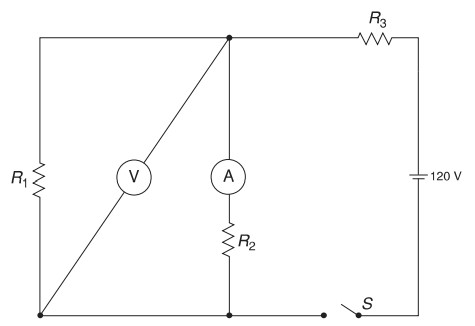
In the circuit above, with the switch closed, what will voltmeter \(V\) read? (\(A\) is an ideal ammeter.) Select two answers.
(B) The voltage drop across ammeter \(A\)
(C) The voltage drop across \(R_{2}\)
(D) Zero
▶️ Answer/Explanation
Correct Answers: \( \boxed{\mathrm{A\ and\ C}} \)
The voltmeter is connected across the same two circuit nodes as both \(R_{1}\) and \(R_{2}\). Components connected across the same pair of nodes are in parallel and therefore have the same potential difference.
Consequently, the voltmeter measures the voltage drop across both \(R_{1}\) and \(R_{2}\).
Thus,
\( V=V_{R_1}=V_{R_2} \)
An ideal ammeter has negligible resistance, so there is no potential difference across it:
\( V_A=0 \)
Therefore, the voltmeter does not read the voltage across the ammeter, and its reading is not zero because current flows through \(R_{1}\) and \(R_{2}\).
Hence, the two correct answers are (A) and (C).
Question
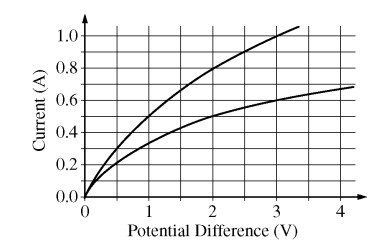
The above graph shows current as a function of potential difference for two different filament lamps. If the two lamps are connected in parallel to a \(3.0\,\mathrm{V}\) battery, what is the total current supplied by the battery?
(B) \(0.8\,\mathrm{A}\)
(C) \(1.0\,\mathrm{A}\)
(D) \(1.6\,\mathrm{A}\)
▶️ Answer/Explanation
Correct Answer: \( \boxed{\mathrm{D}} \)
In a parallel circuit, each lamp has the full battery potential difference across it. Therefore, each lamp operates at \(3.0\,\mathrm{V}\).
From the graph at \(3.0\,\mathrm{V}\):
• Upper lamp: \(I \approx 1.0\,\mathrm{A}\)
• Lower lamp: \(I \approx 0.6\,\mathrm{A}\)
By Kirchhoff’s junction rule, the total current supplied by the battery is the sum of the currents through the two parallel branches:
\( I_{\mathrm{total}} = I_1 + I_2 \)
\( I_{\mathrm{total}} = 1.0 + 0.6 = 1.6\,\mathrm{A} \)
Therefore, the total current supplied by the battery is \(1.6\,\mathrm{A}\).
Therefore, the correct answer is (D).