
AP Physics 2- 9.5 Specific Heat and Thermal Conductivity- Exam Style questions - FRQs- New Syllabus
Specific Heat and Thermal Conductivity AP Physics 2 FRQ
Unit 9: Thermodynamics
Weightage : 15–18%
Question
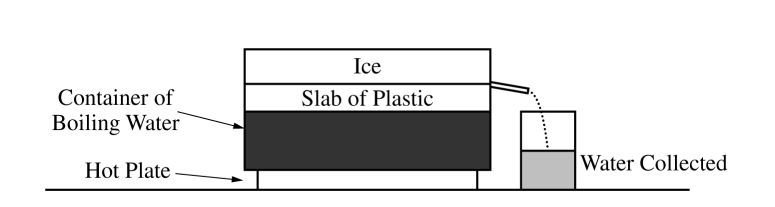
| Energy flow rate \(Q/\Delta t\) \((\text{J/s})\) | \(97\) | \(53\) | \(31\) | \(27\) | \(18\) |
| Total thickness of plastic \(L\) \((\text{m})\) | \(0.010\) | \(0.020\) | \(0.030\) | \(0.040\) | \(0.050\) |

Most-appropriate topic codes (AP Physics 2):
• Topic \(9.5\) — Specific Heat and Thermal Conductivity (Part \( \mathrm{(a)} \), Part \( \mathrm{(b)} \), Part \( \mathrm{(c)} \), Part \( \mathrm{(d)} \), Part \( \mathrm{(e)} \))
▶️ Answer/Explanation
(a)(i)
For thermal conduction through a slab, the energy flow rate is
\( \dfrac{Q}{\Delta t}=\dfrac{kA\Delta T}{L} \)
Since \(k\), \(A\), and \(\Delta T\) are constant in this experiment, \(Q/\Delta t\) is directly proportional to \(1/L\).
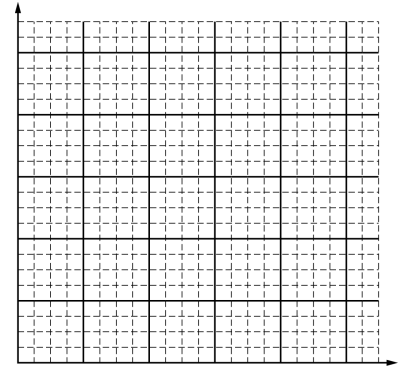
Therefore, a straight-line graph can be made by plotting \(Q/\Delta t\) on the vertical axis and \(1/L\) on the horizontal axis.
Vertical axis: \(Q/\Delta t\) in \(\text{J/s}\)
Horizontal axis: \(1/L\) in \(\text{m}^{-1}\)
\(\boxed{\text{Plot }Q/\Delta t\text{ versus }1/L.}\)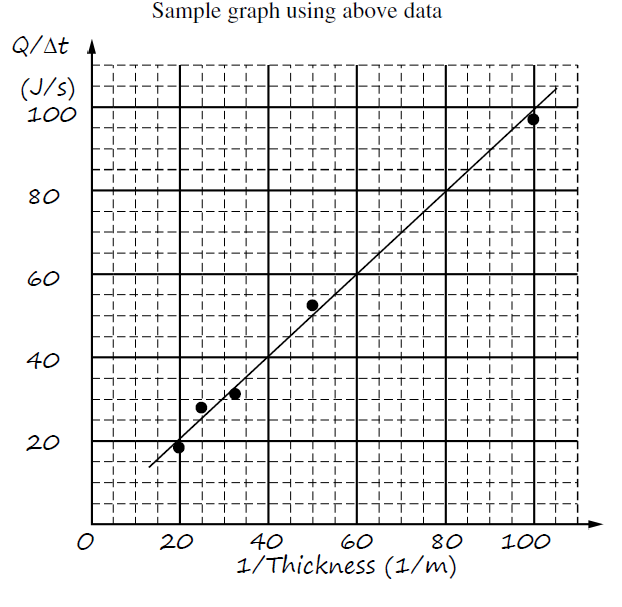
(a)(ii)
First calculate \(1/L\) for each thickness.
| Energy flow rate \(Q/\Delta t\) \((\text{J/s})\) | \(97\) | \(53\) | \(31\) | \(27\) | \(18\) |
| Total thickness \(L\) \((\text{m})\) | \(0.010\) | \(0.020\) | \(0.030\) | \(0.040\) | \(0.050\) |
| \(1/L\) \((\text{m}^{-1})\) | \(100\) | \(50\) | \(33.3\) | \(25\) | \(20\) |
A correct graph should have \(1/L\) \((\text{m}^{-1})\) on the horizontal axis and \(Q/\Delta t\) \((\text{J/s})\) on the vertical axis. The points should follow an approximately straight-line trend with positive slope.
(a)(iii)
From the best-fit line, choose two convenient points. For example, using approximately \((20,20)\) and \((80,80)\):
\( \text{slope}=\dfrac{80\,\text{J/s}-20\,\text{J/s}}{80\,\text{m}^{-1}-20\,\text{m}^{-1}} \)
\( \text{slope}=\dfrac{60\,\text{J/s}}{60\,\text{m}^{-1}}=1.0\,\text{J}\cdot\text{m/s} \)
From the conduction equation,
\( \dfrac{Q}{\Delta t}=kA\Delta T\left(\dfrac{1}{L}\right) \)
Therefore, the slope of the graph is
\( \text{slope}=kA\Delta T \)
Solve for \(k\):
\( k=\dfrac{\text{slope}}{A\Delta T} \)
The area is \(A=0.025\,\text{m}^2\), and the temperature difference is \(\Delta T=100^\circ\text{C}-0^\circ\text{C}=100^\circ\text{C}\).
\( k=\dfrac{1.0\,\text{J}\cdot\text{m/s}}{\left(0.025\,\text{m}^2\right)\left(100^\circ\text{C}\right)} \)
\( k=0.40\,\text{J}/\left(\text{s}\cdot\text{m}\cdot^\circ\text{C}\right) \)
\(\boxed{k=0.40\,\text{W}/\left(\text{m}\cdot^\circ\text{C}\right)}\)
(b)
One possible problem is that not all the energy measured by the melting ice may have traveled through the plastic slab.
For example, thermal energy from the surrounding air could also be transferred to the ice. If this happens, the measured \(Q/\Delta t\) would include energy from the air in addition to energy conducted through the plastic.
Since the students would assume that all of the measured energy passed through the plastic, the calculated \(Q/\Delta t\) would be too large. This would make the slope of the \(Q/\Delta t\) versus \(1/L\) graph too large.
Since \(k=\dfrac{\text{slope}}{A\Delta T}\), a slope that is too large would make the experimental value of \(k\) too large.
\(\boxed{\text{Energy transfer from the air to the ice could make the calculated }k\text{ too large.}}\)
Another possible problem is energy loss out the sides of the plastic slab. In that case, less energy would reach the ice than actually entered the slab from below, which could make the calculated \(k\) too small.
(c)
The bottom surface of the plastic is at \(100^\circ\text{C}\), and the top surface is in contact with ice at \(0^\circ\text{C}\). Thermal energy flows from higher temperature to lower temperature.
Therefore, the net flow of energy is from the bottom of the slab toward the top of the slab.

\(\boxed{\text{The arrow should point upward, from the hot plate side toward the ice.}}\)
(d)
At the microscopic level, particles near the bottom of the plastic slab are at a higher temperature, so they have greater average kinetic energy and vibrate more rapidly.
These faster-vibrating particles interact with nearby particles above them. Through collisions and intermolecular interactions, energy is transferred from the faster-moving particles to slower-moving particles.
This process continues through the plastic slab, so energy is transferred from the hotter bottom surface toward the colder top surface.
\(\boxed{\text{Energy is transferred by microscopic interactions from faster-vibrating particles to slower-vibrating particles.}}\)
(e)
The plastic slab and the wood surface are at the same room temperature, but they can still feel different because they transfer thermal energy from the student’s hand at different rates.
If the plastic feels cooler, it means thermal energy leaves the student’s hand and enters the plastic faster than it enters the wood. This happens because the plastic and wood have different thermal conductivities.
The sensation of “coolness” depends on the rate of thermal energy transfer from the hand, not only on the actual temperature of the object.
\(\boxed{\text{The plastic feels cooler because it transfers thermal energy from the hand at a different, faster rate than the wood.}}\)