
AP Physics 2 - 9.5 Specific Heat and Thermal Conductivity- Exam Style questions- MCQs
Specific Heat and Thermal Conductivity AP Physics 2 MCQ
Unit 9: Thermodynamics
Weightage : 15–18%
Question
A small, well-insulated building is kept cool on a hot day. A person in the building holds a hand close to, but not touching, a solid metal door to the outside and feels warmth coming from the metal door. Which statement best describes how most of the energy is transferred from the outside to the person’s hand?
(B) Thermal energy from the outside is convected through the metal door. The door radiates energy that is detected by the person’s hand.
(C) Thermal energy from the outside is conducted through the metal door. The door radiates energy that is detected by the person’s hand.
(D) Thermal energy from the outside is radiated through the metal door. The door radiates energy that is detected by the person’s hand.
▶️ Answer/Explanation
Correct Answer: \( \boxed{\mathrm{C}} \)
Thermal energy from the hot outdoor environment is transferred through the solid metal door by conduction. Metals are good thermal conductors, so heat moves efficiently from the warmer outside surface to the cooler inside surface of the door.
Because the person’s hand is held close to, but not touching, the energy is not transferred by conduction to the hand. Instead, the warm door emits thermal (infrared) radiation, which is absorbed by the person’s hand and felt as warmth.
Convection cannot occur through a solid metal door, and heat is not primarily transferred by radiation through the metal itself.
Therefore, the correct answer is (C): thermal energy is conducted through the metal door and then radiated from the door to the person’s hand.
Question
A person can stand outside on a cold day for hours without ill effect, but falling into a cold lake can kill a person in a matter of minutes. Which of the following is the primary reason for this phenomenon?
(B) Thermal energy moves from high concentration areas (hot) to low concentration areas (cold).
(C) As heat flows out of the person and warms the fluid surrounding the person, the warmer fluid rises, allowing fresh cool fluid to come in contact with the person and increasing the rate of heat transfer.
(D) Water has more molecules per unit volume than air, increasing molecular contact with the person.
▶️ Answer/Explanation
Correct Answer: \( \boxed{\mathrm{D}} \)
Water is much denser than air, so it contains far more molecules per unit volume. As a result, a person’s body comes into contact with many more water molecules than air molecules.
These frequent molecular collisions allow thermal energy to be conducted away from the body much more rapidly in water than in air, causing the body to lose heat at a much faster rate.
Although thermal energy always flows from a higher-temperature object to a lower-temperature one and convection also contributes to heat loss, the primary reason cold water is much more dangerous than cold air is its much greater molecular density and resulting higher rate of heat transfer.
Therefore, the correct answer is (D).
Question
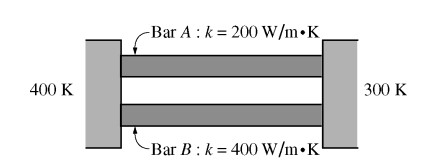
Two metal bars with the same length and the same cross-sectional area are placed between two tanks with temperatures of \(400\,\mathrm{K}\) and \(300\,\mathrm{K}\), as shown above. The thermal conductivity of the top bar is \(200\,\mathrm{W/(m\cdot K)}\), and that of the bottom bar is \(400\,\mathrm{W/(m\cdot K)}\). If the net energy transferred through the top bar in a given time interval is \(Q\), what is the net energy transferred through the bottom bar during the same time interval?
(B) \(2Q\)
(C) \(Q\)
(D) \(\dfrac{Q}{2}\)
▶️ Answer/Explanation
Correct Answer: \( \boxed{\mathrm{B}} \)
The rate of heat conduction through a bar is given by
\( \displaystyle \frac{Q}{t}=\frac{kA\Delta T}{L}, \)
where \(k\) is the thermal conductivity, \(A\) is the cross-sectional area, \(L\) is the length of the bar, and \(\Delta T\) is the temperature difference.
Both bars have the same:
• Length \(L\)
• Cross-sectional area \(A\)
• Temperature difference \(\Delta T=400-300=100\,\mathrm{K}\)
Therefore, the heat transferred is directly proportional to the thermal conductivity:
\( Q\propto k. \)
Since
\( \dfrac{k_{\mathrm{bottom}}}{k_{\mathrm{top}}}=\dfrac{400}{200}=2, \)
the bottom bar transfers twice as much thermal energy in the same time interval:
\( Q_{\mathrm{bottom}}=2Q. \)
Therefore, the correct answer is (B).