
AP Physics 2- 14.5 The Doppler Effect - Exam Style questions - FRQs- New Syllabus
The Doppler Effect AP Physics 2 FRQ
Unit 14: Waves , Sound , and Physical Optics
Weightage : 15–18%
Question
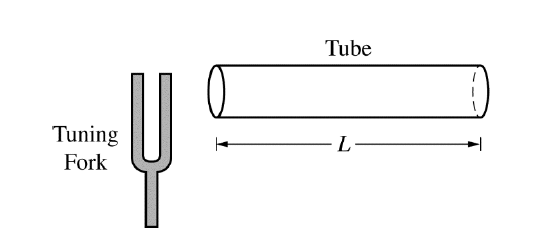
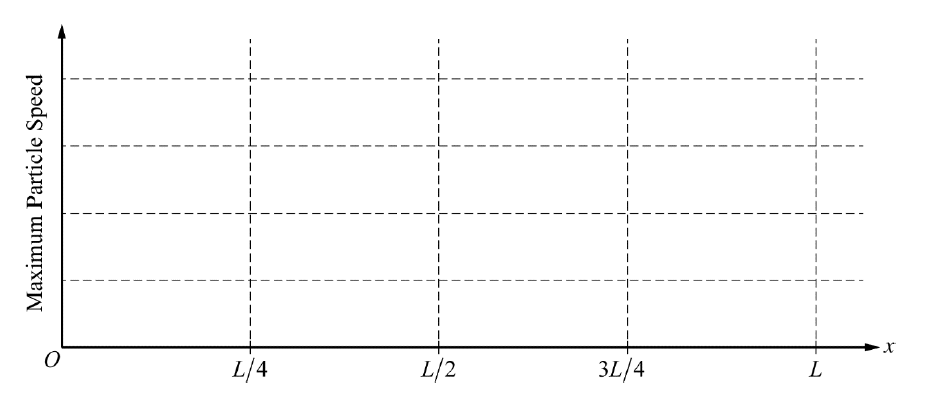
Most-appropriate topic codes (AP Physics 2):
• Topic \( 14.5 \) — The Doppler Effect / Sound-Wave Descriptions Context (Part \( \mathrm{(a)} \), Part \( \mathrm{(b)} \), Part \( \mathrm{(c)} \), through sound behavior in air columns)
• Topic \( 1.B \) — Create quantitative graphs with appropriate scales and units, including plotting data (Part \( \mathrm{(b)} \))
• Topic \( 1.C \) — Create qualitative sketches of graphs that represent features of a model or the behavior of a physical system (Part \( \mathrm{(b)} \))
• Topic \( 2.B \) — Calculate or estimate an unknown quantity from known quantities (Part \( \mathrm{(a)} \), Part \( \mathrm{(c)} \))
▶️ Answer/Explanation
(a)
For a tube open at both ends at the fundamental frequency,
\( L = \dfrac{\lambda}{2} \)
First find the wavelength:
\( \lambda = \dfrac{v}{f} = \dfrac{340\ \mathrm{m/s}}{512\ \mathrm{Hz}} \approx 0.664\ \mathrm{m} \)
Therefore,
\( L = \dfrac{0.664}{2} \approx 0.332\ \mathrm{m} \)
\( \boxed{L \approx 0.33\ \mathrm{m}} \)
This fits the open-open fundamental pattern, which has antinodes at both ends and one half-wavelength inside the tube.
(b)
The maximum particle speed has antinodes at both open ends and a node at the middle of the tube. So the graph:
\( \bullet \) is maximum at \( x=0 \)
\( \bullet \) decreases to \( 0 \) at \( x=\dfrac{L}{2} \)
\( \bullet \) increases back to a maximum at \( x=L \)
\( \bullet \) is symmetric about \( x=\dfrac{L}{2} \)
A correct sketch is: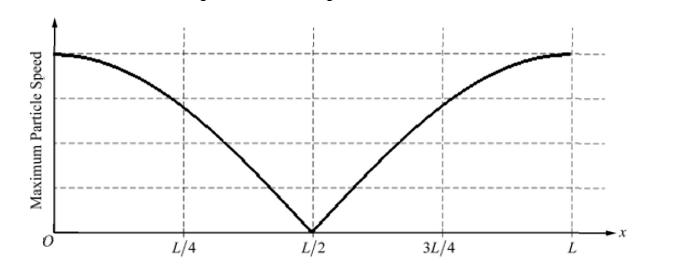
Physically, open ends of an air column correspond to displacement antinodes, so particle motion is greatest there.
(c)
Now the tube is open at one end and closed at the other, so the fundamental mode satisfies
\( L = \dfrac{\lambda}{4} \)
Thus,
\( f = \dfrac{v}{4L} \)
Using \( v = 1005\ \mathrm{m/s} \) and \( L \approx 0.332\ \mathrm{m} \),
\( f = \dfrac{1005}{4(0.332)} \approx 757\ \mathrm{Hz} \)
So the new fundamental frequency is
\( \boxed{7.6 \times 10^2\ \mathrm{Hz}} \)
or about \( \boxed{757\ \mathrm{Hz}} \).
The frequency increases because the sound speed is larger, but it is also affected by the boundary condition changing from open-open to open-closed.