
AP Physics 2 - 14.5 The Doppler Effect- Exam Style questions- MCQs
The Doppler Effect AP Physics 2 MCQ
Unit 14: Waves , Sound , and Physical Optics
Weightage : 15–18%
Question
A radar speed gun is used to measure the speed of a car. The car is moving with speed \(v\) away from the gun.
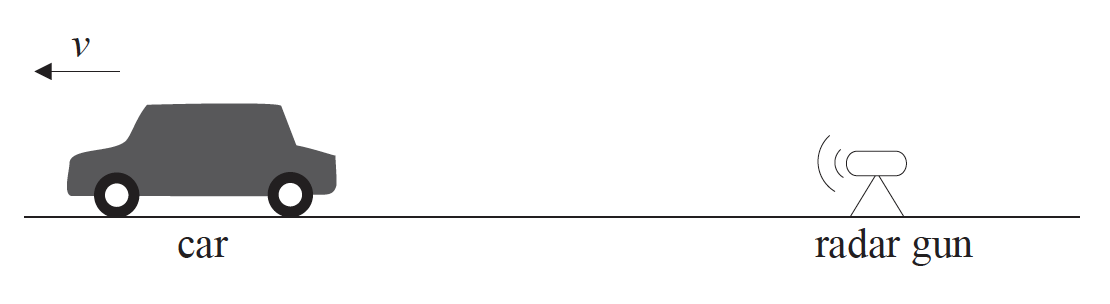
The radar emits microwaves of frequency \(f\) and speed \(c\). Which of the following is the frequency of the microwaves measured at the gun after reflection by the car?
(B) \(f+\left(\frac{v}{c}f\right)\)
(C) \(f-\left(\frac{2v}{c}f\right)\)
(D) \(f-\left(\frac{v}{c}f\right)\)
▶️ Answer/Explanation
Correct Answer: \( \boxed{\mathrm{C}} \)
The reflected radar wave undergoes the Doppler effect twice:
• First, the moving car acts as an observer receiving the radar signal.
• Second, the car reflects the wave and acts as a moving source emitting it back toward the radar gun.
For speeds much smaller than the speed of light (\(v \ll c\)), each Doppler shift changes the frequency by approximately
\( \displaystyle \frac{\Delta f}{f}\approx\frac{v}{c}. \)
Since the car is moving away from the radar, both shifts decrease the frequency. Combining the two shifts gives
\( \displaystyle f_{\mathrm{received}}\approx f\left(1-\frac{2v}{c}\right) =f-\frac{2v}{c}f. \)
Higher-order terms involving \( \left(\frac{v}{c}\right)^2 \) are negligible because \(v\) is much smaller than \(c\).
Therefore, the correct answer is (C).
Question
During a journey an observer travels at constant speed towards, and then goes beyond, a stationary emitter of sound.
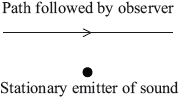
The frequency of the sound as measured at the emitter is \(f\). The frequency according to the observer is
(B) always equal to \(f\).
(C) always less than \(f\).
(D) varies during the journey.
▶️ Answer/Explanation
Correct Answer: \( \boxed{\mathrm{D}} \)
The observed frequency changes because of the Doppler effect. For a stationary source and a moving observer,
\( \displaystyle f’=f\left(\frac{v\pm v_o}{v}\right), \)
where \(v\) is the speed of sound and \(v_o\) is the speed of the observer.
While the observer is moving toward the source,
\( \displaystyle f’=f\left(\frac{v+v_o}{v}\right), \)
so the observed frequency is greater than \(f\).
After passing the source, the observer moves away from it, giving
\( \displaystyle f’=f\left(\frac{v-v_o}{v}\right), \)
so the observed frequency becomes less than \(f\).
Therefore, the frequency heard by the observer changes during the journey as the observer first approaches and then recedes from the source.
Therefore, the correct answer is (D).
Question

The preceding diagram shows a speaker mounted on a cart that moves to the right at constant speed \(v\). Wave fronts for the constant-frequency sound wave produced by the speaker are indicated schematically in the diagram. Which of the following could represent the wave fronts produced by the stationary speaker playing the same note?
(A) 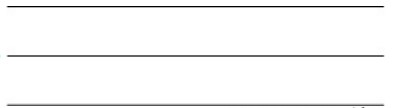
(B) 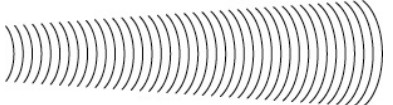
(C) 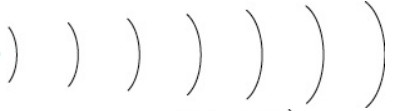
(D) 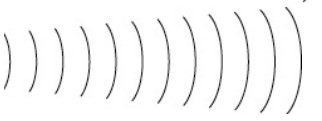
▶️ Answer/Explanation
Correct Answer: \( \boxed{\mathrm{C}} \)
The Doppler effect causes wave fronts to become compressed in front of a moving source and spread farther apart behind it.
The wavelength and frequency are related by
\( v=f\lambda \).
Since the speaker is moving toward the right, the wave fronts shown in the original diagram are closer together than they would be if the speaker were stationary. A stationary speaker producing the same frequency emits wave fronts with a constant spacing equal to the original wavelength.
Among the choices, only (C) shows evenly spaced wave fronts that are farther apart than those in front of the moving speaker, representing the wave pattern from the stationary source.
Therefore, the correct answer is (C).