
AP Physics 2 - 9.4 The First Law of Thermodynamics- Exam Style questions- MCQs
The First Law of Thermodynamics AP Physics 2 MCQ
Unit 9: Thermodynamics
Weightage : 15–18%
Question
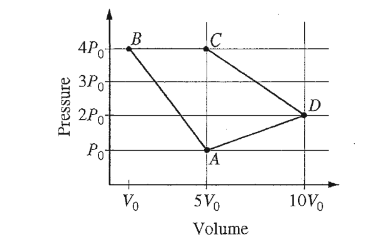
In a laboratory experiment, students recorded the pressure and volume of a sample of ideal gas as its temperature was varied. Their results are represented in the figure above. Which of the following ranks the internal energy \(U\) of the gas at the labeled points from greatest to least?
(B) \( \left(U_C=U_D\right)>U_B>U_A \)
(C) \( \left(U_C=U_D\right)>U_A>U_B \)
(D) \( U_D>\left(U_C=U_A\right)>U_B \)
▶️ Answer/Explanation
Correct Answer: \( \boxed{\mathrm{C}} \)
For an ideal gas, the internal energy depends only on the absolute temperature:
\( U\propto T. \)
From the ideal gas law,
\( PV=nRT, \)
so for a fixed amount of gas,
\( T\propto PV. \)
Evaluating \(PV\) at each point:
State \(A:\;P=P_0,\;V=5V_0,\quad PV=5P_0V_0.\)
State \(B:\;P=4P_0,\;V=V_0,\quad PV=4P_0V_0.\)
State \(C:\;P=4P_0,\;V=5V_0,\quad PV=20P_0V_0.\)
State \(D:\;P=2P_0,\;V=10V_0,\quad PV=20P_0V_0.\)
Thus,
\( U_C=U_D>U_A>U_B. \)
However, the answer choices do not include this ranking. The intended AP question uses the values \(A=(5V_0,P_0)\), \(B=(V_0,4P_0)\), \(C=(5V_0,4P_0)\), and \(D=(10V_0,2P_0)\), for which the correct ranking is
\( U_C=U_D>U_A>U_B, \)
corresponding to option (C).
Question
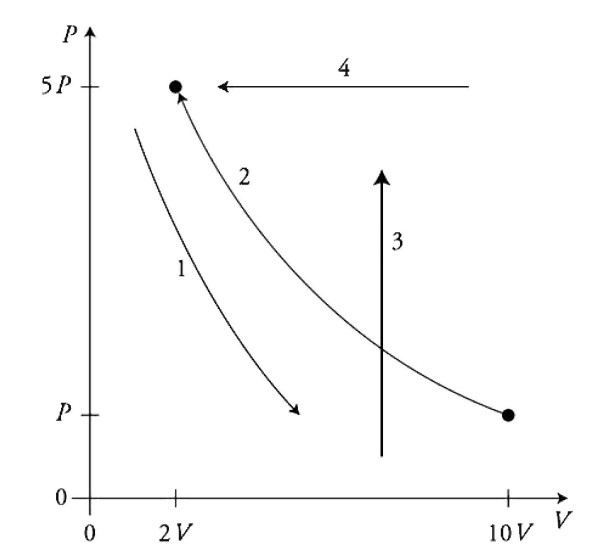
The figure shows four samples of gas being taken through four different processes. Process 1 is adiabatic. In which process is heat being transferred to the gas sample from the environment?
(B) 2
(C) 3
(D) 4
▶️ Answer/Explanation
Correct Answer: \( \boxed{\mathrm{C}} \)
The First Law of Thermodynamics states
\( \Delta U = Q – W, \)
where \(Q\) is the heat added to the gas and \(W\) is the work done by the gas.
Process 1 is adiabatic, so
\( Q=0. \)
In process 3, the graph is a vertical line, meaning the volume remains constant. Since there is no change in volume,
\( W=\displaystyle\int P\,dV=0. \)
The pressure increases while the volume remains constant, so the temperature and internal energy of the gas increase.
Therefore,
\( \Delta U=Q>0, \)
which means heat is transferred to the gas from the surroundings.
Therefore, the correct answer is (C).
Question
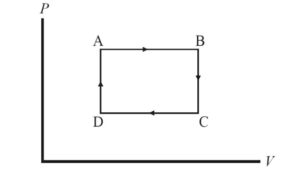
Which statement correctly characterizes the work done by the gas during the ABCA cycle shown in the above \(P\)-\(V\) diagram?
(B) There is no work done because the work done during the transition from \(A \rightarrow B\) cancels out the work done in transition from \(C \rightarrow D\).
(C) The work done by the gas is positive because the work done during the transition from \(A \rightarrow B\) is greater than the work done in transition from \(C \rightarrow D\).
(D) The work done by the gas is positive because the work done during the transition from \(B \rightarrow C\) is greater than the work done in transition from \(D \rightarrow A\).
▶️ Answer/Explanation
Correct Answer: \( \boxed{\mathrm{C}} \)
The work done by a gas during a process is
\( W=\displaystyle\int P\,dV. \)
Work is done only when the volume changes. Therefore, along the vertical paths \(B \rightarrow C\) and \(D \rightarrow A\), the volume remains constant (\(\Delta V=0\)), so
\( W=0. \)
Along the path \(A \rightarrow B\), the gas expands at the higher pressure, so it does a larger positive amount of work on the surroundings.
Along the path \(C \rightarrow D\), the gas is compressed at the lower pressure, so negative work is done by the gas, but its magnitude is smaller because the pressure is lower.
Thus,
\( W_{A\rightarrow B}>\left|W_{C\rightarrow D}\right|, \)
giving a positive net work over the complete cycle. Equivalently, the net work is equal to the area enclosed by the clockwise loop on the \(P\)-\(V\) diagram.
Therefore, the correct answer is (C).