
AP Physics 2 - 9.3 Thermal Energy Transfer and Equilibrium- Exam Style questions- MCQs
Thermal Energy Transfer and Equilibrium AP Physics 2 MCQ
Unit 9: Thermodynamics
Weightage : 15–18%
Question
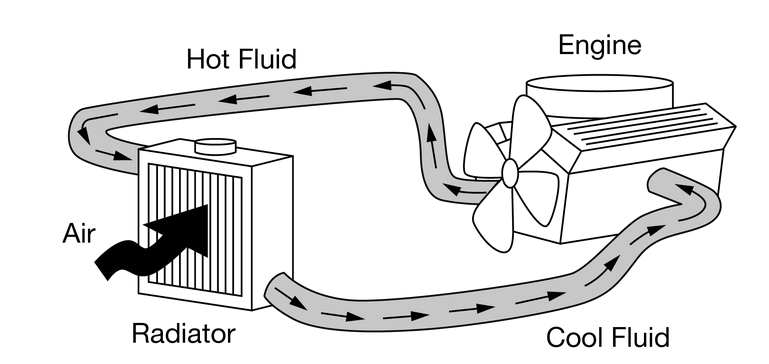
The figure shows the movement of a fluid through an automobile engine and a radiator. The system is designed to prevent overheating of the engine. Which of the following claims correctly describe the energy transfer processes involved? Select two answers.
(B) Thermal energy from the air is added to the hot fluid to reduce the temperature of the hot fluid.
(C) The hot engine adds thermal energy to the cool fluid, which reduces the temperature of the engine and raises the temperature of the cool fluid.
(D) The cool fluid transfers thermal energy to the engine, providing it with the energy it needs to move the car.
▶️ Answer/Explanation
Correct Answers: \( \boxed{\mathrm{A,\ C}} \)
The radiator removes thermal energy from the hot coolant by transferring energy to the surrounding air through conduction, convection, and thermal radiation. As a result, the fluid leaves the radiator at a lower temperature and is recirculated to the engine.
Therefore, statement (A) is correct because the cooled fluid is used to absorb thermal energy from the engine.
When the cool fluid flows through the engine, thermal energy is transferred from the hotter engine to the cooler fluid. This lowers the engine’s temperature while increasing the temperature of the coolant.
Thus, statement (C) is also correct.
Statement (B) is incorrect because thermal energy does not flow from cooler air to hotter fluid. Statement (D) is incorrect because the coolant removes thermal energy from the engine rather than supplying energy to make the car move.
Question
On a day that is warm and sunny, a car is parked in a location where there is no shade. The car’s windows are closed. The air inside the car becomes noticeably warmer than the air outside.
Which of the following factors contribute to the higher temperature? Select two answers.
(B) The body of the car insulates the air inside the car.
(C) Electromagnetic radiation from the Sun enters the car and is absorbed by the materials inside.
(D) The body of the car reflects electromagnetic radiation.
▶️ Answer/Explanation
Correct Answer: \( \boxed{\mathrm{B,\ C}} \)
Sunlight, which is electromagnetic radiation, passes through the car windows and is absorbed by the dashboard, seats, and other interior surfaces. These surfaces convert the radiant energy into thermal energy, warming the air inside the car.
(A) Convection causes warm air to rise and cool air to sink, but this only redistributes heat inside the car. It does not explain why the overall temperature becomes higher. This is incorrect.
(B) The car body and closed windows reduce the rate at which thermal energy escapes to the surroundings, helping the interior remain hotter. This is correct.
(C) Solar electromagnetic radiation enters through the windows and is absorbed by the interior, increasing its thermal energy. This is correct.
(D) Reflection of electromagnetic radiation would reduce the amount of solar energy absorbed by the car, not increase it. This is incorrect.
Therefore, the correct answers are (B) and (C).
Question

Three samples of gas in different containers are put into thermal contact and insulated from the environment as shown in the figure. The three gases, initially at different temperatures, reach a final uniform temperature of \(310\,\mathrm{K}\). Which of the following correctly describes the flow of thermal energy from the initial condition until thermal equilibrium? (Select two answers.)
(B) Heat flows into sample 2 only from sample 1 until both reach the equilibrium temperature of \(310\,\mathrm{K}\).
(C) Heat flows into sample 2 from both samples 1 and 3 until thermal equilibrium of the system is reached.
(D) Heat initially flows from sample 3 into sample 2 and then back from sample 2 into sample 3.
▶️ Answer/Explanation
Correct Answers: \( \boxed{\mathrm{A,\ D}} \)
Thermal energy always flows spontaneously from a higher-temperature object to a lower-temperature object until thermal equilibrium is reached.
Initially,
Sample \(1\) is at \(373\,\mathrm{K}\), sample \(3\) is at \(310\,\mathrm{K}\), and sample \(2\) is at \(273\,\mathrm{K}\).
Therefore, heat continuously flows from sample \(1\) to sample \(2\) because sample \(1\) remains at a higher temperature than sample \(2\) until both reach the common equilibrium temperature of \(310\,\mathrm{K}\). Thus, statement (A) is correct.
At first, sample \(3\) is warmer than sample \(2\), so heat flows from sample \(3\) to sample \(2\). As sample \(3\) loses energy, its temperature drops below \(310\,\mathrm{K}\). Later, as sample \(2\) continues warming due to energy received from sample \(1\), heat reverses direction and flows from sample \(2\) back to sample \(3\) until both reach \(310\,\mathrm{K}\). Therefore, statement (D) is correct.
Statements (B) and (C) are incorrect because they do not account for the reversal of heat flow between samples \(2\) and \(3\).