
AP Physics C E&M - 13.5 Circuits with Resistors and Inductors (LR Circuits)- Exam Style questions- MCQs
Question
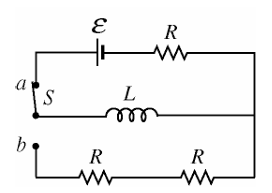
In the circuit above, all of the resistors have the same resistance \(R\). Switch \(S\) has been in position \(a\) for a very long time. The time constant when the switch is in position \(a\) is \( \tau \). How does the time constant when the switch is in position \(b\) compare to \( \tau \)?
(B) It is less than \( \tau \) but greater than zero.
(C) It is equal to \( \tau \).
(D) It is greater than \( \tau \) but not infinite.
(E) It is infinite.
▶️ Answer/Explanation
Correct Answer: \( \boxed{\mathrm{B}} \)
For an LR circuit, the time constant is
\( \tau=\dfrac{L}{R_{\mathrm{eq}}} \)
When the switch is in position \(a\), the inductor sees an equivalent resistance
\( R_{\mathrm{eq,a}}=R \)
Hence,
\( \tau=\dfrac{L}{R} \)
When the switch is moved to position \(b\), the battery is disconnected and the inductor discharges through the two resistors in series, so
\( R_{\mathrm{eq,b}}=2R \)
The new time constant is
\( \tau_b=\dfrac{L}{2R}=\dfrac{\tau}{2} \)
Since \( \dfrac{\tau}{2} \) is positive and smaller than \( \tau \), the new time constant is less than the original but greater than zero.
Therefore, the correct answer is (B).
Question
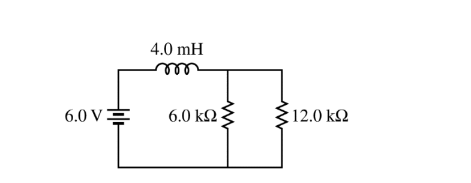
An inductor and two resistors are connected to an ideal battery, as shown in the figure above. What is the time constant for the circuit?
(B) \(0.33~\mu\mathrm{s}\)
(C) \(0.67~\mu\mathrm{s}\)
(D) \(1.0~\mu\mathrm{s}\)
(E) \(72~\mu\mathrm{s}\)
▶️ Answer/Explanation
Correct Answer: \( \boxed{\mathrm{D}} \)
For an LR circuit, the time constant is
\( \tau=\dfrac{L}{R_{\mathrm{eq}}} \)
The two resistors are connected in parallel, so their equivalent resistance is
\( R_{\mathrm{eq}}=\dfrac{(6.0~\mathrm{k}\Omega)(12.0~\mathrm{k}\Omega)}{6.0~\mathrm{k}\Omega+12.0~\mathrm{k}\Omega}=4.0~\mathrm{k}\Omega \)
Using \(L=4.0~\mathrm{mH}\),
\( \tau=\dfrac{4.0\times10^{-3}}{4.0\times10^{3}}=1.0\times10^{-6}\ \mathrm{s}=1.0~\mu\mathrm{s} \)
Therefore, the time constant of the circuit is \( \boxed{1.0~\mu\mathrm{s}} \).
Therefore, the correct answer is (D).
Question
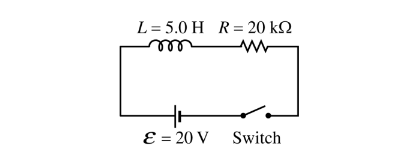
After the switch is closed in the circuit above, the current in the circuit is given by \( i=I\left(1-e^{-t/\tau}\right) \), where \(I\) and \( \tau \) are constants.
What is the value of \( \tau \)?
(B) \(2.5\times10^{-4}\,\mathrm{s}\)
(C) \(1.0\,\mathrm{s}\)
(D) \(4.0\times10^{-3}\,\mathrm{s}\)
(E) \(1.0\times10^{-4}\,\mathrm{s}\)
▶️ Answer/Explanation
Correct Answer: \( \boxed{\mathrm{B}} \)
The time constant of an LR circuit is
\( \tau=\dfrac{L}{R} \)
Substituting the given values,
\( L=5.0~\mathrm{H}, \qquad R=20~\mathrm{k}\Omega=2.0\times10^{4}~\Omega \)
Therefore,
\( \tau=\dfrac{5.0}{2.0\times10^{4}}=2.5\times10^{-4}\,\mathrm{s} \)
Thus, the current reaches its steady-state value with a time constant of \( \boxed{2.5\times10^{-4}\,\mathrm{s}} \).
Therefore, the correct answer is (B).