
AP Physics C E&M - 9.1 Electric Potential Energy- Exam Style questions- MCQs
Question
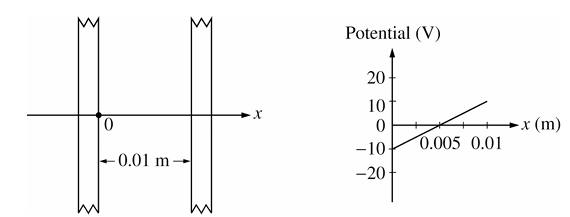
A uniform electric field exists between two parallel plates that are perpendicular to the \(x\)-axis and separated by \(0.01~\mathrm{m}\), as shown above on the left. The graph on the right shows the electric potential between the plates as a function of position \(x\) on the \(x\)-axis. What is the electric potential energy of an object with a \(1.0~\mu\mathrm{C}\) charge located at \(x=0.005~\mathrm{m}\)?
(B) \(-10~\mu\mathrm{J}\)
(C) \(0\)
(D) \(10~\mu\mathrm{J}\)
(E) \(20~\mu\mathrm{J}\)
▶️ Answer/Explanation
Correct Answer: \( \boxed{\mathrm{C}} \)
The electric potential energy of a charge is given by
\( U=qV \)
From the graph, the electric potential at
\( x=0.005~\mathrm{m} \)
is
\( V=0~\mathrm{V} \)
The charge is
\( q=1.0~\mu\mathrm{C}=1.0\times10^{-6}~\mathrm{C} \)
Therefore,
\( U=qV=(1.0\times10^{-6})(0)=0~\mathrm{J} \)
Thus, the electric potential energy of the charge at \(x=0.005~\mathrm{m}\) is
\( \boxed{0} \)
Hence, the correct answer is (C).
Question
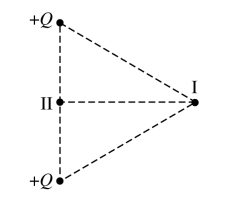
In the figure above, two small spheres, each with charge \(+Q\), are fixed in place at the corners of an equilateral triangle. Point I is at the third corner, and point II is midway between the charges. A small particle with charge \(+q\), where \(q \ll Q\), is moved from point I to point II at constant speed \(v\) by an external force. \(W_{\mathrm{EXT}}\) is the work done by the external force on the moving charge, and \(W_{\mathrm{ELEC}}\) is the work done by the electrostatic force. Which of the following correctly identifies the signs of these quantities?
\(W_{\mathrm{EXT}}\) \(W_{\mathrm{ELEC}}\)
(B) \(+\) \(-\)
(C) \(-\) \(+\)
(D) \(-\) \(-\)
(E) None of the above, since the work done by both the external force and the electrostatic force is zero.
▶️ Answer/Explanation
Correct Answer: \( \boxed{\mathrm{B}} \)
The electric potential at a point due to the two fixed charges is
\(V = k\displaystyle\sum \frac{Q}{r}.\)
Point II is closer to both positive charges than point I, so the electric potential at point II is greater than at point I. Therefore, the electric potential energy
\(U = qV\)
increases as the positive charge moves from point I to point II.
Since the particle moves at constant speed, its kinetic energy does not change, so the net work on the particle is zero:
\(W_{\mathrm{EXT}} + W_{\mathrm{ELEC}} = 0.\)
The electrostatic force opposes the motion toward the positive charges, so it does negative work:
\(W_{\mathrm{ELEC}} = -\Delta U < 0.\)
Therefore, the external force must do an equal amount of positive work:
\(W_{\mathrm{EXT}} = +\Delta U > 0.\)
Therefore, the correct answer is (B).
Question
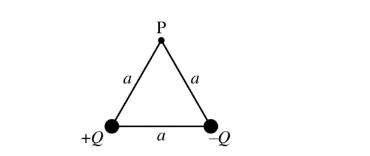
Two small spheres have charges \(+Q\) and \(-Q\) and are located at the bottom corners of an equilateral triangle, as shown in the figure above. The equilateral triangle has sides of length \(a\), and point \(P\) is at the top corner of the triangle.
The potential energy stored in the charge configuration shown is
(B) \( \dfrac{Q}{4\pi\varepsilon_{0}a^{2}} \)
(C) \( 0 \)
(D) \( -\dfrac{Q}{4\pi\varepsilon_{0}a^{2}} \)
(E) \( -\dfrac{Q^{2}}{4\pi\varepsilon_{0}a} \)
▶️ Answer/Explanation
Correct Answer: \( \boxed{\mathrm{E}} \)
The electric potential energy of a system of two point charges is
\( U=\dfrac{1}{4\pi\varepsilon_{0}}\dfrac{q_{1}q_{2}}{r} \)
Here,
\( q_{1}=+Q,\qquad q_{2}=-Q,\qquad r=a \)
Substituting these values,
\( U=\dfrac{1}{4\pi\varepsilon_{0}}\dfrac{(+Q)(-Q)}{a} \)
\( U=-\dfrac{Q^{2}}{4\pi\varepsilon_{0}a} \)
The negative sign indicates that opposite charges attract, so the system has lower potential energy than two charges infinitely far apart.
Therefore, the correct answer is (E).