
AP Physics C- E&M- 11.8 Resistor-Capacitor (RC) Circuits - Exam Style questions - FRQs- New Syllabus
Question

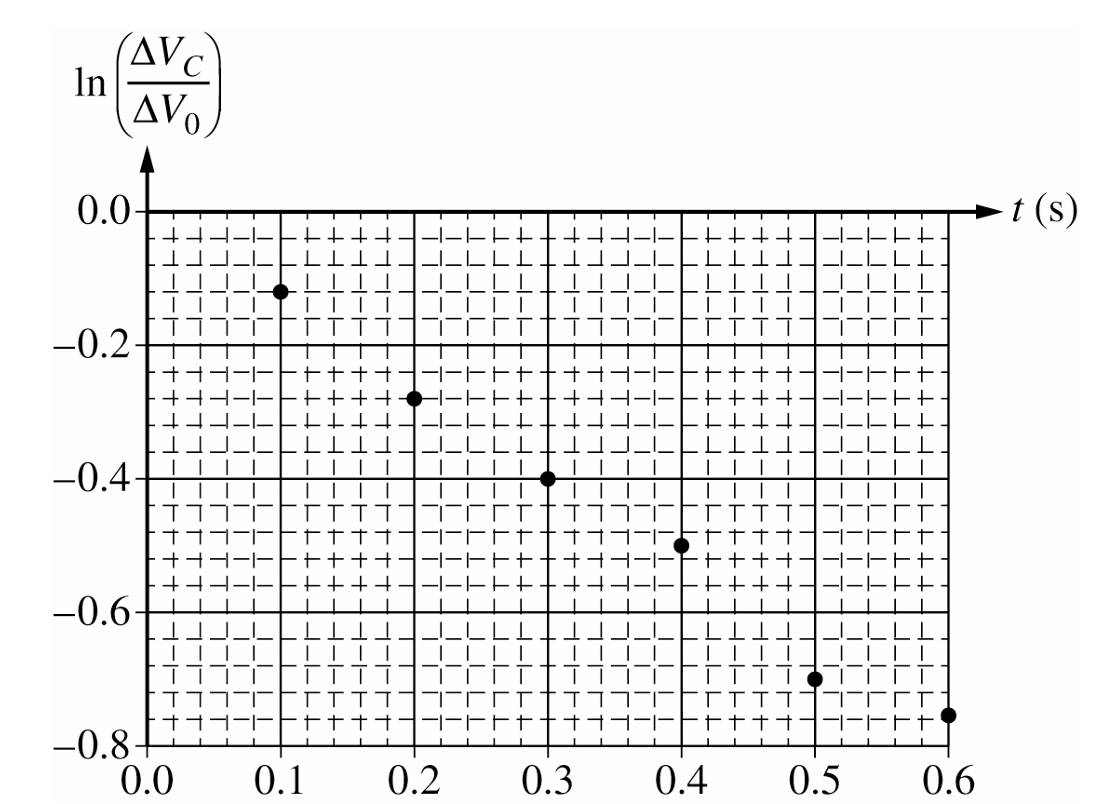
ii. Using the best-fit line, calculate a value for the unknown capacitance \(C\).
_____ Yes _____ No
Briefly justify your answer.
ii. Would the vertical intercept of the graph in this final experiment change compared to the graph in part (c)?
_____ Yes _____ No
Briefly justify your answer.
Most-appropriate topic codes (AP Physics C: Electricity and Magnetism):
• Topic \(10.3\) — Capacitors (Part \( \mathrm{d} \))
▶️ Answer/Explanation
(a)
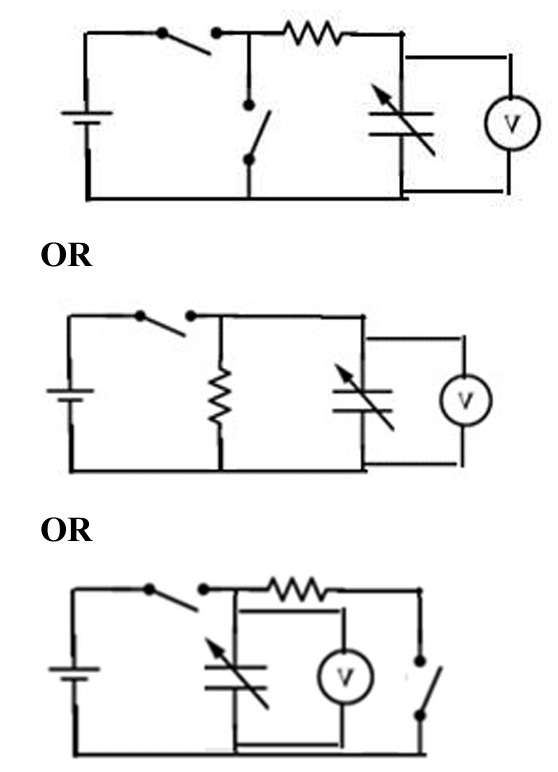
To fulfill the required setup, the battery, capacitor, and a switch must form one loop so the capacitor can be fully charged first. A second switch (or a single-pole double-throw switch configuration) is added so that when it is flipped, the battery is isolated and the capacitor connects directly in series with the resistor \(R\) to form a closed discharging loop. Finally, the voltmeter must be placed directly in parallel across the variable capacitor to correctly measure \(\Delta V_{C}\).
(b)
Applying Kirchhoff’s loop rule to the discharging loop gives:
Since the capacitor is losing its stored charge as time progresses, we substitute the current expression \(I = -\dfrac{dq}{dt}\):
Separating the charge and time variables gives us an integrable expression:
Integrating both sides from the starting state \(t = 0\) (where charge is \(Q_0\)) to an arbitrary time \(t\):
Taking the exponential of both sides yields the time-dependent charge function:
Dividing the entire expression by the constant capacitance \(C\) converts the relationship into potential difference, confirming the target equation:
(c)(i)
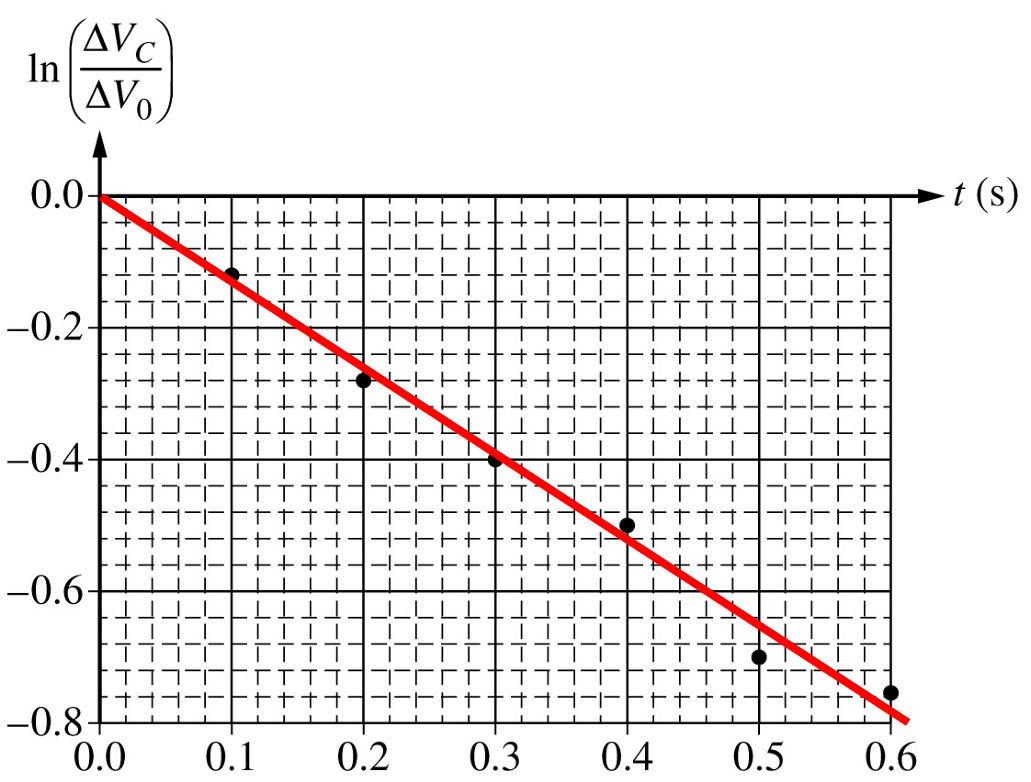
The data points form a linear progression starting from the origin \((0,0)\). An appropriate best-fit straight line is drawn through the center of the coordinate points, balancing roughly an equal number of points above and below the line.
(c)(ii)
Taking the natural log of our verified equation yields the expression:
This proves that a plot of \(\ln\left(\dfrac{\Delta V_{C}}{\Delta V_{0}}\right)\) versus \(t\) forms a straight line whose slope \(m\) is explicitly related to the time constant by:
Choosing two points far apart on the drawn line, such as \((0.0, 0.0)\) and \((0.56, -0.70)\), we evaluate the computational path for the slope:
Now, we can isolate the unknown value of capacitance \(C\):
(d)
Correct selection:
\(\boxed{\text{Less steep}}\)
Justification:
The geometric capacitance formula is \(C = \dfrac{\kappa\varepsilon_0A}{d}\), meaning increasing the plate area \(A\) directly increases the net capacitance \(C\). Since the magnitude of our line’s slope is inversely proportional to capacitance (\(|m| = \dfrac{1}{RC}\)), a higher capacitance slows the discharge rate and makes the line pass through a shallower downward angle.
(e)(i)
Correct selection:
\(\boxed{\text{No}}\)
Justification:
During the secondary stage of the experiment, the capacitor discharges strictly through the isolated resistor loop. Because the battery is completely disconnected from this path during the discharge cycle, its internal resistance plays no part in the loop equation, meaning the time constant and the graph’s slope remain unchanged.
(e)(ii)
Correct selection:
\(\boxed{\text{No}}\)
Justification:
The vertical intercept represents the condition at \(t = 0\), where the expression simplifies to \(\ln(1) = 0\). Once fully charged, no current flows from the battery into the capacitor branch, meaning there is zero steady-state voltage drop across the internal resistance \(r\), leaving the capacitor charged to the ideal maximum potential difference \(\Delta V_{0}\).