
AP Physics C Mechanics - 6.3 Angular Momentum and Angular Impulse- Exam Style questions- FRQs
Angular Momentum and Angular Impulse AP Physics C Mechanics FRQ
Unit 6: Energy and Momentum of Rotating Systems
Weightage : 10-15%
Question
ii. Derive an expression for the rotational inertia of the entire system about the axis of the platform.
Most-appropriate topic codes (AP Physics C: Mechanics):
• Topic \( 2.10 \) — Circular Motion (Parts \( \mathrm{a} \), \( \mathrm{d} \), \( \mathrm{g} \))
• Topic \( 5.4 \) — Rotational Inertia (Part \( \mathrm{b} \))
• Topic \( 6.1 \) — Rotational Kinetic Energy (Part \( \mathrm{f} \))
• Topic \( 6.3 \) — Angular Momentum and Angular Impulse (Parts \( \mathrm{c} \), \( \mathrm{e} \))
▶️ Answer/Explanation
(a)
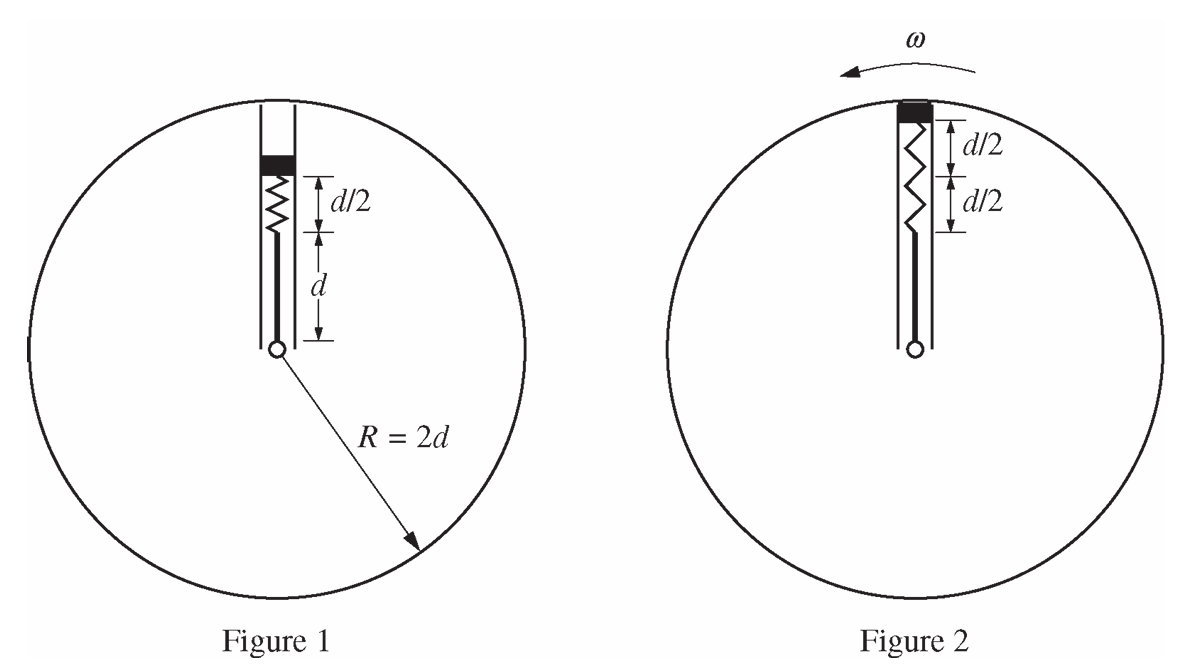
To find the spring constant, we equate the restoring force of the spring to the centripetal force required to maintain the block’s circular motion. The total radius of the block’s path is the sum of the rod’s length, the spring’s equilibrium length, and its stretch.
\( F_S = F_C \)
\( kx = mr\omega^2 \)
\( k\left(\dfrac{d}{2}\right) = m(2d)\omega^2 \)
\( \boxed{k = 4m\omega^2} \)
(b) i.
The rotational inertia of a point mass at a distance \( r \) from the axis of rotation is calculated using \( I = mr^2 \). By substituting the total radius from part (a), we can find the block’s inertia.
\( I = mr^2 \)
\( I = m(2d)^2 \)
\( \boxed{I = 4md^2} \)
(b) ii.
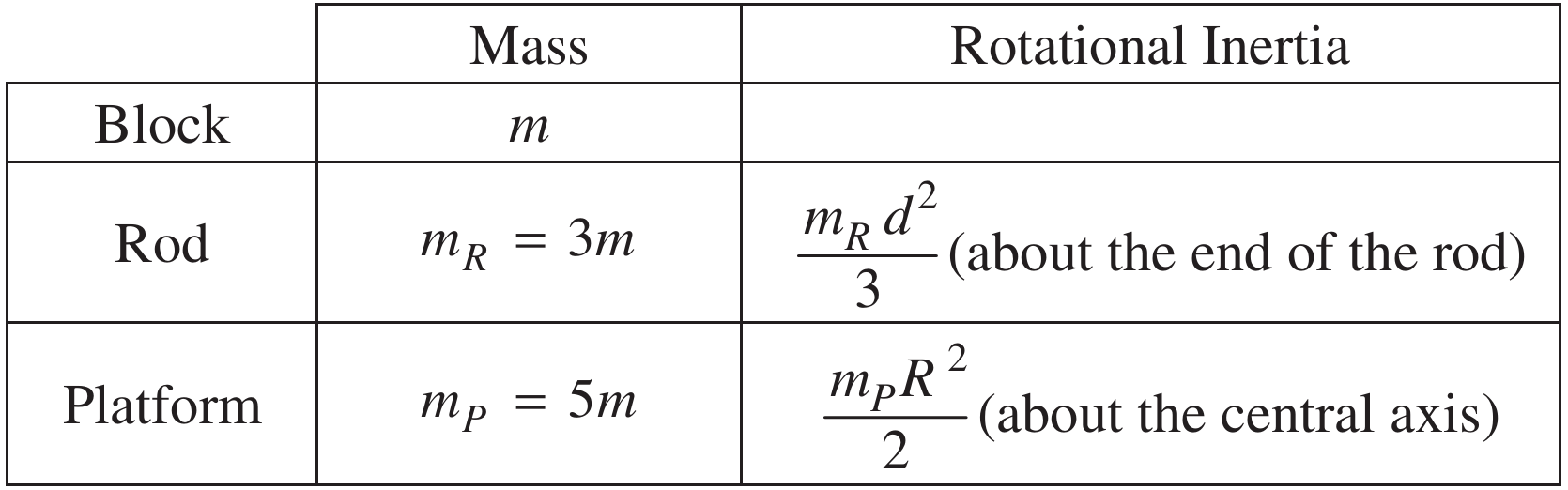
The rotational inertia of the entire system is the sum of the individual rotational inertias of the platform, the rod, and the block. We simply substitute the given mass and radius expressions for each part and sum them up.
\( I_{\text{sys}} = I_{\text{P}} + I_{\text{R}} + I_{\text{B}} \)
\( I_{\text{sys}} = \dfrac{m_P R^2}{2} + \dfrac{m_R d^2}{3} + mr^2 \)
\( I_{\text{sys}} = \dfrac{(5m)(2d)^2}{2} + \dfrac{(3m)d^2}{3} + 4md^2 \)
\( I_{\text{sys}} = 10md^2 + md^2 + 4md^2 \)
\( \boxed{I_{\text{sys}} = 15md^2} \)
(c)
Angular momentum is the product of the system’s total rotational inertia and its angular velocity. Since we already have the total inertia, we just multiply it by the given angular speed \( \omega \).
\( L = I_{\text{sys}}\omega \)
\( \boxed{L = 15md^2\omega} \)
(d)
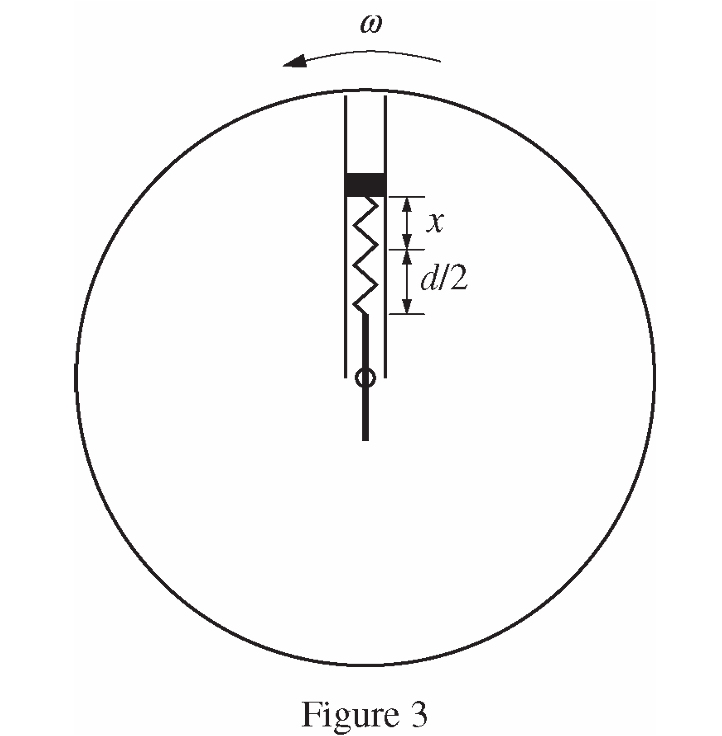
When the rod is centered on the axis, the new radius for the block is half the rod length \( d/2 \) plus the spring’s equilibrium length \( d/2 \) and its new stretch \( x \). We again equate the spring force to the centripetal force and solve for \( x \).
\( F_S = F_C \)
\( kx = m r_{\text{new}} \omega^2 \)
\( (4m\omega^2)x = m\left(\dfrac{d}{2} + \dfrac{d}{2} + x\right)\omega^2 \)
\( 4x = d + x \)
\( 3x = d \)
\( \boxed{x = d/3} \)
(e)
Correct choice:
\( \boxed{\text{Decreasing}} \)
As the rod moves toward the axis, the mass of the system is distributed closer to the center of rotation, which decreases the overall rotational inertia \( I \). Since the angular momentum is given by \( L = I\omega \) and the angular velocity \( \omega \) remains constant, the angular momentum must decrease.
(f)
Correct choice:
\( \boxed{\text{Negative}} \)
The rotational kinetic energy of the system is given by \( K = \frac{1}{2}I\omega^2 \). As the rotational inertia \( I \) decreases and \( \omega \) is kept constant, the system’s total rotational kinetic energy drops. According to the work-energy theorem, a decrease in kinetic energy indicates that the net work done on the rotating system by the motor is negative.
(g)
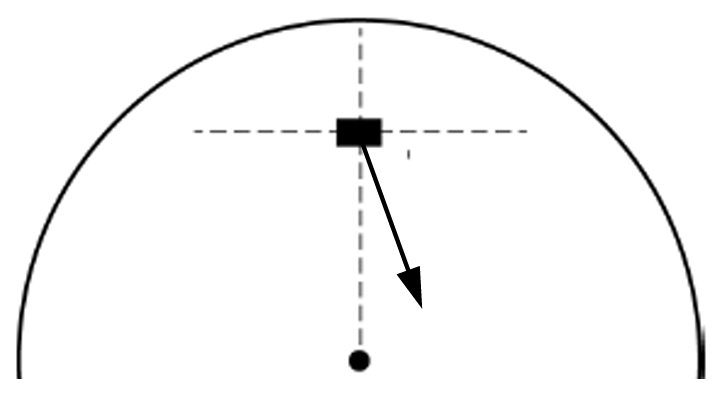
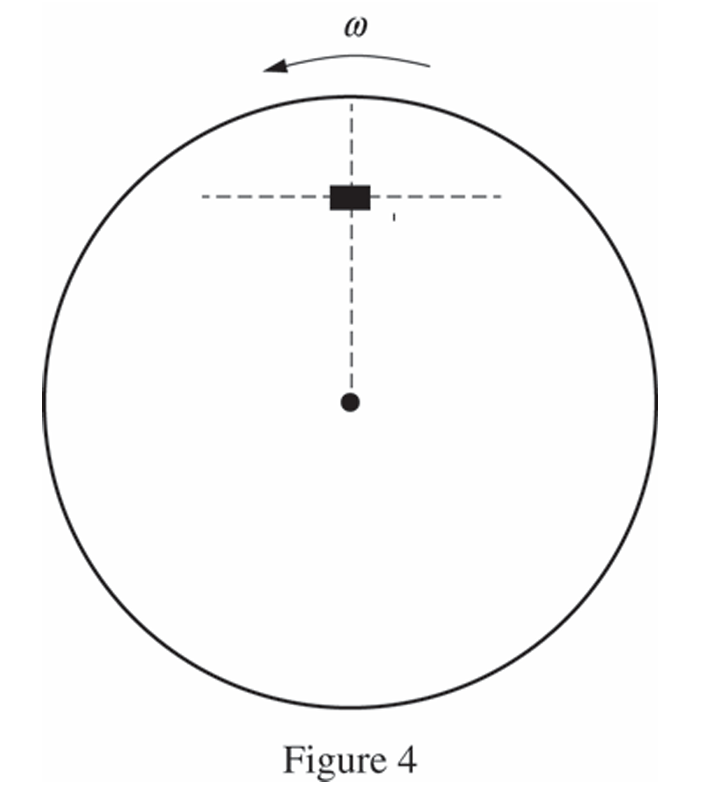
The block’s acceleration is made up of two distinct components. First, there is the centripetal acceleration directing it toward the center of the platform. Second, as it moves radially inward while rotating, there is a tangential component (the Coriolis acceleration) pointing in the direction of the rotation. The combination yields a net vector pointing diagonally.
\( \boxed{\text{An arrow starting on the box and pointing down and to the right}} \)