
AP Physics C Mechanics - 4.2 Change in Momentum and Impulse- Exam Style questions- MCQs
Change in Momentum and Impulse AP Physics C Mechanics MCQ
Unit 4: Linear Momentum
Weightage : 15-25%
Question
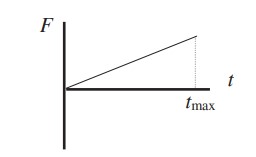
The force \(F\) on a mass is shown above as a function of time \(t\).
Which of the following methods can be used to determine the impulse experienced by the mass?
I. Multiplying the average force by \(t_{\mathrm{max}}\)
II. Calculating the area under the line on the graph
III. Taking the integral \(\int_{0}^{t_{\mathrm{max}}}F\,dt\)
(B) III only
(C) II and III only
(D) I and II only
(E) I, II, and III
▶️ Answer/Explanation
Correct Answer: \( \boxed{\mathrm{E}} \)
Impulse is defined as the change in momentum and is given by
\(J=\Delta p=\int_{0}^{t_{\mathrm{max}}}F\,dt\)
Therefore, statement III is correct.
The integral of force with respect to time is equal to the area under the force-time graph, so statement II is also correct.
Since the force increases linearly from zero to its maximum value, the average force is
\(F_{\mathrm{avg}}=\dfrac{F_{\mathrm{max}}}{2}\)
Thus, the impulse can also be calculated as
\(J=F_{\mathrm{avg}}\,t_{\mathrm{max}}\)
This is equivalent to the area of the triangular region under the graph, making statement I correct as well.
Therefore, the correct answer is (E).
Question
A \(5\,\mathrm{kg}\) object is propelled from rest at time \(t=0\) by a net force \(F\) that always acts in the same direction. The magnitude of the force, in newtons, is given as a function of time \(t\) (in seconds) by
\(F=0.5t\)
What is the speed of the object at \(t=4\,\mathrm{s}\)?
(B) \(0.8\,\mathrm{m/s}\)
(C) \(2.0\,\mathrm{m/s}\)
(D) \(4.0\,\mathrm{m/s}\)
(E) \(8.0\,\mathrm{m/s}\)
▶️ Answer/Explanation
Correct Answer: \( \boxed{\mathrm{B}} \)
Using Newton’s second law,
\(a=\dfrac{F}{m}=\dfrac{0.5t}{5}=0.1t\)
The object starts from rest, so its speed is obtained by integrating the acceleration:
\(v=\int_0^4 a\,dt=\int_0^4 0.1t\,dt\)
\(v=0.1\left[\dfrac{t^2}{2}\right]_0^4=0.1\left(\dfrac{16}{2}\right)=0.8\,\mathrm{m/s}\)
Equivalently, the impulse is
\(J=\int_0^4 F\,dt=\int_0^4 0.5t\,dt=4\,\mathrm{N\cdot s}\)
Since \(J=\Delta p=mv\),
\(v=\dfrac{4}{5}=0.8\,\mathrm{m/s}\)
Therefore, the correct answer is (B).
Question
The momentum \(p\) of a moving object as a function of time \(t\) is given by the expression \(p=kt^3\), where \(k\) is a constant.
The force causing this motion is given by which of the following expressions?
(B) \(\dfrac{3kt^2}{2}\)
(C) \(\dfrac{kt^2}{2}\)
(D) \(kt^4\)
(E) \(\dfrac{kt^4}{4}\)
▶️ Answer/Explanation
Correct Answer: \( \boxed{\mathrm{A}} \)
Force is defined as the time rate of change of momentum:
\(F=\dfrac{dp}{dt}\)
Given
\(p=kt^3\)
Differentiate with respect to time:
\(F=\dfrac{d}{dt}(kt^3)=3kt^2\)
Since \(k\) is a constant, it remains unchanged during differentiation. The force increases proportionally to \(t^2\).
Therefore, the correct answer is (A).