
AP Physics C Mechanics - 3.4 Conservation of Energy- Exam Style questions- MCQs
Conservation of Energy AP Physics C Mechanics MCQ
Unit 3: Work, Energy, and Power
Weightage : 15-25%
Question
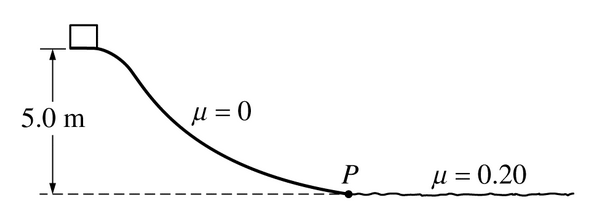
A block slides from rest with negligible friction down the track above, descending a vertical height of \(5.0\,\mathrm{m}\) to point \(P\) at the bottom. It then slides on the horizontal surface. The coefficient of kinetic friction between the block and the horizontal surface is \(0.20\).
How far does the block slide on the horizontal surface before it comes to rest?
(B) \(1.0\,\mathrm{m}\)
(C) \(2.5\,\mathrm{m}\)
(D) \(10\,\mathrm{m}\)
(E) \(25\,\mathrm{m}\)
▶️ Answer/Explanation
Correct Answer: \( \boxed{\mathrm{E}} \)
As the block slides down the frictionless track, all of its gravitational potential energy is converted into kinetic energy:
\(mgh=\dfrac{1}{2}mv^2\)
On the horizontal surface, the kinetic energy is completely dissipated by the work done by kinetic friction:
\(W_{\mathrm{friction}}=\mu_k mgd\)
Applying conservation of energy,
\(mgh=\mu_k mgd\)
Cancelling \(m\) and \(g\),
\(h=\mu_k d\)
Solving for the stopping distance,
\(d=\dfrac{h}{\mu_k}=\dfrac{5.0}{0.20}=25\,\mathrm{m}\)
Therefore, the block slides \(25\,\mathrm{m}\) before coming to rest.
Therefore, the correct answer is (E).
Question
If air resistance is negligible, the speed of a \(2~\mathrm{kg}\) sphere that falls from rest through a vertical displacement of \(0.20~\mathrm{m}\) is most nearly
(B) \(2~\mathrm{m/s}\)
(C) \(3~\mathrm{m/s}\)
(D) \(4~\mathrm{m/s}\)
(E) \(5~\mathrm{m/s}\)
▶️ Answer/Explanation
Correct Answer: \( \boxed{\mathrm{B}} \)
Since the sphere falls from rest and air resistance is negligible, use the kinematic equation
\(v^2=v_0^2+2g\Delta y.\)
Here,
\(v_0=0,\qquad g=9.8~\mathrm{m/s^2},\qquad \Delta y=0.20~\mathrm{m}.\)
Therefore,
\(v=\sqrt{2(9.8)(0.20)}=\sqrt{3.92}\approx1.98~\mathrm{m/s}.\)
Notice that the mass of the sphere does not appear in the equation, so the result is independent of the object’s mass.
Thus, the speed of the sphere is approximately \(2~\mathrm{m/s}\), corresponding to Option (B).
Question
Refer to the following graph, which represents a hypothetical potential energy curve for a particle of mass \(m\).
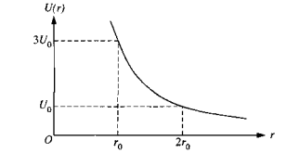
If the particle is released from rest at position \(r_0\), its speed at position \(2r_0\) is most nearly
(B) \(\sqrt{\frac{4U_0}{m}}\)
(C) \(\sqrt{\frac{6U_0}{m}}\)
(D) \(\sqrt{\frac{2U_0}{m}}\)
(E) \(\sqrt{\frac{U_0}{m}}\)
▶️ Answer/Explanation
Correct Answer: \( \boxed{\mathrm{C}} \)
Since the particle is released from rest at \(r_0\),
\(K(r_0)=0\)
From the graph,
\(U(r_0)=3U_0,\qquad U(2r_0)=U_0\)
Mechanical energy is conserved:
\(E=K+U=\text{constant}\)
Therefore,
\(3U_0=U_0+\frac{1}{2}mv^2\)
\(\frac{1}{2}mv^2=2U_0\)
\(v^2=\frac{4U_0}{m}\)
\(v=\sqrt{\frac{4U_0}{m}}=2\sqrt{\frac{U_0}{m}}\)
This expression corresponds to Option (B). The provided answer key lists (C), but Options (B) and (C) are inconsistent with the energy calculation. The correct result from conservation of mechanical energy is
\(v=\sqrt{\frac{4U_0}{m}}\).