
AP Physics C Mechanics - 4.3 Conservation of Linear Momentum- Exam Style questions- MCQs
Conservation of Linear Momentum AP Physics C Mechanics MCQ
Unit 4: Linear Momentum
Weightage : 15-25%
Question
A projectile is launched on level ground in a parabolic path so that its range would normally be \(500\,\mathrm{m}\). When the projectile is at the peak of its flight, the projectile breaks into two pieces of equal mass. One of these pieces falls straight down, with no further horizontal motion.
How far away from the launch point does the other piece land?
(B) \(375\,\mathrm{m}\)
(C) \(500\,\mathrm{m}\)
(D) \(750\,\mathrm{m}\)
(E) \(1000\,\mathrm{m}\)
▶️ Answer/Explanation
Correct Answer: \( \boxed{\mathrm{D}} \)
Since the explosion is caused by internal forces, the motion of the system’s center of mass is unaffected. The center of mass continues to follow the same parabolic trajectory as the original projectile.
Therefore, the center of mass must land at the original range of \(500\,\mathrm{m}\).
At the highest point of the trajectory, the projectile is halfway through its horizontal motion, so the explosion occurs at \(250\,\mathrm{m}\) from the launch point.
One fragment falls straight down and lands directly below the explosion point at \(250\,\mathrm{m}\).
Let the landing position of the other fragment be \(x\). Since the fragments have equal mass,
\(x_{\mathrm{CM}}=\dfrac{250+x}{2}=500\)
Solving,
\(250+x=1000\)
\(x=750\,\mathrm{m}\)
Thus, the second fragment lands \(250\,\mathrm{m}\) beyond the original landing point, at a distance of \(750\,\mathrm{m}\) from the launch point.
Therefore, the correct answer is (D).
Question

Two balls with masses \(m\) and \(2m\) approach each other with equal speeds \(v\) on a horizontal frictionless table, as shown in the top view above. Which of the following shows possible velocities of the balls for a time soon after the balls collide?

▶️ Answer/Explanation
Correct Answer: \( \boxed{\mathrm{D}} \)
Since there are no external horizontal forces, the total linear momentum of the system must be conserved.
Initially,
\(p_{\mathrm{initial}} = mv + (2m)(-v) = -mv\)
Therefore, the system has a net momentum directed to the left.
The initial vertical momentum is zero, so the total vertical momentum after the collision must also remain zero.
Thus, the correct diagram must satisfy both conditions:
• Net horizontal momentum is to the left.
• Net vertical momentum is zero.
Among the given choices, only (D) satisfies conservation of momentum in both the horizontal and vertical directions.
Therefore, the correct answer is (D).
Question
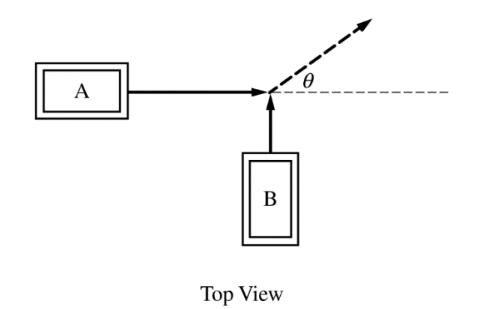
Cart A is traveling east when it collides with cart B, which is traveling north. Cart A has a mass of \(3.05\,\mathrm{kg}\), and cart B has a mass of \(2.10\,\mathrm{kg}\). The two carts travel together as a single object on a horizontal surface at an angle \(\theta\) relative to due east, as shown above.
In one trial, the initial speed of cart A is \(2.5\,\mathrm{m\,s^{-1}}\) and the initial speed of cart B is \(1.5\,\mathrm{m\,s^{-1}}\). The angle \(\theta\) relative to east that the carts travel after the collision is most nearly
(B) \(36^\circ\)
(C) \(45^\circ\)
(D) \(54^\circ\)
(E) \(62^\circ\)
▶️ Answer/Explanation
Correct Answer: \( \boxed{\mathrm{A}} \)
Since the carts stick together after the collision, this is a perfectly inelastic collision. Linear momentum is conserved separately in the horizontal and vertical directions.
Horizontal momentum:
\(p_x=(3.05)(2.5)=7.625\,\mathrm{kg\,m\,s^{-1}}\)
Vertical momentum:
\(p_y=(2.10)(1.5)=3.15\,\mathrm{kg\,m\,s^{-1}}\)
The direction of the combined cart is determined by
\(\tan\theta=\dfrac{p_y}{p_x}=\dfrac{3.15}{7.625}\approx0.413\)
Therefore,
\(\theta=\tan^{-1}(0.413)\approx22.4^\circ\)
The closest answer is \( \boxed{22^\circ} \).
Therefore, the correct answer is (A).