
AP Physics C Mechanics - 2.6 Gravitational Force- Exam Style questions- FRQs
Gravitational Force AP Physics C Mechanics FRQ
Unit 2: Force and Translational Dynamics
Weightage : 20-15%
Question

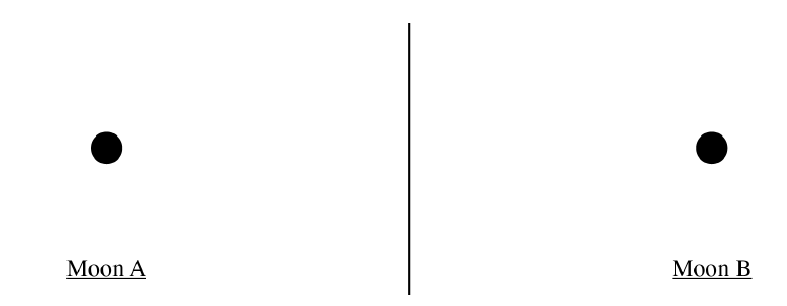
Most-appropriate topic codes (AP Physics C: Mechanics):
• Topic \(2.6\) — Gravitational Force (Part \( \mathrm{(a)} \), Part \( \mathrm{(b)} \), Part \( \mathrm{(c)} \), Part \( \mathrm{(d)} \))
▶️ Answer/Explanation
(a)
On Moon \(A\), both gravitational forces point to the right: one force due to Moon \(B\), and one force due to the planet.
On Moon \(B\), the force due to Moon \(A\) points to the left, while the force due to the planet points to the right.
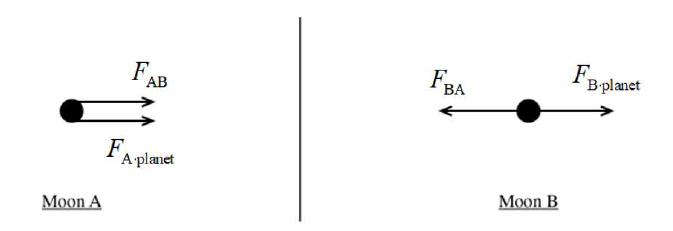
\(\boxed{\text{Moon }A:\ F_{AB}\text{ right and }F_{A,p}\text{ right}}\)
\(\boxed{\text{Moon }B:\ F_{BA}\text{ left and }F_{B,p}\text{ right}}\)
(b)(i)
The net force on Moon \(A\) could be larger because both gravitational forces on Moon \(A\) point in the same direction. The planet pulls Moon \(A\) to the right, and Moon \(B\) also pulls Moon \(A\) to the right.
Therefore, the magnitudes of the two forces on Moon \(A\) add. On Moon \(B\), the forces from Moon \(A\) and the planet point in opposite directions, so they partially cancel.
(b)(ii)
The net force on Moon \(B\) could be larger because Moon \(B\) is closer to the planet than Moon \(A\) is. Since gravitational force varies inversely with the square of distance, the planet exerts a stronger gravitational force on Moon \(B\) than on Moon \(A\).
If the force from the planet on Moon \(B\) is much larger than the force from Moon \(A\) on Moon \(B\), then the net force on Moon \(B\) could be larger than the net force on Moon \(A\).
(c)
Use Newton’s law of universal gravitation:
\(F_g=\dfrac{Gm_1m_2}{r^2}\)
Let the positive direction be to the right. The distance between Moon \(A\) and Moon \(B\) is
\(R_A-R_B\)
For Moon \(A\), both forces point to the right:
\(F_A=F_{A,p}+F_{AB}\)
\(F_A=\dfrac{Gm_0m_p}{R_A^2}+\dfrac{Gm_0^2}{\left(R_A-R_B\right)^2}\)
\(\boxed{F_A=Gm_0\left(\dfrac{m_p}{R_A^2}+\dfrac{m_0}{\left(R_A-R_B\right)^2}\right)}\)
For Moon \(B\), the planet pulls Moon \(B\) to the right, while Moon \(A\) pulls Moon \(B\) to the left:
\(F_B=F_{B,p}-F_{BA}\)
\(F_B=\dfrac{Gm_0m_p}{R_B^2}-\dfrac{Gm_0^2}{\left(R_A-R_B\right)^2}\)
\(\boxed{F_B=Gm_0\left(\dfrac{m_p}{R_B^2}-\dfrac{m_0}{\left(R_A-R_B\right)^2}\right)}\)
This expression uses right as positive. If \(F_B\) is positive, Moon \(B\)’s net force is to the right. If \(F_B\) is negative, Moon \(B\)’s net force is to the left.
(d)(i)
\(\boxed{\text{Yes}}\)
The expressions support the reasoning in part (b)(i) because the two terms in \(F_A\) have the same sign, so they add. In contrast, the two terms in \(F_B\) have opposite signs, so they subtract. This shows that the net force on Moon \(A\) could be larger.
(d)(ii)
\(\boxed{\text{Yes}}\)
The expressions also support the reasoning in part (b)(ii) because the planet term for Moon \(B\), \(\dfrac{Gm_0m_p}{R_B^2}\), can be much larger than the planet term for Moon \(A\), \(\dfrac{Gm_0m_p}{R_A^2}\), since \(R_B<R_A\).
Therefore, if Moon \(B\) is much closer to the planet than Moon \(A\), the net force on Moon \(B\) could be larger even though the moon-moon force partially cancels the planet’s force.