
AP Physics C Mechanics - 2.6 Gravitational Force- Exam Style questions- MCQs
Gravitational Force AP Physics C Mechanics MCQ
Unit 2: Force and Translational Dynamics
Weightage : 20-15%
Question
An astronaut lands on a planet whose mass and radius are each twice that of Earth. If the astronaut weighs \(800\,\mathrm{N}\) on Earth, how much will the astronaut weigh on this planet?
(B) \(400\,\mathrm{N}\)
(C) \(800\,\mathrm{N}\)
(D) \(1600\,\mathrm{N}\)
(E) \(3200\,\mathrm{N}\)
▶️ Answer/Explanation
Correct Answer: \( \boxed{\mathrm{B}} \)
The gravitational field strength at the surface of a planet is
\(g=\dfrac{GM}{R^2}\)
Let the mass and radius of Earth be \(M_{\mathrm{E}}\) and \(R_{\mathrm{E}}\). For the new planet,
\(M=2M_{\mathrm{E}}\) and \(R=2R_{\mathrm{E}}\).
Therefore,
\(g_{\mathrm{planet}}=\dfrac{G(2M_{\mathrm{E}})}{(2R_{\mathrm{E}})^2}=\dfrac{2GM_{\mathrm{E}}}{4R_{\mathrm{E}}^2}=\dfrac{1}{2}g_{\mathrm{E}}\)
Since weight is given by \(W=mg\), the astronaut’s weight on the new planet is half of the weight on Earth:
\(W_{\mathrm{planet}}=\dfrac{1}{2}\times800=400\,\mathrm{N}\)
Thus, the astronaut weighs \(400\,\mathrm{N}\) on the new planet.
Therefore, the correct answer is (B).
Question
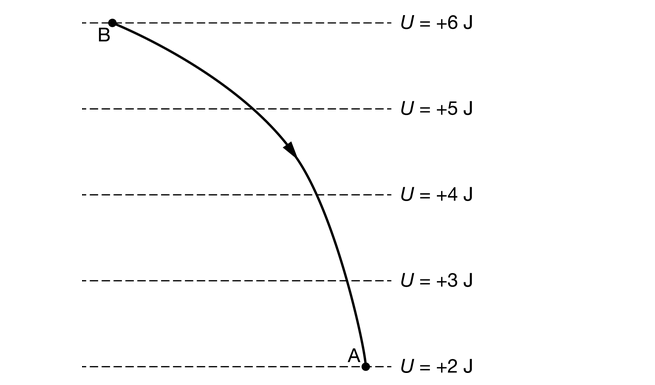
The figure shows an object moving from point B to point A and the gravitational potential energy of the object-Earth system at different points along the trajectory. The potential energy values shown are:
There are no other forces exerted on the object.
Which of the following best describes the direction of the force exerted on the object due to the gravitational field as the object moves along the path from point B to point A?
(B) The force is always directed perpendicular to the path.
(C) The force is always directed downward.
(D) The force is always directed upward.
(E) The force is always directed opposite the motion of the object.
▶️ Answer/Explanation
Correct Answer: \( \boxed{\mathrm{C}} \)
The gravitational force is related to gravitational potential energy by
\(\vec{F}=-\nabla U\)
Since the potential energy decreases from \(+6\,\mathrm{J}\) at point \(B\) to \(+2\,\mathrm{J}\) at point \(A\), the force always points toward lower gravitational potential energy.
Near Earth’s surface, the gravitational field is uniform and always points vertically downward, regardless of the object’s path or direction of motion.
Therefore, the force is not necessarily tangent to the path, perpendicular to the path, or opposite the motion. It remains directed downward throughout the motion.
Therefore, the correct answer is (C).
Question
A moon executes an elliptical orbit about its planet. Point \(P\) is where the moon is closest to the planet, and point \(A\) is where the moon is farthest from the planet.
As the moon moves from point \(P\) to point \(A\) and then back to its original position, what happens to the magnitude of the force of the moon on the planet?
(B) It decreases, then increases.
(C) It decreases the entire way.
(D) It remains constant.
(E) It increases the entire way.
▶️ Answer/Explanation
Correct Answer: \( \boxed{\mathrm{B}} \)
The magnitude of the gravitational force between the moon and the planet is given by Newton’s law of gravitation:
\( F=\frac{GMm}{r^2} \)
where \(M\) is the planet’s mass, \(m\) is the moon’s mass, and \(r\) is the distance between their centers.
As the moon moves from point \(P\) (closest) to point \(A\) (farthest), the distance \(r\) increases. Since the force is inversely proportional to \(r^2\), the gravitational force decreases.
As the moon returns from point \(A\) to point \(P\), the distance decreases, causing the gravitational force to increase.
By Newton’s third law, the force of the moon on the planet has the same magnitude as the force of the planet on the moon at every instant.
Therefore, the correct answer is (B).