
AP Physics C Mechanics - 1.5 Motion in Two or Three Dimensions- Exam Style questions- MCQs
Motion in Two or Three Dimensions AP Physics C Mechanics MCQ
Unit: 1. Kinematics
Weightage : 10-15%
Question
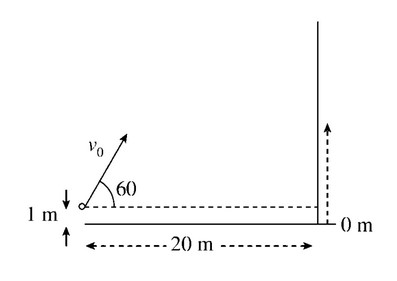
A ball is projected with an initial velocity of magnitude \(v_0=40\,\mathrm{m/s}\) toward a vertical wall as shown in the figure above. How long does the ball take to reach the wall?
(B) \(0.60\,\mathrm{s}\)
(C) \(1.0\,\mathrm{s}\)
(D) \(2.0\,\mathrm{s}\)
(E) \(3.0\,\mathrm{s}\)
▶️ Answer/Explanation
Correct Answer: \( \boxed{\mathrm{C}} \)
The horizontal component of the projectile’s velocity is
\(v_x=v_0\cos60^\circ=40\left(\dfrac{1}{2}\right)=20\,\mathrm{m/s}\)
The wall is \(20\,\mathrm{m}\) away horizontally. Since the horizontal velocity remains constant,
\(x=v_xt\)
Therefore,
\(t=\dfrac{20}{20}=1.0\,\mathrm{s}\)
The vertical motion does not affect the time required to reach the wall because the horizontal and vertical motions are independent.
Therefore, the correct answer is (C).
Question
An object is sliding along a horizontal table surface of negligible friction with velocity \(v_x\) when it leaves the end of the table of height \(H\). The object lands a horizontal distance \(D\) from the edge of the table.
If the object leaves the edge of a horizontal table of height \(2H\) with the same velocity \(v_x\), which of the following represents the horizontal distance the object will land from the edge of the new table?
(B) \(D\)
(C) \( \sqrt{2}\,D \)
(D) \(2D\)
(E) \(4D\)
▶️ Answer/Explanation
Correct Answer: \( \boxed{\mathrm{C}} \)
The object leaves the table horizontally, so its initial vertical velocity is zero.
Using vertical motion,
\(H=\dfrac{1}{2}gt^2\)
which gives
\(t=\sqrt{\dfrac{2H}{g}}\)
The horizontal distance is
\(D=v_xt=v_x\sqrt{\dfrac{2H}{g}}\)
If the table height is doubled to \(2H\),
\(t’=\sqrt{\dfrac{2(2H)}{g}}=\sqrt{2}\sqrt{\dfrac{2H}{g}}=\sqrt{2}\,t\)
Therefore, the new horizontal distance is
\(D’=v_xt’=\sqrt{2}\,D\)
Thus, doubling the height increases the horizontal range by a factor of \(\sqrt{2}\).
Therefore, the correct answer is (C).
Question
Two projectiles are launched with the same initial speed from the same location, one at a \(30^\circ\) angle and the other at a \(60^\circ\) angle with the horizontal. They land at the same height at which they were launched. If air resistance is negligible, how do the projectiles’ respective maximum heights, \(H_{30}\) and \(H_{60}\), and times in the air, \(T_{30}\) and \(T_{60}\), compare with each other?
| Option | Maximum Height | Time in Air |
|---|---|---|
| (A) | \(H_{30}>H_{60}\) | \(T_{30}>T_{60}\) |
| (B) | \(H_{30}>H_{60}\) | \(T_{30}<T_{60}\) |
| (C) | \(H_{30}=H_{60}\) | \(T_{30}=T_{60}\) |
| (D) | \(H_{30}<H_{60}\) | \(T_{30}>T_{60}\) |
| (E) | \(H_{30}<H_{60}\) | \(T_{30}<T_{60}\) |
▶️ Answer/Explanation
Correct Answer: \( \boxed{\mathrm{E}} \)
The maximum height of a projectile is
\(H=\dfrac{v_0^2\sin^2\theta}{2g}\)
Since
\(\sin^2 30^\circ=\dfrac{1}{4}\) and \(\sin^2 60^\circ=\dfrac{3}{4}\),
it follows that
\(H_{30}<H_{60}\)
The total time of flight for a projectile that lands at the launch height is
\(T=\dfrac{2v_0\sin\theta}{g}\)
Since
\(\sin30^\circ=\dfrac{1}{2}\) and \(\sin60^\circ=\dfrac{\sqrt{3}}{2}\),
we have
\(T_{30}<T_{60}\)
Therefore, the projectile launched at \(60^\circ\) reaches a greater maximum height and remains in the air longer.
Therefore, the correct answer is (E).