
AP Physics C Mechanics - 5.6 Newton’s Second Law in Rotational Form- Exam Style questions- FRQs
Newton’s Second Law in Rotational Form AP Physics C Mechanics FRQ
Unit 5: Torque and Rotational Dynamics
Weightage : 10-15%
Question
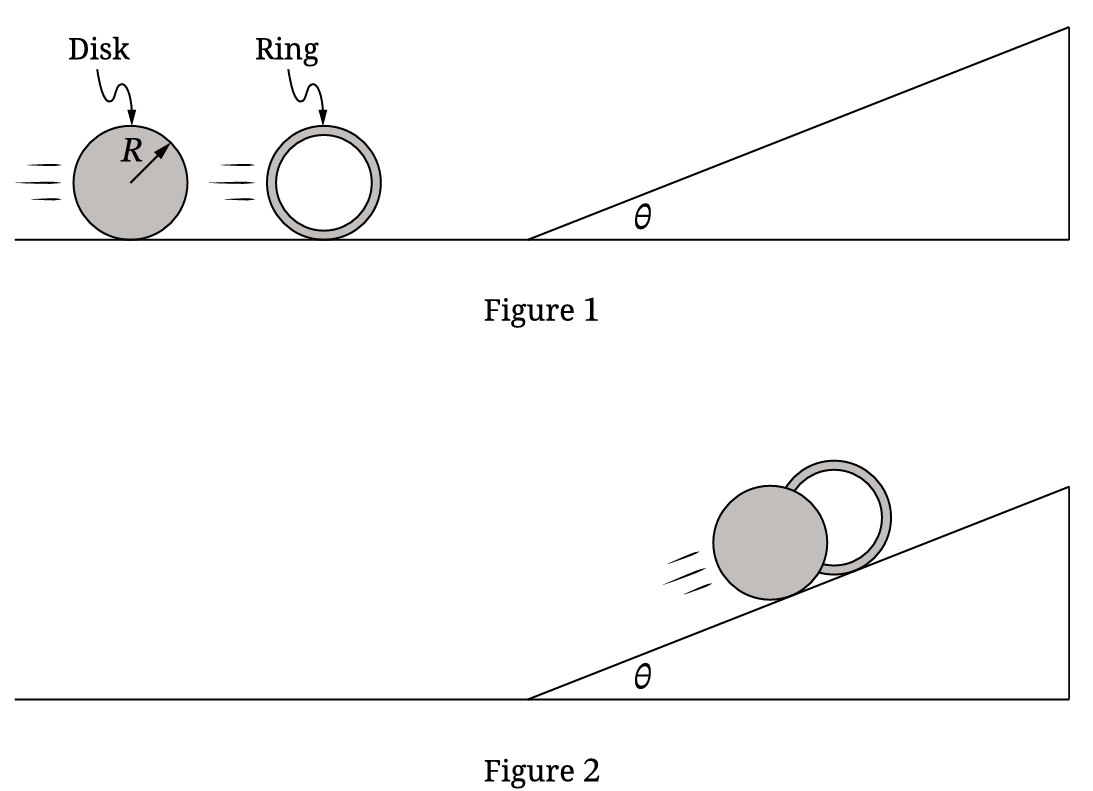
A. While the disk and the ring are rolling on the ramp without slipping, the magnitudes of the static frictional force exerted on the disk and on the ring by the ramp are \(f_{D}\) and \(f_{R}\) respectively.
Indicate whether \(f_{D}\) is greater than, less than, or equal to \(f_{R}\) by writing one of the following.
\(f_{D}>f_{R}\) .
\(f_{D}<f_{R}\)
\(f_{D}=f_{R}\)
Justify your answer using qualitative reasoning beyond referencing equations.
B. A cylinder has mass \(M\), radius \(R\), and rotational inertia \(I\) about its central axis. The cylinder rolls without slipping up a ramp that is inclined at an angle above the horizontal.
Derive an expression for the magnitude of the static frictional force \(f\) exerted on the cylinder by the ramp. Express your answer in terms of \(M\), \(R\), \(I\), \(\theta\), and physical constants, as appropriate. Begin your derivation by writing a fundamental physics principle or an equation from the reference information.
C. In a different scenario, the centers of mass of the original disk and ring each have the same initial speed \(v\) as they did in the original scenario. The ramp is replaced by a new ramp on which the disk and the ring initially slip as they roll up the new ramp.
Indicate whether the magnitude of the kinetic frictional force exerted on the disk by the new ramp is greater than, less than, or equal to the magnitude of the kinetic frictional force exerted on the ring by the new ramp while both are slipping.
Briefly justify your answer.
Most-appropriate topic codes (AP Physics C: Mechanics):
• Topic 5.6 — Newton’s Second Law in Rotational Form (Parts A, B)
• Topic 5.4 — Rotational Inertia (Parts A, B)
• Topic 3.4 — Conservation of Energy (Part A)
▶️ Answer/Explanation
(A)
\(f_{D}<f_{R}\)
The ring has a greater rotational inertia because its mass is entirely distributed along its outer perimeter, whereas the disk has its mass distributed uniformly throughout its volume.
According to Newton’s second law in rotational form, a larger rotational inertia requires a greater net torque to produce a given angular deceleration.
Since the torque is provided by static friction, the ramp must exert a greater static frictional force on the ring than on the disk to keep it rolling smoothly without slipping.
(B)
Apply Newton’s second law for translational motion along the incline:
\(\sum F_x = M a\)
\(f – M g \sin\theta = -M a\)
Apply Newton’s second law for rotational motion about the central axis:
\(\sum \tau = I \alpha\)
\(f R = I \alpha\)
Since the cylinder rolls without slipping, link the linear and angular accelerations:
\(a = R \alpha\)
Substitute \(\alpha = \frac{a}{R}\) into the torque equation to find linear acceleration:
\(f R = I \left(\frac{a}{R}\right) \implies a = \frac{f R^2}{I}\)
Substitute this expression for acceleration back into the translational equation:
\(f – M g \sin\theta = -M \left(\frac{f R^2}{I}\right)\)
\(f + \frac{M f R^2}{I} = M g \sin\theta\)
\(f \left(1 + \frac{M R^2}{I}\right) = M g \sin\theta\)
\(\boxed{f = \frac{M g \sin\theta}{1 + \frac{M R^2}{I}}}\)
(C)
Equal to
The force of kinetic friction is determined by the equation \(f_k = \mu_k F_N\).
Both objects have the exact same total mass \(M\) and are moving up the same ramp incline, meaning they experience an identical normal force given by \(F_N = M g \cos\theta\).
Because their outer surfaces are composed of the same material, the coefficient of kinetic friction \(\mu_k\) is the same, making the kinetic frictional forces acting on the disk and the ring equal while they slip.