
AP Physics C Mechanics - 3.5 Power- Exam Style questions- MCQs
Power AP Physics C Mechanics MCQ
Unit 3: Work, Energy, and Power
Weightage : 15-25%
Question
A particle’s kinetic energy is changing at a rate of \(-6.0\,\mathrm{J/s}\) when its speed is \(3.0\,\mathrm{m/s}\). What is the magnitude of the force on the particle at this moment?
(B) \(2.0\,\mathrm{N}\)
(C) \(4.5\,\mathrm{N}\)
(D) \(9.0\,\mathrm{N}\)
(E) \(18\,\mathrm{N}\)
▶️ Answer/Explanation
Correct Answer: \( \boxed{\mathrm{B}} \)
The rate of change of kinetic energy is equal to the instantaneous power delivered by the net force:
\(P=\dfrac{dK}{dt}=Fv\)
Equivalently, differentiating \(K=\dfrac{1}{2}mv^2\) with respect to time gives
\(\dfrac{dK}{dt}=mv\dfrac{dv}{dt}=vF\)
Therefore,
\(F=\dfrac{dK/dt}{v}=\dfrac{-6.0\,\mathrm{J/s}}{3.0\,\mathrm{m/s}}=-2.0\,\mathrm{N}\)
The negative sign indicates that the force acts opposite the direction of motion, causing the kinetic energy to decrease.
Hence, the magnitude of the force is
\(|F|=2.0\,\mathrm{N}\)
Therefore, the correct answer is (B).
Question
During a certain time interval, a constant force delivers an average power of \(4\,\mathrm{W}\) to an object. If the object has an average speed of \(2\,\mathrm{m/s}\) and the force acts in the direction of motion of the object, the magnitude of the force is
(B) \(8\,\mathrm{N}\)
(C) \(6\,\mathrm{N}\)
(D) \(4\,\mathrm{N}\)
(E) \(2\,\mathrm{N}\)
▶️ Answer/Explanation
Correct Answer: \( \boxed{\mathrm{E}} \)
When a force acts in the direction of motion, the power delivered is given by
\(P=Fv\)
Solving for the force,
\(F=\dfrac{P}{v}\)
Substituting the given values,
\(F=\dfrac{4\,\mathrm{W}}{2\,\mathrm{m/s}}=2\,\mathrm{N}\)
Therefore, the magnitude of the force is \(2\,\mathrm{N}\).
Therefore, the correct answer is (E).
Question
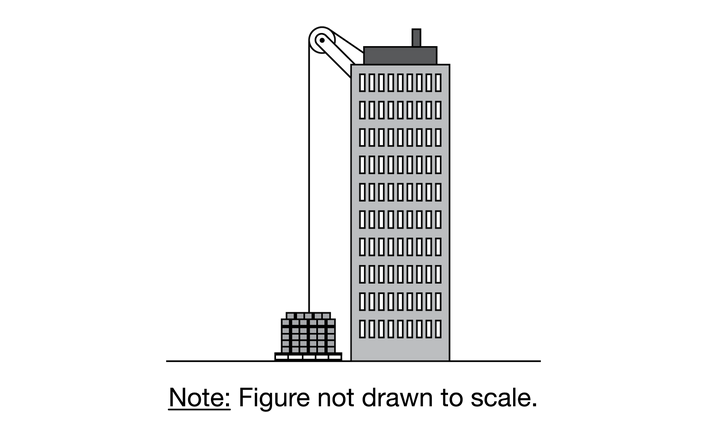
A pile of bricks of mass \(M\) is being raised to the tenth floor of a building of height \(H=4y\) above the ground by a crane that is on top of the building.
During the first part of the lift, the crane lifts the bricks a vertical distance \(h_1=3y\) in a time \(t_1=4T\). During the second part of the lift, the crane lifts the bricks a vertical distance \(h_2=y\) in a time \(t_2=T\).
Which of the following correctly relates the power \(P_1\) generated by the crane during the first part of the lift to the power \(P_2\) generated by the crane during the second part of the lift?
(B) \(P_2=\dfrac{4}{3}P_1\)
(C) \(P_2=P_1\)
(D) \(P_2=\dfrac{3}{4}P_1\)
(E) \(P_2=\dfrac{1}{3}P_1\)
▶️ Answer/Explanation
Correct Answer: \( \boxed{\mathrm{B}} \)
Power is the rate at which work is done:
\(P=\dfrac{W}{t}=\dfrac{mgh}{t}\)
During the first part of the lift,
\(P_1=\dfrac{Mg(3y)}{4T}=\dfrac{3Mgy}{4T}\)
During the second part of the lift,
\(P_2=\dfrac{Mg(y)}{T}=\dfrac{Mgy}{T}\)
Taking the ratio,
\(\dfrac{P_2}{P_1}=\dfrac{\dfrac{Mgy}{T}}{\dfrac{3Mgy}{4T}}=\dfrac{4}{3}\)
Therefore,
\(P_2=\dfrac{4}{3}P_1\)
Thus, the crane generates greater power during the second part of the lift because the same weight is lifted through a shorter distance in proportionally less time.
Therefore, the correct answer is (B).