
AP Physics C Mechanics - 2.9 Resistive Forces- Exam Style questions- MCQs
Resistive Forces AP Physics C Mechanics MCQ
Unit 2: Force and Translational Dynamics
Weightage : 20-15%
Question
A student is testing the kinematic equations for uniformly accelerated motion by measuring the time it takes for lightweight plastic balls to fall to the floor from a height of \(3~\mathrm{m}\) in the lab. The student predicts the time to fall using \(g=9.80~\mathrm{m/s^2}\) but finds the measured time to be \(35\%\) greater.
Which of the following is the most likely cause of the large percent error?
(B) The acceleration due to gravity is \(70\%\) less than \(9.80~\mathrm{m/s^2}\) at this location.
(C) Air resistance increases the downward acceleration.
(D) The acceleration of the plastic balls is not uniform.
(E) The plastic balls are not truly spherical.
▶️ Answer/Explanation
Correct Answer: \( \boxed{\mathrm{D}} \)
The kinematic equations,
\(y=v_0t+\dfrac{1}{2}at^2,\)
are valid only when the acceleration is constant.
Lightweight plastic balls experience significant air resistance as they fall. The upward drag force increases with speed, reducing the net downward acceleration throughout the motion. As a result, the acceleration is not constant, causing the measured fall time to be greater than the value predicted using constant acceleration \(g\).
Choices (A) and (B) are unrealistic because the value of \(g\) varies only slightly over Earth’s surface. Choice (C) is incorrect because air resistance decreases the downward acceleration rather than increasing it. Choice (E) has little effect compared with the influence of air resistance.
Therefore, the most likely cause of the large percent error is that the acceleration of the plastic balls is not uniform, making Option (D) correct.
Question
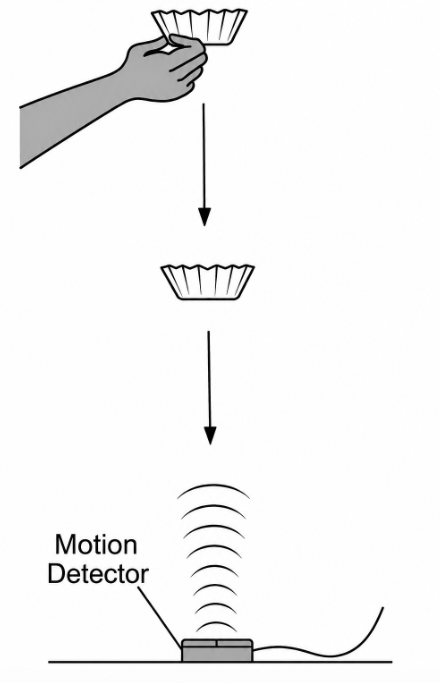
The drag force on a falling coffee filter can be modeled as a linear function of velocity,
\(\vec{F}_D=-bv\),
where \(b\) is a positive constant related to the surface area and shape of the coffee filter. A teacher demonstrates how the value of the constant \(b\) can be determined by releasing coffee filters from rest and allowing them to fall toward a motion detector, as shown. Students repeat the activity and use the motion detector to measure the position, velocity, and acceleration of different coffee filters as they fall.
Which of the following would provide the data needed to determine the value of \(b\)?
(B) Vary the diameter of the coffee filter and measure the final velocity of the coffee filter.
(C) Vary the starting height of the coffee filter and measure the final velocity of the coffee filter.
(D) Stack multiple coffee filters to vary the weight of the system without changing the surface area and measure the acceleration of the coffee filters.
(E) Stack multiple coffee filters to vary the weight of the system without changing the surface area and measure the terminal velocity of the coffee filters.
▶️ Answer/Explanation
Correct Answer: \( \boxed{\mathrm{E}} \)
At terminal velocity, the acceleration of the coffee filters is zero, so the net force is zero.
Applying Newton’s second law,
\(\sum F=mg-bv_T=0\)
Rearranging gives
\(mg=bv_T\)
Therefore,
\(v_T=\dfrac{g}{b}m\)
By stacking multiple coffee filters, the mass changes while the surface area and shape remain approximately constant, so the drag coefficient \(b\) remains unchanged.
Measuring the terminal velocity for different masses allows a graph of \(v_T\) versus \(m\) to be plotted. The slope is \(\dfrac{g}{b}\), so the drag constant can be determined from
\(b=\dfrac{g}{\text{slope}}\)
Therefore, the correct answer is (E).
Question
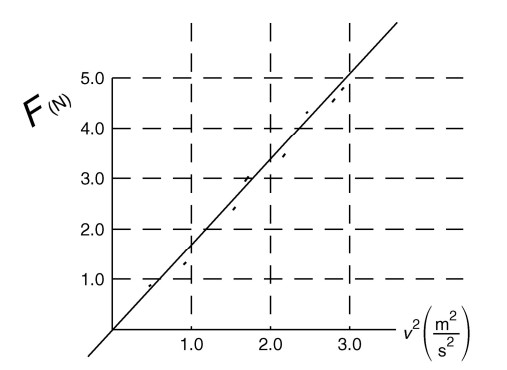
The force of air resistance \(F\) on a mass is found to obey the equation \(F=bv^{2}\), where \(v\) is the speed of the mass, for the range of speeds investigated in an experiment. A graph of \(F\) versus \(v^{2}\) is shown above.
What is the value of \(b\)?
(B) \(1.7\,\mathrm{kg/m}\)
(C) \(3.0\,\mathrm{kg/m}\)
(D) \(5.0\,\mathrm{kg/m}\)
(E) \(1.0\,\mathrm{kg/m}\)
▶️ Answer/Explanation
Correct Answer: \( \boxed{\mathrm{B}} \)
The given equation
\(F=bv^{2}\)
has the same form as the equation of a straight line,
\(y=mx\)
where \(F\) is plotted on the vertical axis and \(v^{2}\) is plotted on the horizontal axis. Therefore, the constant \(b\) is equal to the slope of the graph.
From the graph, the line passes through approximately \((3.0\,\mathrm{m^{2}/s^{2}},\,5.0\,\mathrm{N})\).
Hence,
\(b=\dfrac{\Delta F}{\Delta(v^{2})}=\dfrac{5.0\,\mathrm{N}}{3.0\,\mathrm{m^{2}/s^{2}}}=1.67\,\mathrm{kg/m}\)
Rounding to two significant figures,
\(b\approx1.7\,\mathrm{kg/m}\)
Therefore, the correct answer is (B).