
AP Physics C Mechanics - 6.5 Rolling- Exam Style questions- MCQs
Rolling AP Physics C Mechanics MCQ
Unit 6: Energy and Momentum of Rotating Systems
Weightage : 10-15%
Question
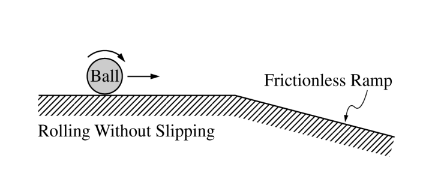
A ball, rolling without slipping on a horizontal surface, encounters a frictionless, downward-sloping ramp, as shown above. Which of the following correctly describes the motion of the ball on the ramp?
(B) Increasing translational speed with no angular speed
(C) Increasing translational speed with constant nonzero angular speed
(D) Increasing translational speed with decreasing angular speed
(E) Increasing translational speed with increasing angular speed
▶️ Answer/Explanation
Correct Answer: \(\boxed{\mathrm{C}}\)
While the ball rolls on the horizontal surface, it satisfies the rolling condition
\(v=\omega R\)
Once the ball reaches the frictionless ramp, there is no frictional force to exert a torque about its center of mass.
Therefore,
\(\sum\tau=0 \quad \Rightarrow \quad \alpha=0\)
so the angular speed remains constant:
\(\omega=\text{constant}\)
However, gravity has a component along the incline,
\(F_{\parallel}=mg\sin\theta\)
which accelerates the center of mass down the ramp. Thus, the translational speed increases.
Since there is no friction, the rolling condition \(v=\omega R\) no longer needs to hold. The ball simply translates faster while continuing to rotate at the same angular speed.
Therefore, the ball has increasing translational speed with constant nonzero angular speed.
Therefore, the correct answer is (C).
Question
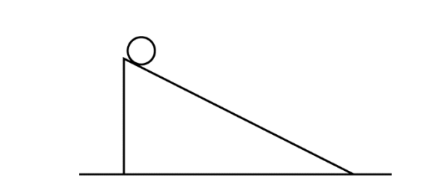
A sphere starts from rest at the top of a ramp, as shown above. It rolls without slipping down the ramp. The potential energy of the sphere-Earth system is zero at the bottom of the ramp. Which of the following is true of the sphere when it reaches the bottom of the ramp?
(B) Its translational kinetic energy equals the initial potential energy of the sphere-Earth system.
(C) Its translational kinetic energy and rotational kinetic energy are equal.
(D) The sum of its translational kinetic energy and rotational kinetic energy equals the initial potential energy of the sphere-Earth system.
(E) The sum of its translational kinetic energy and rotational kinetic energy equals the energy lost because of friction.
▶️ Answer/Explanation
Correct Answer: \(\boxed{\mathrm{D}}\)
As the sphere rolls without slipping, the force of static friction does no work. Therefore, the total mechanical energy of the sphere-Earth system is conserved.
Initially, the sphere is at rest, so its energy is entirely gravitational potential energy:
\(E_i=U_i=mgh\)
At the bottom of the ramp, the potential energy is zero, and all of the initial potential energy has been converted into kinetic energy:
\(E_f=K_{\mathrm{trans}}+K_{\mathrm{rot}}\)
where
\(K_{\mathrm{trans}}=\frac{1}{2}mv^2\)
and
\(K_{\mathrm{rot}}=\frac{1}{2}I\omega^2\)
By conservation of mechanical energy,
\(mgh=\frac{1}{2}mv^2+\frac{1}{2}I\omega^2\)
Thus, the sum of the translational and rotational kinetic energies equals the sphere’s initial gravitational potential energy.
Since static friction does not dissipate energy, no mechanical energy is lost due to friction.
Therefore, the correct answer is (D).
Question
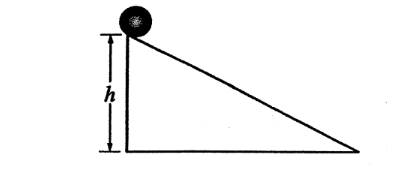
A sphere of mass \(M\), radius \(r\), and rotational inertia \(I\) is released from rest at the top of an inclined plane of height \(h\), as shown above.
If the plane has friction so that the sphere rolls without slipping, what is the speed \(v_{cm}\) of the center of mass at the bottom of the incline?
(B) \( \frac{2Mgh}{I} \)
(C) \( \frac{2Mghr^2}{I} \)
(D) \( \sqrt{\frac{2Mghr^2}{I}} \)
(E) \( \sqrt{\frac{2Mghr^2}{I+Mr^2}} \)
▶️ Answer/Explanation
Correct Answer: \( \boxed{\mathrm{E}} \)
Because the sphere rolls without slipping, gravitational potential energy is converted into both translational and rotational kinetic energy.
Conservation of mechanical energy gives
\( Mgh=\frac{1}{2}Mv_{cm}^{2}+\frac{1}{2}I\omega^{2} \)
Since rolling without slipping requires
\( v_{cm}=r\omega \), or equivalently, \( \omega=\frac{v_{cm}}{r} \).
Substituting into the energy equation,
\( Mgh=\frac{1}{2}Mv_{cm}^{2}+\frac{1}{2}I\left(\frac{v_{cm}}{r}\right)^{2} \)
Rearranging,
\( 2Mgh=v_{cm}^{2}\left(M+\frac{I}{r^{2}}\right) \)
Therefore,
\( v_{cm}=\sqrt{\frac{2Mghr^{2}}{I+Mr^{2}}} \)
Thus, the correct answer is (E). The rotational inertia reduces the translational speed because some of the gravitational potential energy is converted into rotational kinetic energy.