
AP Physics C Mechanics - 6.1 Rotational Kinetic Energy- Exam Style questions- MCQs
Rotational Kinetic Energy AP Physics C Mechanics MCQ
Unit 6: Energy and Momentum of Rotating Systems
Weightage : 10-15%
Question
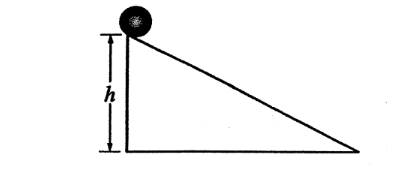
A sphere of mass \(M\), radius \(r\), and rotational inertia \(I\) is released from rest at the top of an inclined plane of height \(h\), as shown above.
If the plane is frictionless, what is the speed \(v\) of the center of mass of the sphere at the bottom of the incline?
(B) \( \frac{2Mgh}{I} \)
(C) \( \frac{2Mghr^2}{I} \)
(D) \( \sqrt{\frac{2Mghr^2}{I}} \)
(E) \( \sqrt{\frac{2Mghr^2}{I+Mr^2}} \)
▶️ Answer/Explanation
Correct Answer: \( \boxed{\mathrm{A}} \)
Since the incline is frictionless, no frictional force acts on the sphere. Therefore, no torque is produced about its center of mass, and the sphere does not rotate. Its gravitational potential energy is converted entirely into translational kinetic energy.
Applying conservation of mechanical energy,
\( Mgh=\frac{1}{2}Mv^2 \)
Solving for the speed,
\( v=\sqrt{2gh} \)
The rotational inertia \(I\) and radius \(r\) do not affect the motion because the sphere does not roll without friction.
Therefore, the correct answer is (A).
Question
A cylinder rotates with constant angular acceleration about a fixed axis. The cylinder’s moment of inertia about the axis is \(4\,\mathrm{kg\cdot m^2}\). At time \(t=0\), the cylinder is at rest. At time \(t=2\,\mathrm{s}\), its angular velocity is \(1\,\mathrm{rad\,s^{-1}}\).
What is the kinetic energy of the cylinder at time \(t=2\,\mathrm{s}\)?
(B) \(2\,\mathrm{J}\)
(C) \(3\,\mathrm{J}\)
(D) \(4\,\mathrm{J}\)
(E) Cannot be determined without knowing the radius of the cylinder
▶️ Answer/Explanation
Correct Answer: \(\boxed{\mathrm{B}}\)
The rotational kinetic energy of a rotating object is
\(K_{\mathrm{rot}}=\frac{1}{2}I\omega^2\)
Given,
\(I=4\,\mathrm{kg\cdot m^2}\)
\(\omega=1\,\mathrm{rad\,s^{-1}}\)
Therefore,
\(K_{\mathrm{rot}}=\frac{1}{2}(4)(1)^2=2\,\mathrm{J}\)
The radius of the cylinder is not required because the moment of inertia is already given.
Therefore, the kinetic energy of the cylinder at \(t=2\,\mathrm{s}\) is
\(\boxed{2\,\mathrm{J}}\)
Therefore, the correct answer is (B).