
AP Physics C Mechanics - 2.8 Spring Forces- Exam Style questions- FRQs
Spring Forces AP Physics C Mechanics FRQ
Unit 2: Force and Translational Dynamics
Weightage : 20-15%
Question
Most-appropriate topic codes (AP Physics C: Mechanics):
• Topic 7.2 — Frequency and Period of SHM (Parts a, b, c, d)
• Topic 7.4 — Energy of Simple Harmonic Oscillators (Part d)
▶️ Answer/Explanation
(a)
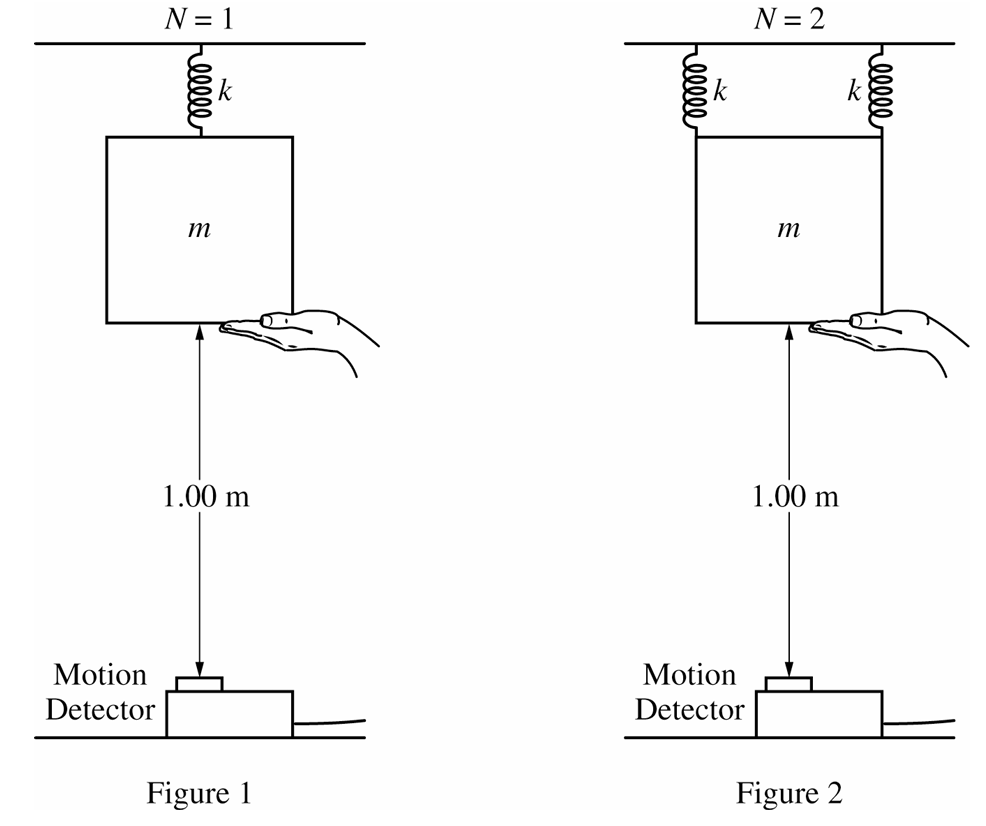
When identical springs are arranged in parallel, the equivalent spring constant is simply the sum of the individual constants.
\( k_{\text{eq}} = \sum_{i=1}^{N} k_i \)
\( k_{\text{eq}} = Nk \)
The period of a mass on a spring is derived from the standard equation:
\( T = 2\pi\sqrt{\dfrac{m}{k_{\text{eq}}}} \)
Substituting the equivalent spring constant gives the final expression:
\( \boxed{T = 2\pi\sqrt{\dfrac{m}{Nk}}} \)
(b)
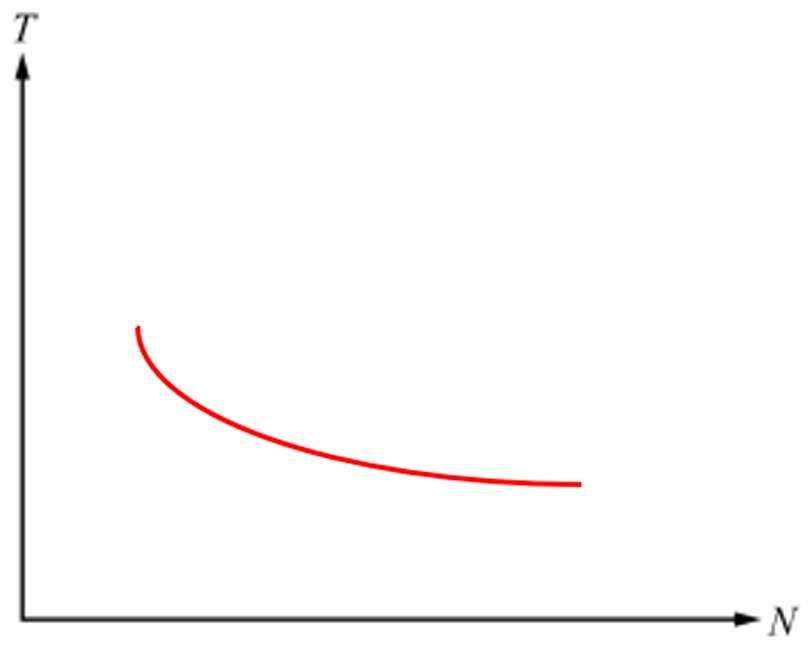
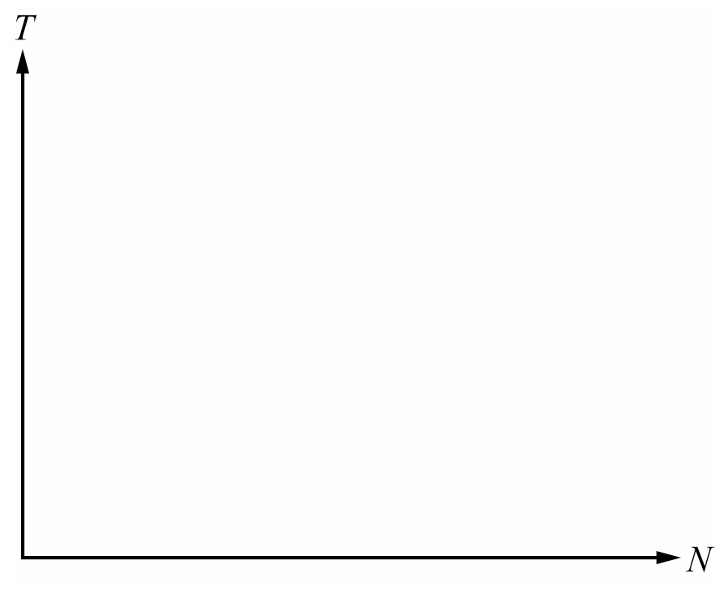
Using the formula \( T = \dfrac{2\pi\sqrt{m/k}}{\sqrt{N}} \), we see that the period \( T \) is proportional to \( N^{-1/2} \).
Therefore, the graph should be a decreasing curve that is concave up.
(c)(i)
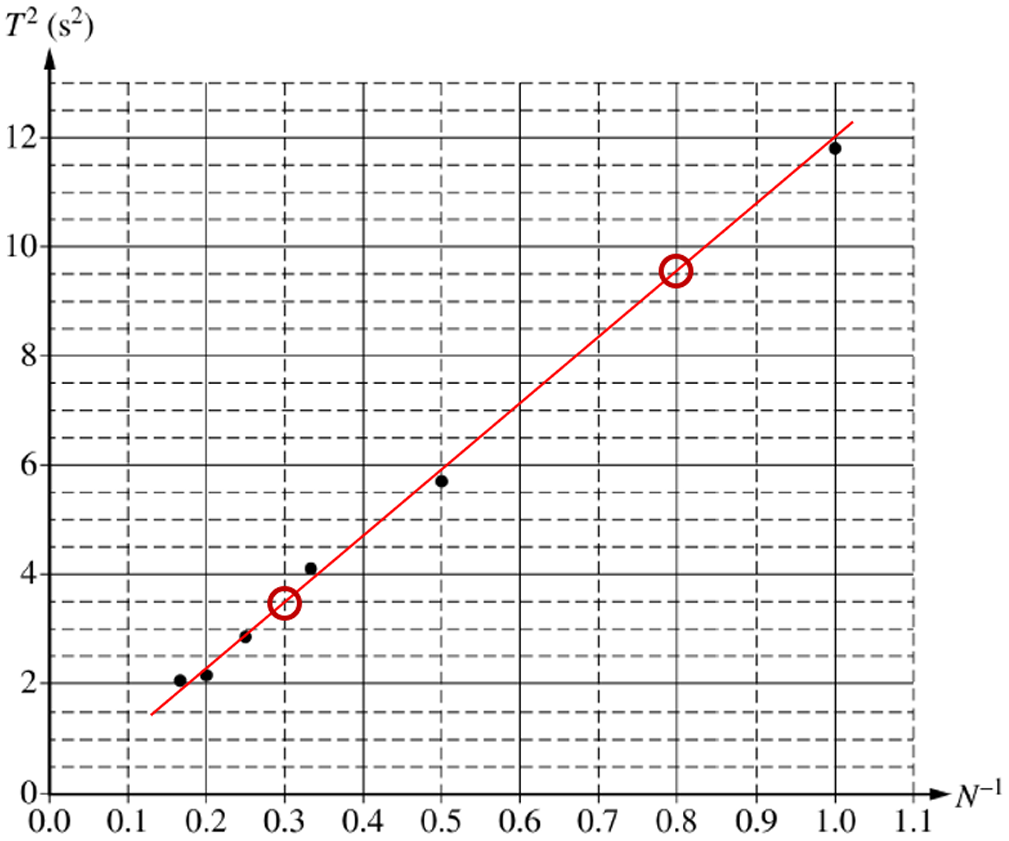
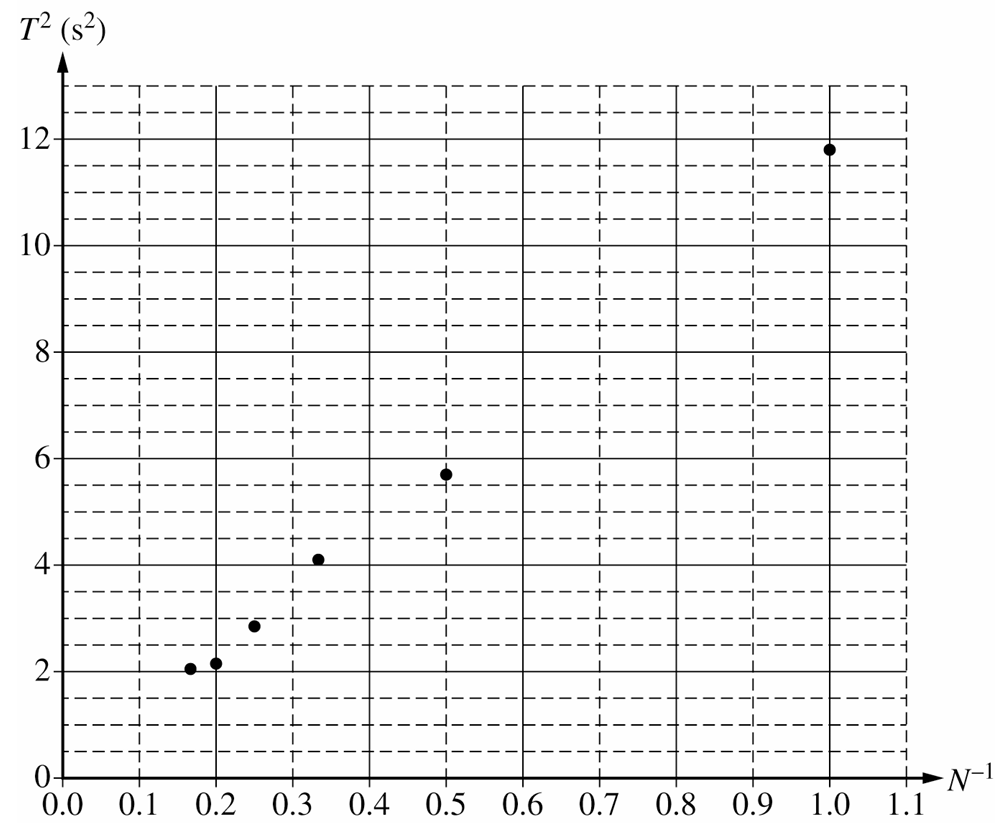
Draw an appropriate straight line of best fit that closely matches the trend of the plotted data, balancing the points above and below the line.
(c)(ii)
Select two points directly from your line of best fit to determine the slope.
\( \text{slope} = \dfrac{\Delta(T^2)}{\Delta(N^{-1})} \)
Using typical data points (e.g., \( (0.3, 3.5) \) and \( (0.8, 9.5) \)):
\( \text{slope} = \dfrac{9.5\,\text{s}^2 – 3.5\,\text{s}^2}{0.8 – 0.3} = 12\,\text{s}^2 \)
By squaring the expression from part (a), we get \( T^2 = 4\pi^2\dfrac{m}{k} (N^{-1}) \), which means the slope is equal to \( 4\pi^2\dfrac{m}{k} \).
\( k = \dfrac{4\pi^2m}{\text{slope}} \)
\( k = \dfrac{4\pi^2(1.5\,\text{kg})}{12\,\text{s}^2} \)
\( \boxed{k \approx 4.93\,\text{N/m}} \)
(c)(iii)
A possible source of error is that the true mass of the oscillating system was larger than \( 1.5\,\text{kg} \) because the mass of the springs wasn’t accounted for.
A larger mass will yield a larger measured period \( T \) for the oscillation. Since the calculated \( k \) is inversely proportional to the slope (which depends on \( T^2 \)), a larger period leads to a smaller calculated experimental value for \( k \).
(d)(i)
Correct choice: the same as
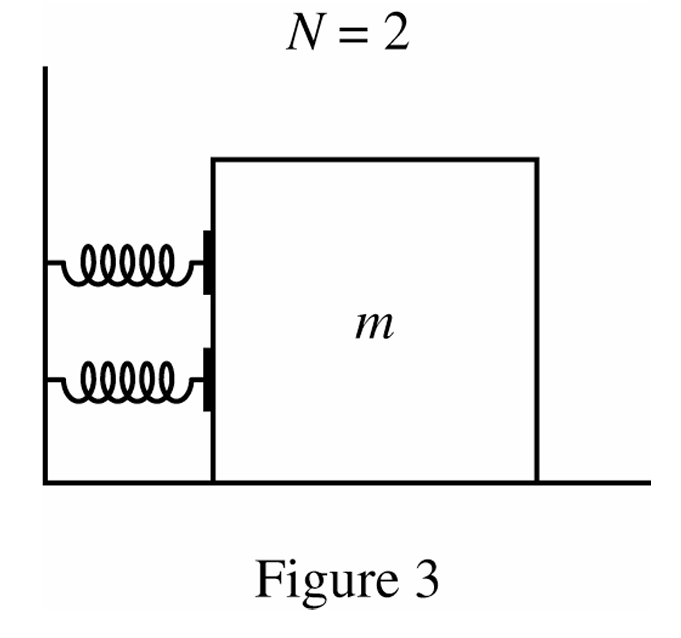
The period of a horizontal or vertical spring-block system depends exclusively on the mass of the block and the spring constant.
Because the period is completely independent of the gravitational force, altering the orientation of the setup does not affect the period, keeping the slope unchanged.
(d)(ii)
Correct choice: increase
Adding more springs increases the effective spring constant \( k_{\text{eq}} \).
For the same displacement \( x \), the elastic potential energy stored in the system \( U_s = \dfrac{1}{2}k_{\text{eq}}x^2 \) will be greater.
Through the conservation of mechanical energy, this extra potential energy converts entirely into kinetic energy at the equilibrium position, resulting in a higher maximum speed \( v_{\text{max}} \).