Home / AP® Exam / AP® PreCalculus / AP® Precalculus

AP Precalculus -1.1 Change in Tandem- FRQ Exam Style Questions - Effective Fall 2023

AP Precalculus -1.1 Change in Tandem- FRQ Exam Style Questions – Effective Fall 2023

AP Precalculus -1.1 Change in Tandem- FRQ Exam Style Questions – AP Precalculus- per latest AP Precalculus Syllabus.

AP Precalculus – FRQ Exam Style Questions- All Topics

Question

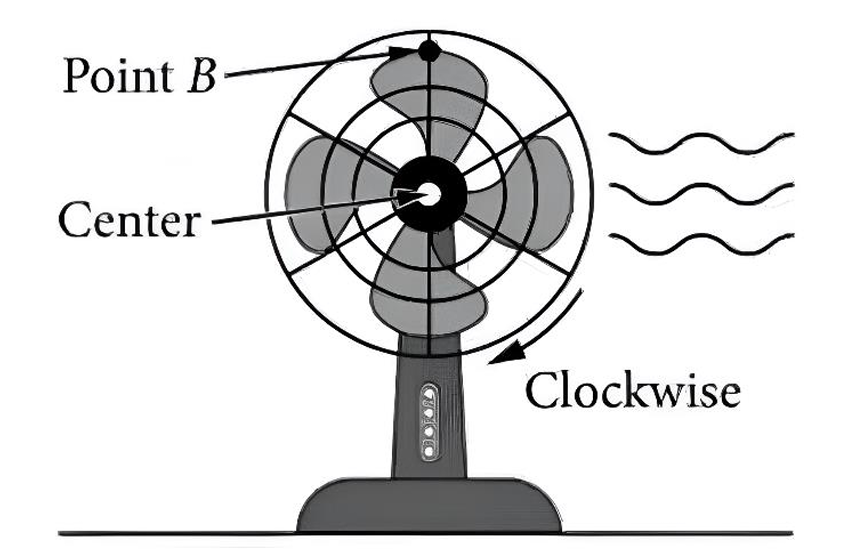
The blades of an electric fan rotate in a clockwise direction and complete $5$ rotations every second. Point $B$ is on the tip of one of the fan blades and is located directly above the center of the fan at time $t = 0$ seconds. Point $B$ is $6$ inches from the center of the fan. The center of the fan is $20$ inches above a level table. The sinusoidal function $h$ models the distance between $B$ and the surface of the table in inches as a function of time $t$ in seconds.
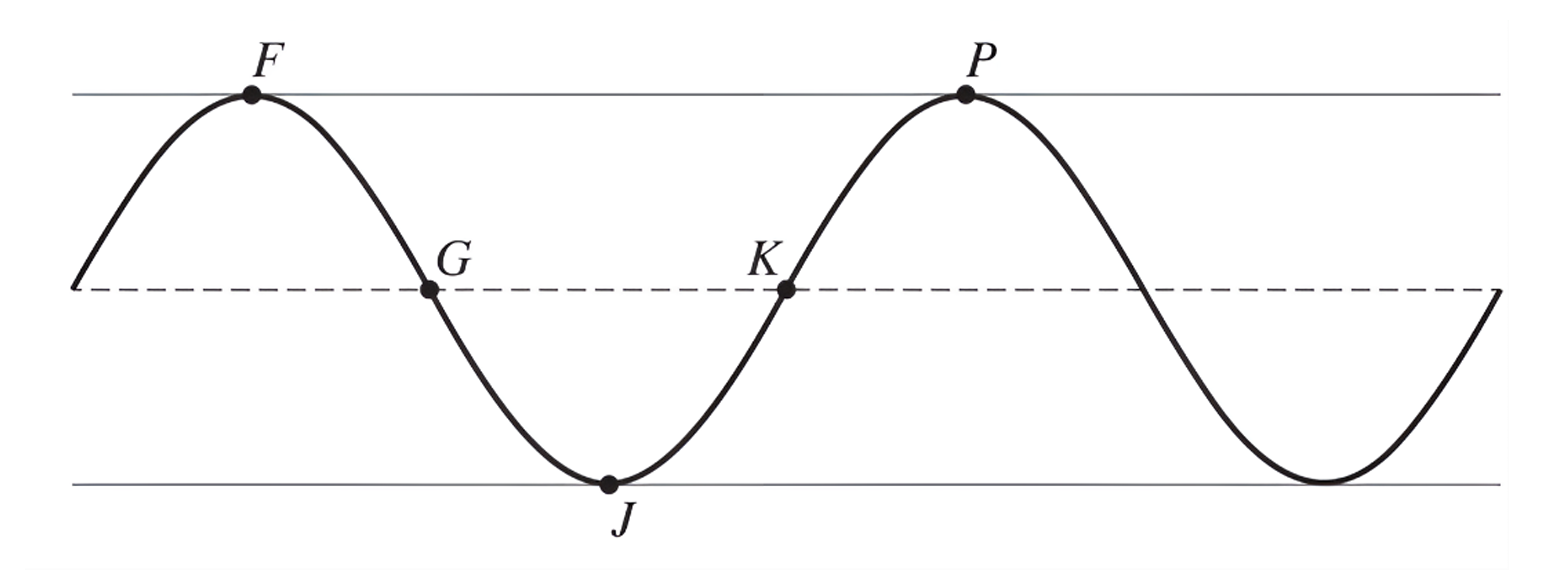
(A) The graph of ℎ and its dashed midline for two full cycles is shown. Five points, 𝐹, 𝐺, 𝐽, 𝐾, and 𝑃 are labeled on the graph. No scale is indicated, and no axes are presented.
Determine the possible coordinates $(t, h(t))$ for the $5$ points: $F, G, J, K,$ and $P$.
(B) The function $h$ can be written in the form $h(t) = a \sin(b(t + c)) + d$. Find values of constants $a, b, c,$ and $d$.
(C) Refer to the graph of $h$ in part (A). The $t$-coordinate of $K$ is $t_1$, and the $t$-coordinate of $P$ is $t_2$.
(i) On the interval $(t_1, t_2)$, which of the following is true about $h$?
      (A) $h$ is positive and increasing
     (B) $h$ is positive and decreasing
     (C) $h$ is negative and increasing
     (D) $h$ is negative and decreasing
(ii) Describe how the rate of change of $h$ is changing on the interval $(t_1, t_2)$.

Most-appropriate topic codes (AP Precalculus CED):

3.7: Sinusoidal Function Context and Data Modeling – part A, part B
1.1: Change in Tandem – part C(i)
1.3: Rates of Change in Linear and Quadratic Functions – part C(ii)
▶️ Answer/Explanation
Detailed solution

(A)

The center of the fan is $d = 20$ inches above the table. The radius of the fan blade is $r = 6$ inches, which is the amplitude $a$. The maximum height is $20 + 6 = 26$ inches and the minimum height is $20 – 6 = 14$ inches. The fan completes $5$ rotations per second, so the period is $T = \frac{1}{5} = 0.2$ seconds. Point $B$ starts at the maximum height at $t = 0$, so point $F$ is $(0, 26)$. Point $G$ is at the midline after $\frac{1}{4}$ of a period: $(\frac{0.2}{4}, 20) = (0.05, 20)$. Point $J$ is at the minimum after $\frac{1}{2}$ of a period: $(\frac{0.2}{2}, 14) = (0.1, 14)$. Point $K$ is at the midline after $\frac{3}{4}$ of a period: $(\frac{3 \times 0.2}{4}, 20) = (0.15, 20)$. Point $P$ is at the maximum after $1$ full period: $(0.2, 26)$. The coordinates are: $F(0, 26)$, $G(0.05, 20)$, $J(0.1, 14)$, $K(0.15, 20)$, and $P(0.2, 26)$.

(B)

The amplitude is $a = 6$. The vertical shift (midline) is $d = 20$. The period is $T = 0.2$, so the frequency constant is $b = \frac{2\pi}{0.2} = 10\pi$. Since the function starts at a maximum at $t=0$, it follows $h(t) = 6 \cos(10\pi t) + 20$. To write this as a sine function $h(t) = 6 \sin(10\pi(t + c)) + 20$, we use the identity $\cos(\theta) = \sin(\theta + \frac{\pi}{2})$. Setting $10\pi(t + c) = 10\pi t + \frac{\pi}{2}$, we find $10\pi c = \frac{\pi}{2}$, which gives $c = \frac{1}{20} = 0.05$. Thus, $a = 6$, $b = 10\pi$, $c = 0.05$, and $d = 20$.

(C)

(i) On the interval $(t_1, t_2)$, which is $(0.15, 0.2)$, the graph moves from the midline (point $K$) up to the maximum (point $P$). Throughout this interval, $h(t)$ is between $20$ and $26$, so it is positive. The function is moving upwards, so it is increasing. The correct option is (A) $h$ is positive and increasing.
(ii) On the interval $(t_1, t_2)$, the graph is concave down as it levels off toward the maximum. The slope (rate of change) is positive because the function is increasing. However, the slope is becoming less steep as it approaches the horizontal tangent at point $P$. Therefore, the rate of change of $h$ is decreasing on the interval $(t_1, t_2)$.

Question 

Describe the transformations applied to the graph of the function \(y = f(2x + 1)\) to obtain the graph of the function \(y = f(3x + 2)\). Describe two ways to obtaining the function \(y = f(2x + 1)\) from the original function \(y = f(x)\). Explain your reasoning.
▶️ Answer/Explanation
Detailed solution
Part 1: Transformation from \(y = f(2x + 1)\) to \(y = f(3x + 2)\)
To transform the graph, apply a horizontal translation left by \(\frac{1}{2}\) unit followed by a horizontal compression by a factor of \(\frac{2}{3}\).
Reasoning: Shifting left by \(\frac{1}{2}\) changes \(x \to x + \frac{1}{2}\), giving \(f(2(x+0.5)+1) = f(2x+2)\). Compressing by \(\frac{2}{3}\) changes \(x \to \frac{3}{2}x\), resulting in \(f(2(\frac{3}{2}x)+2) = f(3x+2)\).
Part 2: Two ways to obtain \(y = f(2x + 1)\) from \(y = f(x)\)
Way 1 (Shift then Scale):
First, apply a horizontal translation left by 1 unit to get \(y = f(x+1)\). Then, apply a horizontal compression by a factor of \(\frac{1}{2}\). This replaces \(x\) with \(2x\), resulting in \(y = f(2x+1)\).
Way 2 (Scale then Shift):
First, apply a horizontal compression by a factor of \(\frac{1}{2}\) to get \(y = f(2x)\). Then, apply a horizontal translation left by \(\frac{1}{2}\) unit. This replaces \(x\) with \(x+\frac{1}{2}\), resulting in \(y = f(2(x+0.5)) = f(2x+1)\).
Scroll to Top