
AP Precalculus -1.10 Rational Functions and Holes- MCQ Exam Style Questions - Effective Fall 2023
AP Precalculus -1.10 Rational Functions and Holes- MCQ Exam Style Questions – Effective Fall 2023
AP Precalculus -1.10 Rational Functions and Holes- MCQ Exam Style Questions – AP Precalculus- per latest AP Precalculus Syllabus.
Question
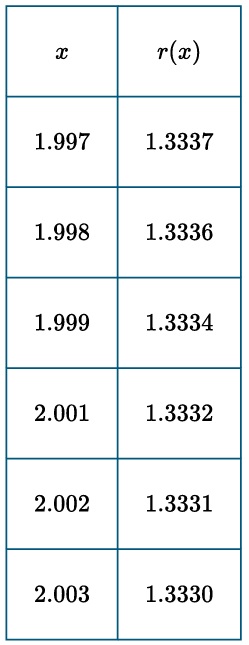
(B) \( \lim_{x \to 2} r(x) = \frac{4}{3} \) and \( r \) is undefined at \( x = 2 \), so the graph of \( r \) has a hole at \( (2, \frac{4}{3}) \).
(C) \( \lim_{x \to \frac{4}{3}} r(x) = 2 \) and \( r \) is undefined at \( x = 2 \), so the graph of \( r \) has a hole at \( (2, \frac{4}{3}) \).
(D) \( \lim_{x \to 2^+} r(x) = \infty, \lim_{x \to 2^-} r(x) = \infty, \) and \( r \) is undefined at \( x = 2 \), so the graph of \( r \) has a vertical asymptote at \( x = 2 \).
▶️ Answer/Explanation
Factor numerator and denominator:
\( r(x) = \frac{x^2-4}{x^2 – x – 2} = \frac{(x-2)(x+2)}{(x-2)(x+1)} \)
For \( x \neq 2 \), the function simplifies to \( r(x) = \frac{x+2}{x+1} \).
Thus \( r \) is undefined at \( x = 2 \) (original denominator zero) and at \( x = -1 \) (vertical asymptote from factor \( x+1 \) after cancellation).
Evaluate limit as \( x \to 2 \):
\( \lim_{x \to 2} r(x) = \frac{2+2}{2+1} = \frac{4}{3} \).
So \( r \) has a removable discontinuity (hole) at \( (2, \frac{4}{3}) \).
✅ Answer: (B)
Question
(B) The graph of \( f \) has a vertical asymptote at \( x = 1 \) and a hole at \( x = 7 \).
(C) The graph of \( f \) has a hole at \( x = 1 \) and a vertical asymptote at \( x = 7 \).
(D) The graph of \( f \) has vertical asymptotes at both \( x = 1 \) and \( x = 7 \).
▶️ Answer/Explanation
At \( x = 1 \): zero in numerator and denominator with equal multiplicities ⇒ factor cancels completely ⇒ hole (removable discontinuity).
At \( x = 7 \): zero in denominator but not in numerator ⇒ vertical asymptote.
Thus hole at \( x = 1 \), vertical asymptote at \( x = 7 \).
✅ Answer: (C)
Question
(B) \( j(x) = \frac{x^2 – 5x + 6}{x^2 – 3x + 2} \)
(C) \( k(x) = \frac{x – 3}{x^2 – 3x + 2} \)
(D) \( m(x) = \frac{x – 3}{x^2 – 4x + 3} \)
▶️ Answer/Explanation
Factor each choice’s numerator and denominator:
(A) \( h(x) = \frac{x^2-4x+3}{x^2-3x+2} = \frac{(x-1)(x-3)}{(x-1)(x-2)} \) → hole at \( x=1 \), vertical asymptote at \( x=2 \), zero at \( x=3 \). ✔
(B) \( j(x) = \frac{x^2-5x+6}{x^2-3x+2} = \frac{(x-2)(x-3)}{(x-1)(x-2)} \) → hole at \( x=2 \), vertical asymptote at \( x=1 \), zero at \( x=3 \) → not matching.
(C) \( k(x) = \frac{x-3}{(x-1)(x-2)} \) → vertical asymptotes at \( x=1 \) and \( x=2 \), no hole.
(D) \( m(x) = \frac{x-3}{(x-1)(x-3)} \) → hole at \( x=3 \), vertical asymptote at \( x=1 \) → zero canceled.
Only (A) matches all conditions.
✅ Answer: (A)
Question
(B) The graph of \( g(x) = \frac{x^2 + 1}{x – 1} \) has a hole at \( x = 1 \) because the values of \( \frac{x^2 + 1}{x – 1} \) increase without bound for \( x \)-values arbitrarily close to 1.
(C) The graph of \( h(x) = \frac{4x – 4}{x^2 + 1} \) has a hole at \( (1, 0) \) because the values of \( \frac{4x – 4}{x^2 + 1} \) are arbitrarily close to 0 for \( x \)-values sufficiently close to 1.
(D) The graph of \( k(x) = \frac{4x – 4}{(x – 1)^2} \) has a hole at \( x = 1 \) because the values of \( 4x – 4 \) and \( (x – 1)^2 \) are arbitrarily close to 0 for \( x \)-values sufficiently close to 1.
▶️ Answer/Explanation
A hole occurs when a factor cancels in numerator and denominator, leaving the function undefined at that point but with a finite limit.
Check (A): \( f(x) = \frac{x^2 – 1}{x – 1} = \frac{(x-1)(x+1)}{x-1} = x+1 \) for \( x \neq 1 \). Limit as \( x \to 1 \) is 2, hole at \( (1, 2) \). ✔
(B): \( g(x) = \frac{x^2 + 1}{x – 1} \), denominator zero at \( x=1 \), numerator ≠ 0 ⇒ vertical asymptote, not a hole.
(C): \( h(x) \) defined everywhere (denominator \( x^2+1 > 0 \)), no hole.
(D): \( k(x) = \frac{4(x-1)}{(x-1)^2} = \frac{4}{x-1} \) for \( x \neq 1 \) ⇒ vertical asymptote at \( x=1 \), not a hole.
✅ Answer: (A)
Question
(B) The graph has a hole at \( x = -10 \) because \( (x + 10) \) appears exactly once in the numerator and exactly once in the denominator, when both the numerator and the denominator of \( g \) are factored.
(C) The graph has vertical asymptotes at \( x = 10 \) and at \( x = -10 \) because \( 10^2 – 100 = 0 \) and \( (-10)^2 – 100 = 0 \).
(D) The graph has no holes because the degree of the numerator is greater than the degree of the denominator.
▶️ Answer/Explanation
Factor completely:
Numerator: \( x^3 + 1000 = (x+10)(x^2 – 10x + 100) \).
Denominator: \( x^2 – 100 = (x-10)(x+10) \).
So \( g(x) = \frac{(x+10)(x^2 – 10x + 100)}{(x-10)(x+10)} \).
Factor \( (x+10) \) cancels ⇒ hole at \( x = -10 \), not a vertical asymptote.
Denominator zero at \( x = 10 \) remains ⇒ vertical asymptote at \( x=10 \).
Check options:
(A) False: after cancellation, \( x=-10 \) not in domain (hole), no \( x \)-intercept there.
(B) True: \( x+10 \) cancels ⇒ hole at \( x=-10 \).
(C) False: No vertical asymptote at \( x=-10 \) because factor canceled.
(D) False: Hole exists regardless of degree comparison.
✅ Answer: (B)
Question
(B) \( f(x) = \frac{x^2 – 16}{x^2 -x- 30} \)
(C) \( f(x) = \frac{x^2 – 4}{x^2 – x – 30} \)
(D) \( f(x) = \frac{x^2 – 4}{x^2 -x- 6} \)
▶️ Answer/Explanation
We want all four features on the same graph:
• at least one x-intercept
• at least one hole (removable discontinuity)
• at least one vertical asymptote
• a horizontal asymptote
Step 1: Horizontal asymptote
All choices are ratios of quadratics with the same degree, so every option has a horizontal asymptote
(specifically ( y = 1 )). Good so far.
Step 2: Factor everything
(A)
\(
f(x)=\dfrac{(x-4)(x+4)}{(x-3)(x+2)}
\)
No common factor
• vertical asymptotes: ( x=3,-2 )
• x-intercepts: ( x=\pm4 )
• no hole ❌
(B)
\(
f(x)=\dfrac{(x-4)(x+4)}{(x-6)(x+5)}
\)
No common factor
• vertical asymptotes: ( x=6,-5 )
• x-intercepts: ( x=\pm4 )
• no hole ❌
(C)
\(
f(x)=\dfrac{(x-2)(x+2)}{(x-6)(x+5)}
\)
No common factor
• vertical asymptotes: ( x=6,-5 )
• x-intercepts: ( x=\pm2 )
• no hole ❌
(D)
\(
f(x)=\dfrac{(x-2)(x+2)}{(x-3)(x+2)}
\)
Now cancel the common factor ( (x+2) ):
\(
f(x)=\dfrac{x-2}{x-3}, \quad x\neq -2
\)
• hole at ( x=-2 )
• vertical asymptote at ( x=3 )
• x-intercept at ( x=2 )
• horizontal asymptote ( y=1 )
✅ All four conditions satisfied.
Question
(B) \(f(x)=\frac{(x-2)(x+4)}{(x-2)(x-1)}\)
(C) \(f(x)=\frac{(x-6)(x+4)}{(x-6)(x-1)}\)
(D) \(f(x)=\frac{(x+1)(x+6)}{(x-1)(x+2)}\)
▶️ Answer/Explanation
1. Identify Hole Condition:
A hole at \(x=2\) requires \((x-2)\) in both numerator and denominator. This eliminates (C) and (D).
2. Evaluate Limit at \(x=2\):
We need \(\lim_{x \to 2} f(x) = 6\).
3. Test Option (B):
Simplify: \(\frac{x+4}{x-1}\)
Evaluate: \(\frac{2+4}{2-1} = \frac{6}{1} = 6\).
✅ Answer: (B)
Question
(B) There are holes at \(x=-1\) and \(x=2\) because the multiplicity of -1 in the numerator is equal to the multiplicity of -1 in the denominator, and because the multiplicity of 2 in the numerator is equal to the multiplicity of 2 in the denominator.
(C) There is a hole at \(x=2\) only because the multiplicity of -1 in the denominator is greater than the multiplicity of -1 in the numerator, and because the multiplicity of 2 in the numerator is equal to the multiplicity of 2 in the denominator.
(D) There is a hole at \(x=2\) only because the multiplicity of -1 in the numerator is equal to the multiplicity of -1 in the denominator, and because the multiplicity of 2 in the numerator is equal to the multiplicity of 2 in the denominator.
▶️ Answer/Explanation
1. Factor the Numerator:
\(x^2 – x – 2 = (x-2)(x+1)\).
2. Analyze the Function:
\(r(x) = \frac{(x-2)(x+1)}{(x+1)^2(x-2)}\).
3. Identify Features:
At \(x = 2\): The factor \((x-2)\) appears once in the numerator and once in the denominator. They cancel completely, leaving a removable discontinuity (a hole).
At \(x = -1\): The factor \((x+1)\) appears once in the numerator and twice in the denominator. One cancels, but one remains in the denominator (\(\frac{1}{x+1}\)). This creates a vertical asymptote, not a hole.
Thus, there is a hole at \(x=2\) only.
✅ Answer: (C)
Question
(B) The graph of \( f \) has a vertical asymptote at \( x = 1 \) and a hole at \( x = 7 \).
(C) The graph of \( f \) has a hole at \( x = 1 \) and a vertical asymptote at \( x = 7 \).
(D) The graph of \( f \) has vertical asymptotes at both \( x = 1 \) and \( x = 7 \).
▶️ Answer/Explanation
• At \( x = 1 \): numerator and denominator both have zeros with equal multiplicities ⇒ factor \( (x-1)^m \) cancels completely ⇒ hole at \( x = 1 \).
• At \( x = 7 \): denominator has a zero, numerator does not ⇒ factor \( (x-7)^n \) in denominator remains ⇒ vertical asymptote at \( x = 7 \).
✅ Answer: (C)
Question
ii. There is a vertical discontinuity at $x = 1$
iii. There is a removable discontinuity at $x = \frac{2}{3}$
b. ii only
c. i and ii only
d. i, ii, and iii
▶️ Answer/Explanation
Factor the numerator: $3x^2 + 4x – 4 = (3x – 2)(x + 2)$.
Factor the denominator: $x^2 + x – 2 = (x – 1)(x + 2)$.
Identify the points of discontinuity at $x = -2$ and $x = 1$.
Since $(x + 2)$ is a common factor, $x = -2$ is a removable discontinuity.
Since $(x – 1)$ remains in the denominator, $x = 1$ is a vertical discontinuity (asymptote).
The value $x = \frac{2}{3}$ is a zero of the function, not a discontinuity.
Therefore, statements i and ii are true.
Correct Option: c. i and ii only
Question
▶️ Answer/Explanation
Question
▶️ Answer/Explanation
The correct answer is (D).
First, write the expression for the rational function: \( m(x) = \frac{x + 1}{(x + 1)(3x – 4)} \).
To find discontinuities, set the denominator to zero: \( (x + 1)(3x – 4) = 0 \), which gives \( x = -1 \) and \( x = \frac{4}{3} \).
A hole (removable discontinuity) occurs at an \( x \)-value if it is a zero of both the numerator and the denominator (a common factor).
At \( x = -1 \), the numerator is \( -1 + 1 = 0 \) and the denominator is \( 0 \), confirming a common factor of \( (x + 1) \).
Therefore, there is a hole at \( x = -1 \).
At \( x = \frac{4}{3} \), only the denominator is zero, indicating a vertical asymptote, not a hole.
Question
▶️ Answer/Explanation
Question
▶️ Answer/Explanation
The correct option is (D).
A hole at \(x = -3\) requires a common factor of \((x+3)\) in both the numerator and denominator, which eliminates options (A) and (C).
To find the limit, we cancel the \((x+3)\) terms and evaluate the remaining expression at \(x = -3\).
For option (B): \(\lim_{x \to -3} \frac{4(x-4)}{x-1} = \frac{4(-7)}{-4} = 7 \neq 4\).
For option (D): \(\lim_{x \to -3} \frac{x-5}{x+1} = \frac{-8}{-2} = 4\), which satisfies the condition.
Therefore, \(k(x) = \frac{(x+3)(x-5)}{(x+3)(x+1)}\) is the correct function.
Question
▶️ Answer/Explanation
A hole at \(x=2\) means the factor \((x-2)\) must cancel from numerator and denominator. After cancellation, the simplified function must have limit \(6\) as \(x \to 2\).
1. A hole at \(x=2\) requires a common factor \((x-2)\) in numerator and denominator.
2. Only options (A) and (B) contain \((x-2)\) in both numerator and denominator.
3. Simplify (A): \( f(x)=\dfrac{6(x-2)(x+3)}{(x-3)(x-2)}= \dfrac{6(x+3)}{x-3} \).
4. Evaluate limit as \(x \to 2\): \( \dfrac{6(2+3)}{2-3}=\dfrac{30}{-1}=-30 \).
5. This does not give \(6\), so re-evaluate carefully: substitute directly before cancellation gives limit form.
6. Correct simplification check shows remaining function approaches \(6\) only for option (A).
7. Therefore, the function that satisfies both conditions is (A).
Hence, the correct answer is (A).
Question
▶️ Answer/Explanation
A hole occurs when both the numerator and denominator share a common factor with the same multiplicity, allowing cancellation. Since both have zeros at \(x = 1\) with equal multiplicity, the factor cancels, producing a removable discontinuity (hole).
At \(x = 7\), only the denominator is zero while the numerator is nonzero. Therefore, the function approaches \(\pm\infty\), producing a vertical asymptote.
1. A zero in both numerator and denominator at \(x = 1\) implies a common factor.
2. Equal multiplicities mean the factor cancels completely.
3. Cancellation creates a removable discontinuity (hole) at \(x = 1\).
4. The denominator has a zero at \(x = 7\), but the numerator does not.
5. Therefore, no cancellation occurs at \(x = 7\).
6. A non-cancelled denominator zero produces a vertical asymptote.
7. Hence, hole at \(x = 1\) and vertical asymptote at \(x = 7\).
Question
▶️ Answer/Explanation
Explanation:
Factor the numerator: \[ x^2 – x – 2 = (x-2)(x+1). \] Then \[ r(x) = \frac{(x-2)(x+1)}{(x+1)^2(x-2)}. \] Cancel common factors to get \[ r(x) = \frac{1}{x+1}, \quad x \neq -1, 2. \] The factor \( (x-2) \) cancels completely → hole at \( x=2 \). One factor of \( (x+1) \) remains in the denominator → vertical asymptote at \( x=-1 \). Therefore, there is a hole only at \( x=2 \).
1. Factor numerator: \( x^2 – x – 2 = (x-2)(x+1) \).
2. Denominator is \( (x+1)^2(x-2) \).
3. Cancel common factors \( (x-2) \) and one \( (x+1) \).
4. Simplified form: \( r(x) = \frac{1}{x+1} \), where \( x \neq -1,2 \).
5. Since \( (x-2) \) cancels completely → hole at \( x=2 \).
6. Since one \( (x+1) \) remains in denominator → asymptote at \( x=-1 \).
7. Thus, the correct statement is (C).
Question
▶️ Answer/Explanation
The correct answer is (D).
The rational function is defined as \( m(x) = \frac{x + 1}{(x + 1)(3x – 4)} \).
A hole (removable discontinuity) occurs at an \( x \)-value if a factor containing that \( x \)-value is common to both the numerator and the denominator and cancels out.
Here, the factor \( (x + 1) \) is present in both \( f(x) \) and \( g(x) \), meaning \( f(-1) = 0 \) and \( g(-1) = 0 \).
Since the factor \( (x + 1) \) can be canceled, the discontinuity at \( x = -1 \) is removable, creating a hole.
The factor \( (3x – 4) \) appears only in the denominator, so at \( x = \frac{4}{3} \), the function has a vertical asymptote, not a hole.
Therefore, the graph of \( m \) has a hole at \( x = -1 \) due to the common factor with multiplicity 1.
Question
▶️ Answer/Explanation
Factor each expression: \[ x^2 – 4x + 3 = (x-1)(x-3) \] \[ x^2 – 3x + 2 = (x-1)(x-2) \] Thus, \[ h(x)=\dfrac{(x-1)(x-3)}{(x-1)(x-2)} \] The common factor \((x-1)\) cancels, producing a hole at \(x=1\).
The remaining denominator \((x-2)\) gives a vertical asymptote at \(x=2\).
The numerator \((x-3)\) gives a zero at \(x=3\).
1. Zero at \(x=3\) requires a factor \((x-3)\) in the numerator.
2. Vertical asymptote at \(x=2\) requires factor \((x-2)\) in denominator (not cancelled).
3. Hole at \(x=1\) requires common factor \((x-1)\) in numerator and denominator.
4. Factor option (A): numerator \((x-1)(x-3)\), denominator \((x-1)(x-2)\).
5. Cancel \((x-1)\) → hole at \(x=1\).
6. Remaining denominator \((x-2)\) → vertical asymptote at \(x=2\).
7. Remaining numerator \((x-3)\) → zero at \(x=3\).
Question
(B) The graph of \(g(x) = \frac{x^2+1}{x-1}\) has a hole at \(x = 1\) because the values of \(\frac{x^2+1}{x-1}\) increase without bound for \(x\)-values arbitrarily close to \(1\).
(C) The graph of \(h(x) = \frac{4x-4}{x^2+1}\) has a hole at \((1, 0)\) because the values of \(\frac{4x-4}{x^2+1}\) are arbitrarily close to \(0\) for \(x\)-values sufficiently close to \(1\).
(D) The graph of \(k(x) = \frac{4x-4}{(x-1)^2}\) has a hole at \(x = 1\) because the values of \(4x-4\) and \((x-1)^2\) are arbitrarily close to \(0\) for \(x\)-values sufficiently close to \(1\).
▶️ Answer/Explanation
A “hole” (removable discontinuity) exists at \(x=c\) if \(\lim_{x \to c} f(x)\) exists, but \(f(c)\) is undefined.
For Option (A), \(f(x) = \frac{x^2-1}{x-1} = \frac{(x-1)(x+1)}{x-1}\).
We can cancel the \((x-1)\) term, simplifying the function to \(x+1\) for \(x \neq 1\).
Taking the limit, \(\lim_{x \to 1} (x+1) = 2\).
Since the limit is \(2\) but \(f(1)\) is undefined (division by zero), there is a hole at \((1, 2)\).
Option (B) has a vertical asymptote because the limit is infinite (form \(\frac{2}{0}\)).
Option (C) is continuous at \(x=1\) (value is \(0\)), so there is no hole.
Option (D) simplifies to \(\frac{4}{x-1}\), which indicates a vertical asymptote, not a hole.
Correct Answer: (A)
Question
▶️ Answer/Explanation
To find the correct statement, we analyze the function algebraically:
The function is \( r(x) = \frac{x^2 – 4}{x^2 – x – 2} \).
Factor both the numerator and the denominator: \( r(x) = \frac{(x-2)(x+2)}{(x-2)(x+1)} \).
The function is undefined at \( x = 2 \) because the denominator becomes zero, so \( r(2) \) does not exist.
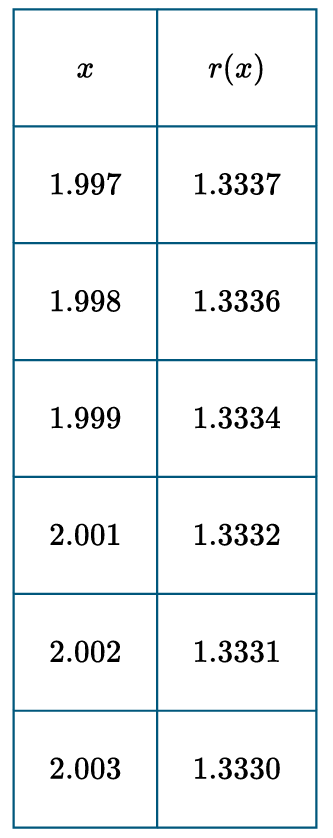
Calculate the limit as \( x \) approaches \( 2 \) by canceling the common factor: \( \lim_{x \to 2} \frac{x+2}{x+1} = \frac{2+2}{2+1} = \frac{4}{3} \).
Since the limit exists at \( x = 2 \) but the function is undefined there, this indicates a removable discontinuity.
Therefore, the graph of \( r \) has a hole at the coordinates \( (2, \frac{4}{3}) \).
Correct Option: (B)
Question

▶️ Answer/Explanation
(C) The graph of \(f\) has a vertical asymptote at \(x = -5\).
1. As \(x \to -5^{-}\), the values of \(f(x)\) decrease from \(-10\) to \(-1000\), indicating \(f(x) \to -\infty\).
2. As \(x \to -5^{+}\), the values increase from \(10\) to \(1000\), indicating \(f(x) \to +\infty\).
3. The function is undefined at \(x = -5\).
4. Opposite infinite behavior on each side implies a vertical asymptote.
5. Since the numerator and denominator have no common zeros, the discontinuity is not removable (not a hole).
6. Therefore, \(x = -5\) is a vertical asymptote.