AP Precalculus -1.11 Equivalent Forms of Polynomial and Rational Expressions- FRQ Exam Style Questions - Effective Fall 2023
AP Precalculus -1.11 Equivalent Forms of Polynomial and Rational Expressions- FRQ Exam Style Questions – Effective Fall 2023
AP Precalculus -1.11 Equivalent Forms of Polynomial and Rational Expressions- FRQ Exam Style Questions – AP Precalculus- per latest AP Precalculus Syllabus.
Question

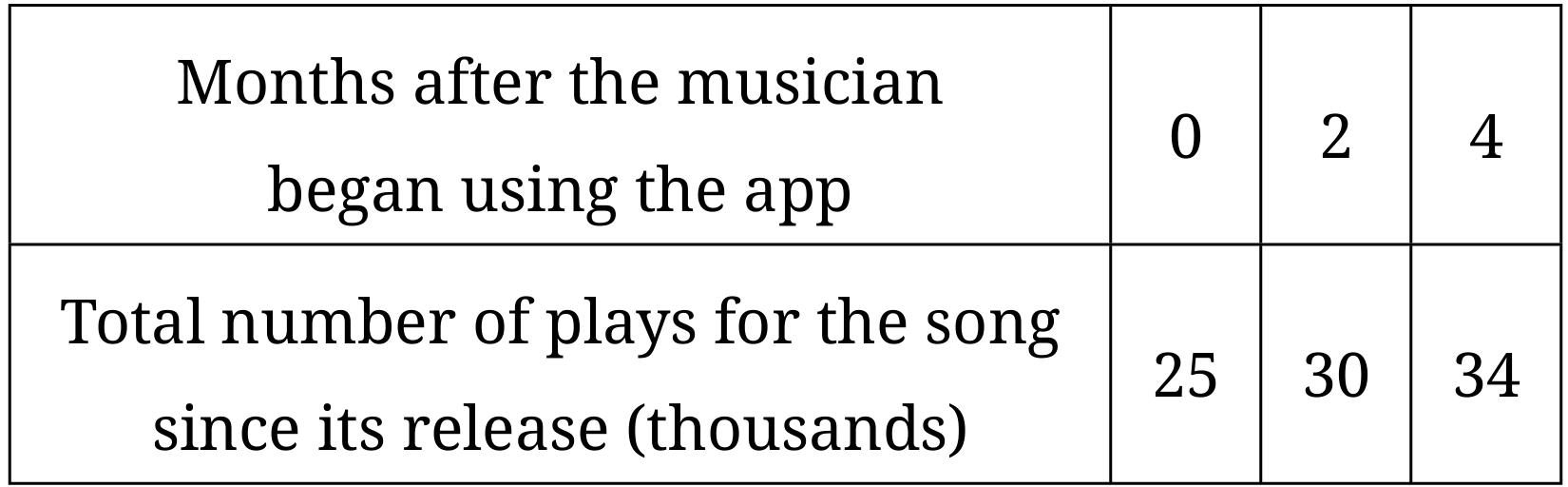
(i) Use the given data to write three equations that can be used to find the values for constants \( a \), \( b \), and \( c \) in the expression for \( D(t) \).
(ii) Find the values for \( a \), \( b \), and \( c \) as decimal approximations.
(i)Use the given data to find the average rate of change of the total number of plays for the song, in thousands per month, from \( t = 0 \) to \( t = 4 \) months. Express your answer as a decimal approximation. Show the computations that lead to your answer.
(ii) Use the average rate of change found in part B (i) to estimate the total number of plays for the song, in thousands, for \( t = 1.5 \) months. Show the work that leads to your answer.
(iii) Let \( A_t \) represent the estimate of the total number of plays for the song, in thousands, using the average rate of change found in part B (i). For \( A_{1.5} \) found in part B (ii), it can be shown that \( A_{1.5} < D(1.5) \). Explain why, in general, \( A_t < D(t) \) for all \( t \), where \( 0 < t < 4 \). Your explanation should include a reference to the graph of \( D \) and its relationship to \( A_t \).
Most-appropriate topic codes (AP Precalculus 2024):
• 1.2: Compare rates of change using average rates of change — part B(i)
• 2.5: Construct a model for situations involving proportional output values — part B(ii)
• 1.3: Determine the change in average rates of change for quadratic functions — part B(iii)
• 1.13: Articulate model assumptions and domain restrictions — part C
▶️ Answer/Explanation
A.
(i)
Because \( D(0) = 25 \), \( D(2) = 30 \), and \( D(4) = 34 \), the three equations are: \[ \begin{align*} a(0)^2 + b(0) + c &= 25 \\ a(2)^2 + b(2) + c &= 30 \\ a(4)^2 + b(4) + c &= 34 \end{align*} \] These simplify to: \[ \begin{align*} c &= 25 \quad \text{(1)} \\ 4a + 2b + c &= 30 \quad \text{(2)} \\ 16a + 4b + c &= 34 \quad \text{(3)} \end{align*} \] ✅ Answer: \(\boxed{c=25, \; 4a+2b+c=30, \; 16a+4b+c=34}\)
(ii)
Substitute \( c = 25 \) into (2) and (3): \[ \begin{align*} 4a + 2b &= 5 \quad \text{(2′)} \\ 16a + 4b &= 9 \quad \text{(3′)} \end{align*} \] Multiply (2′) by 2: \( 8a + 4b = 10 \).
Subtract this from (3′): \( (16a+4b) – (8a+4b) = 9 – 10 \) gives \( 8a = -1 \), so \( a = -\frac{1}{8} = -0.125 \).
Substitute into (2′): \( 4(-0.125) + 2b = 5 \) gives \( -0.5 + 2b = 5 \), so \( 2b = 5.5 \), \( b = 2.75 \).
✅ Answer: \(\boxed{a = -0.125, \; b = 2.75, \; c = 25}\)
Thus, \( D(t) = -0.125t^2 + 2.75t + 25 \).
B.
(i)
Average rate of change from \( t=0 \) to \( t=4 \): \[ \frac{D(4)-D(0)}{4-0} = \frac{34 – 25}{4} = \frac{9}{4} = 2.25 \] ✅ Answer: \(\boxed{2.25}\) thousand plays per month.
(ii)
Using the average rate of change, the linear estimate is \( A_t = D(0) + 2.25t = 25 + 2.25t \).
For \( t = 1.5 \): \[ A_{1.5} = 25 + 2.25(1.5) = 25 + 3.375 = 28.375 \] ✅ Answer: \(\boxed{28.375}\) thousand plays.
(iii)
The estimate \( A_t \) is the \( y \)-coordinate of a point on the secant line passing through \( (0, D(0)) \) and \( (4, D(4)) \).
Since \( D(t) \) is a quadratic with \( a = -0.125 < 0 \), its graph is concave down on \( 0 < t < 4 \).
For a concave-down function over an interval, the secant line connecting the endpoints lies below the graph of the function for all \( t \) in the open interval \( (0, 4) \).
Therefore, \( A_t < D(t) \) for all \( t \) where \( 0 < t < 4 \).
✅ Explanation: Concave-down shape places the secant line below the curve.
C.
The quadratic \( D(t) = -0.125t^2 + 2.75t + 25 \) has \( a < 0 \), so it has an absolute maximum (vertex).
Find vertex: \( t = -\frac{b}{2a} = -\frac{2.75}{2(-0.125)} = \frac{2.75}{0.25} = 11 \) months.
In the context, \( D(t) \) models the total number of plays since release, which cannot decrease. However, the quadratic model decreases after \( t = 11 \) (its maximum), which would imply the total plays go down—impossible in reality.
Therefore, the model is only valid up to the time it reaches its maximum. The domain of \( D \) should be restricted to \( t \le 11 \) months (or until the maximum is reached) to ensure the total plays are non-decreasing.
✅ Explanation: The absolute maximum at \( t = 11 \) gives a right endpoint for the domain because the total plays cannot decrease after that time.
Question
Directions:
- Unless otherwise specified, the domain of a function \( f \) is assumed to be the set of all real numbers \( x \) for which \( f(x) \) is a real number. Angle measures for trigonometric functions are assumed to be in radians.
- Solutions to equations must be real numbers. Determine the exact value of any expression that can be obtained without a calculator.
- Unless otherwise specified, combine terms using algebraic methods and rules for exponents and logarithms where applicable.
- For each part of the question, show the work that leads to your answers.
(A) The functions \( g \) and \( h \) are given by
\( g(x) = 3^{(2x)} \cdot 3^{(x+4)} \)
\( h(x) = 2\tan^2 x – 1 \)
(ii) Solve \( h(x) = 5 \) for values of \( x \) in the interval \( [0, 2\pi) \).
(B) The functions \( j \) and \( k \) are given by
\( j(x) = 2\log_{10}(x+3) – \log_{10} x – \log_{10} 3 \)
\( k(x) = \frac{(\tan^2 x)(\cot x)}{\csc x} \)
(ii) Rewrite \( k(x) \) as a fraction involving \( \sec x \) and no other trigonometric functions.
(C) The function \( m \) is given by
\( m(x) = \frac{2^{(5x+3)}}{\left(2^{(x-2)}\right)^3} \)
▶️ Answer/Explanation
(A)(i) Solve \( g(x) = 27 \)
First, simplify the expression for \( g(x) \) using the property of exponents \( a^m \cdot a^n = a^{m+n} \).
\( g(x) = 3^{2x} \cdot 3^{x+4} = 3^{(2x + x + 4)} = 3^{(3x+4)} \)
Set \( g(x) \) equal to 27 and rewrite 27 as a base of 3:
\( 3^{(3x+4)} = 27 \)
\( 3^{(3x+4)} = 3^3 \)
Since the bases are equal, the exponents must be equal:
\( 3x + 4 = 3 \)
\( 3x = 3 – 4 \)
\( 3x = -1 \)
\( x = -\frac{1}{3} \)
(A)(ii) Solve \( h(x) = 5 \) on \( [0, 2\pi) \)
Set the expression for \( h(x) \) equal to 5:
\( 2\tan^2 x – 1 = 5 \)
Add 1 to both sides:
\( 2\tan^2 x = 6 \)
Divide by 2:
\( \tan^2 x = 3 \)
Take the square root of both sides:
\( \tan x = \pm\sqrt{3} \)
The reference angle for \( \tan \theta = \sqrt{3} \) is \( \frac{\pi}{3} \).
Since we have \( \pm\sqrt{3} \), we must consider solutions in all four quadrants within the interval \( [0, 2\pi) \):
Quadrant I: \( x = \frac{\pi}{3} \)
Quadrant II: \( x = \pi – \frac{\pi}{3} = \frac{2\pi}{3} \)
Quadrant III: \( x = \pi + \frac{\pi}{3} = \frac{4\pi}{3} \)
Quadrant IV: \( x = 2\pi – \frac{\pi}{3} = \frac{5\pi}{3} \)
Solution set: \( x = \frac{\pi}{3}, \frac{2\pi}{3}, \frac{4\pi}{3}, \frac{5\pi}{3} \)
(B)(i) Rewrite \( j(x) \) as a single logarithm
Given: \( j(x) = 2\log_{10}(x+3) – \log_{10} x – \log_{10} 3 \)
Use the power rule \( n\log a = \log(a^n) \):
\( = \log_{10}((x+3)^2) – \log_{10} x – \log_{10} 3 \)
Factor out the negative sign for the last two terms to group them:
\( = \log_{10}((x+3)^2) – (\log_{10} x + \log_{10} 3) \)
Use the product rule \( \log a + \log b = \log(ab) \):
\( = \log_{10}((x+3)^2) – \log_{10}(3x) \)
Use the quotient rule \( \log a – \log b = \log(\frac{a}{b}) \):
\( = \log_{10}\left(\frac{(x+3)^2}{3x}\right) \)
(B)(ii) Rewrite \( k(x) \) involving \( \sec x \)
Given: \( k(x) = \frac{(\tan^2 x)(\cot x)}{\csc x} \)
First, simplify the numerator using \( \tan x \cdot \cot x = 1 \):
\( (\tan^2 x)(\cot x) = \tan x \cdot (\tan x \cdot \cot x) = \tan x \cdot 1 = \tan x \)
Now substitute back into the expression:
\( k(x) = \frac{\tan x}{\csc x} \)
Convert to sine and cosine:
\( = \frac{\frac{\sin x}{\cos x}}{\frac{1}{\sin x}} \)
\( = \frac{\sin x}{\cos x} \cdot \frac{\sin x}{1} = \frac{\sin^2 x}{\cos x} \)
We need the expression in terms of \( \sec x \). Use the identity \( \sin^2 x = 1 – \cos^2 x \):
\( = \frac{1 – \cos^2 x}{\cos x} \)
Substitute \( \cos x = \frac{1}{\sec x} \):
\( = \frac{1 – \left(\frac{1}{\sec x}\right)^2}{\frac{1}{\sec x}} \)
\( = \frac{1 – \frac{1}{\sec^2 x}}{\frac{1}{\sec x}} \)
Find a common denominator for the numerator:
\( = \frac{\frac{\sec^2 x – 1}{\sec^2 x}}{\frac{1}{\sec x}} \)
Multiply by the reciprocal of the denominator:
\( = \frac{\sec^2 x – 1}{\sec^2 x} \cdot \frac{\sec x}{1} \)
\( = \frac{\sec^2 x – 1}{\sec x} \)
(C) Find input values for \( m(x) = \frac{1}{16} \)
First, simplify the expression for \( m(x) \):
\( m(x) = \frac{2^{(5x+3)}}{\left(2^{(x-2)}\right)^3} \)
Simplify the denominator using the power rule \( (a^m)^n = a^{m \cdot n} \):
\( \left(2^{(x-2)}\right)^3 = 2^{3(x-2)} = 2^{3x-6} \)
Now apply the quotient rule \( \frac{a^m}{a^n} = a^{m-n} \):
\( m(x) = \frac{2^{5x+3}}{2^{3x-6}} = 2^{(5x+3) – (3x-6)} \)
\( = 2^{5x + 3 – 3x + 6} \)
\( = 2^{2x + 9} \)
Set \( m(x) = \frac{1}{16} \) and rewrite \( \frac{1}{16} \) as a power of 2:
\( \frac{1}{16} = \frac{1}{2^4} = 2^{-4} \)
Equate the simplified \( m(x) \) to \( 2^{-4} \):
\( 2^{2x + 9} = 2^{-4} \)
Equate the exponents:
\( 2x + 9 = -4 \)
\( 2x = -13 \)
\( x = -\frac{13}{2} \) or \( -6.5 \)
