Home / AP® Exam / AP® PreCalculus / AP® Precalculus

AP Precalculus -1.12 Transformations of Functions- MCQ Exam Style Questions - Effective Fall 2023

AP Precalculus -1.12 Transformations of Functions- MCQ Exam Style Questions – Effective Fall 2023

AP Precalculus -1.12 Transformations of Functions- MCQ Exam Style Questions – AP Precalculus- per latest AP Precalculus Syllabus.

AP Precalculus – MCQ Exam Style Questions- All Topics

Question 

The function \( f \) is given by \( f(x) = 3x^2 + 2x + 1 \). The graph of which of the following functions is the image of the graph of \( f \) after a vertical dilation of the graph of \( f \) by a factor of 2?
(A) \( m(x) = 12x^2 + 4x + 1 \), because this is a multiplicative transformation of \( f \) that results from multiplying each input value \( x \) by 2.
(B) \( k(x) = 6x^2 + 4x + 2 \), because this is a multiplicative transformation of \( f \) that results from multiplying \( f(x) \) by 2.
(C) \( p(x) = 3(x + 2)^2 + 2(x + 2) + 1 \), because this is an additive transformation of \( f \) that results from adding 2 to each input value \( x \).
(D) \( n(x) = 3x^2 + 2x + 3 \), because this is an additive transformation of \( f \) that results from adding 2 to \( f(x) \).
▶️ Answer/Explanation
Detailed solution

Vertical dilation by factor 2 means: multiply \( f(x) \) by 2.
\( 2f(x) = 2(3x^2 + 2x + 1) = 6x^2 + 4x + 2 \).
This matches \( k(x) \) in option (B).
Answer: (B)

Question 

\(x\)
\(-8\)
\(-4\)
\(-2\)
\(-1\)
\(0\)
\(3\)
\(f(x)\)
\(87\)
\(55\)
\(5\)
\(-4\)
\(-7\)
\(20\)

The table gives values for a polynomial function \(f\) at selected values of \(x\). Let \(g(x) = af(bx) + c\), where \(a, b,\) and \(c\) are positive constants. In the \(xy\)-plane, the graph of \(g\) is constructed by applying three transformations to the graph of \(f\) in this order: a horizontal dilation by a factor of 2, a vertical dilation by a factor of 3, and a vertical translation by 5 units. What is the value of \(g(-4)\)?

(A) 266
(B) 170
(C) 28
(D) 20
▶️ Answer/Explanation
Detailed solution

Horizontal dilation by factor 2 ⇒ input scaled by \( \frac{1}{2} \) (since dilation by factor \( k \) means \( x \) replaced by \( x/k \)).
So \( b = \frac{1}{2} \).
Vertical dilation by factor 3 ⇒ multiply output by 3 ⇒ \( a = 3 \).
Vertical translation up 5 ⇒ add 5 ⇒ \( c = 5 \).
Thus \( g(x) = 3f\left(\frac{1}{2}x\right) + 5 \).
To find \( g(-4) \):
First compute \( \frac{1}{2}(-4) = -2 \).
From table, \( f(-2) = 5 \).
Then \( g(-4) = 3 \cdot 5 + 5 = 15 + 5 = 20 \).
Answer: (D)

Question 


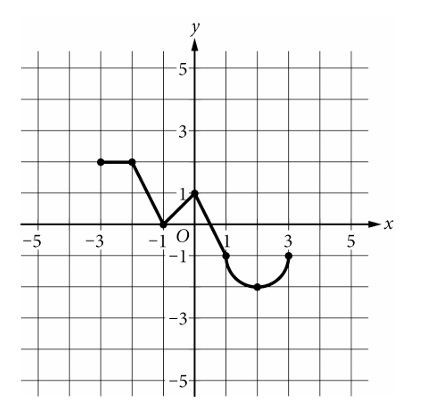
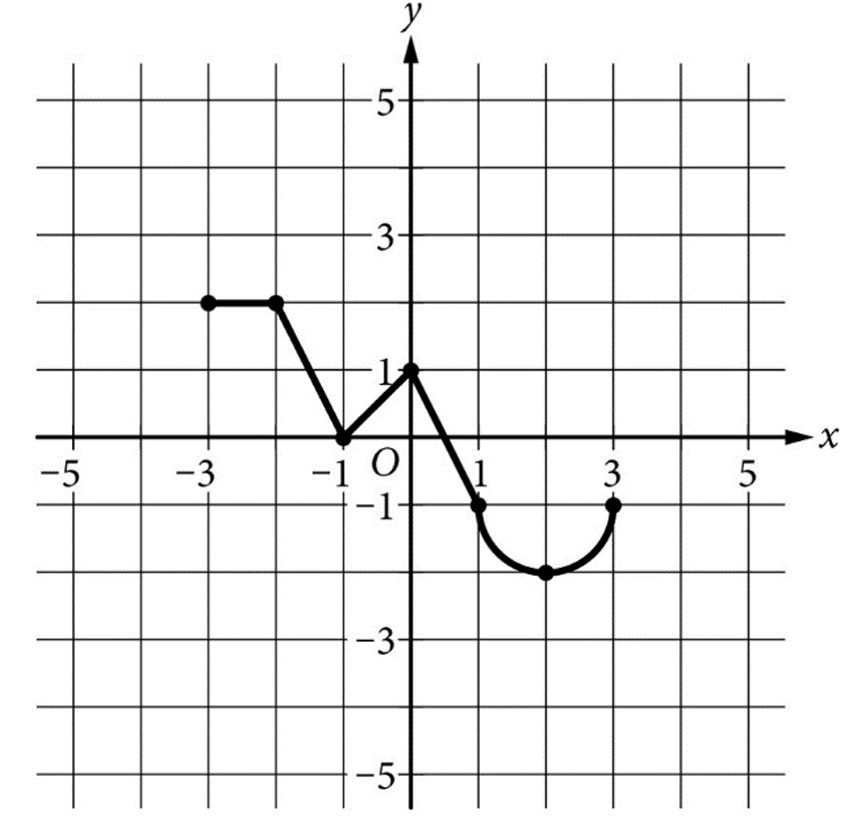
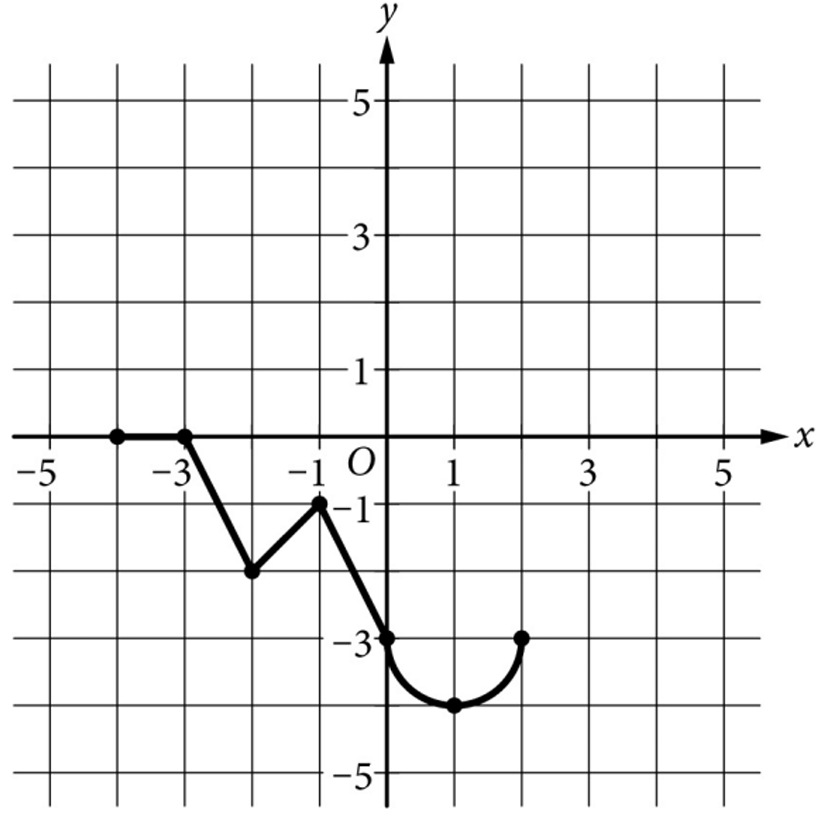
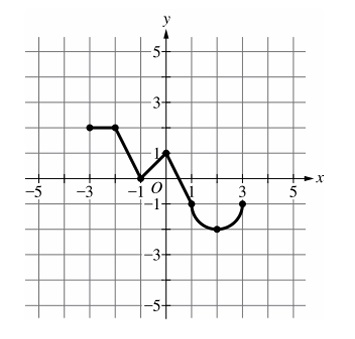
The graph of \( y = f(x) \), consisting of four line segments and a semicircle, is shown for \(-3 \leq x \leq 3\).
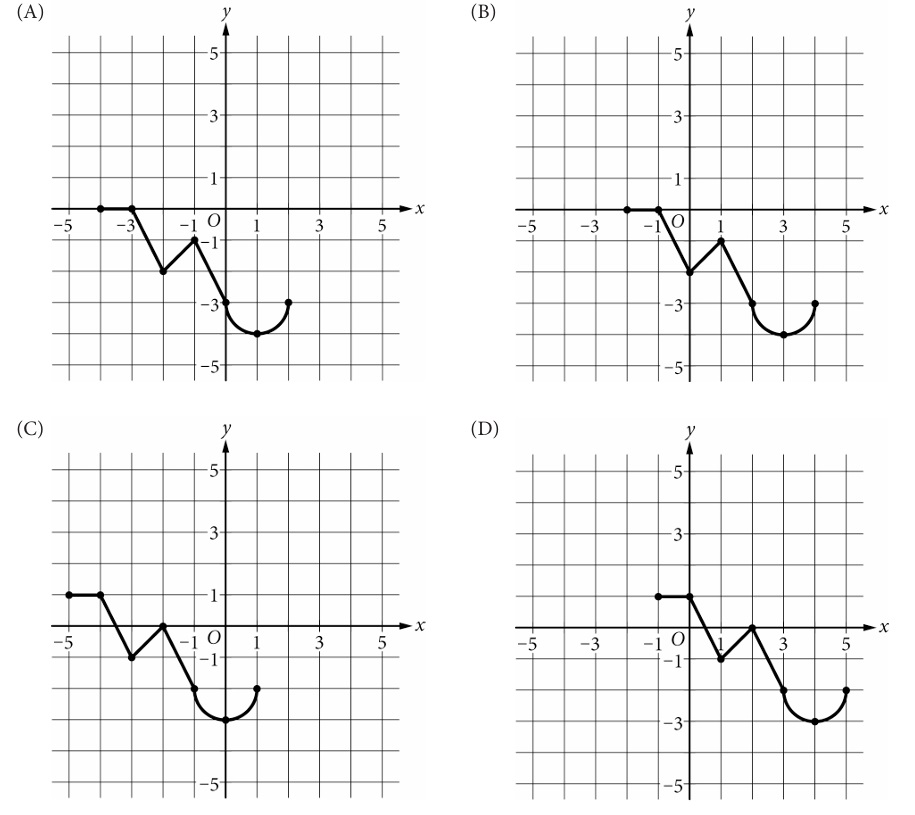
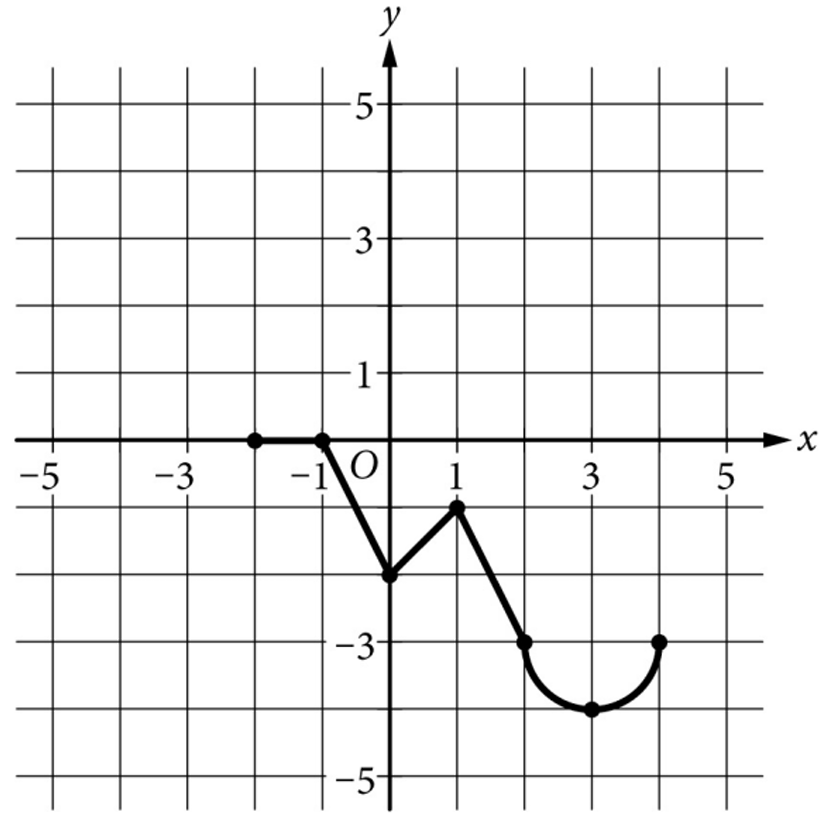
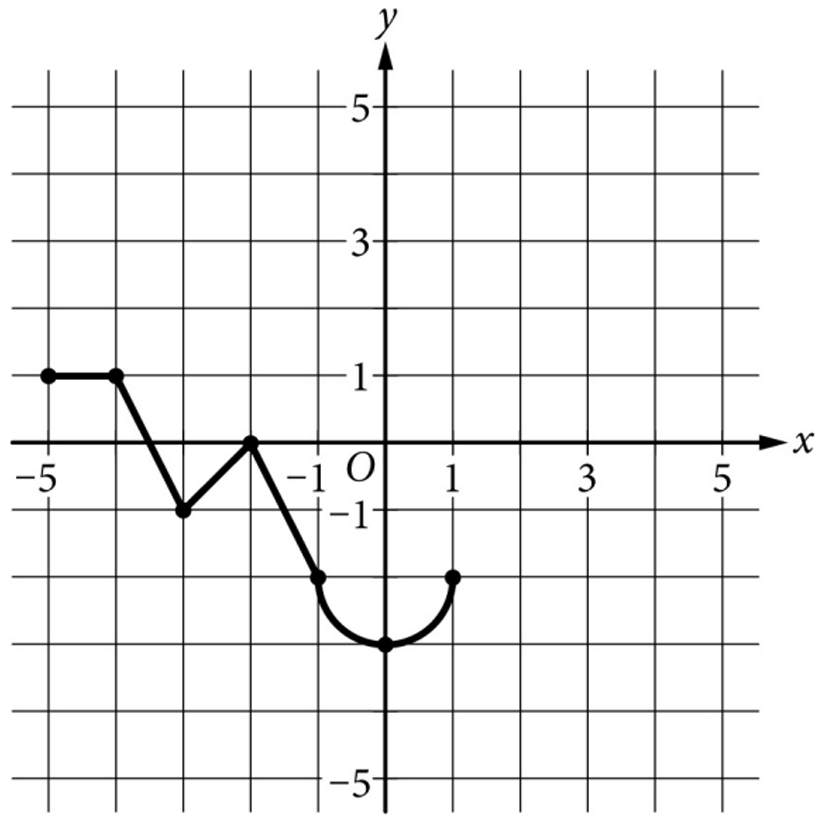
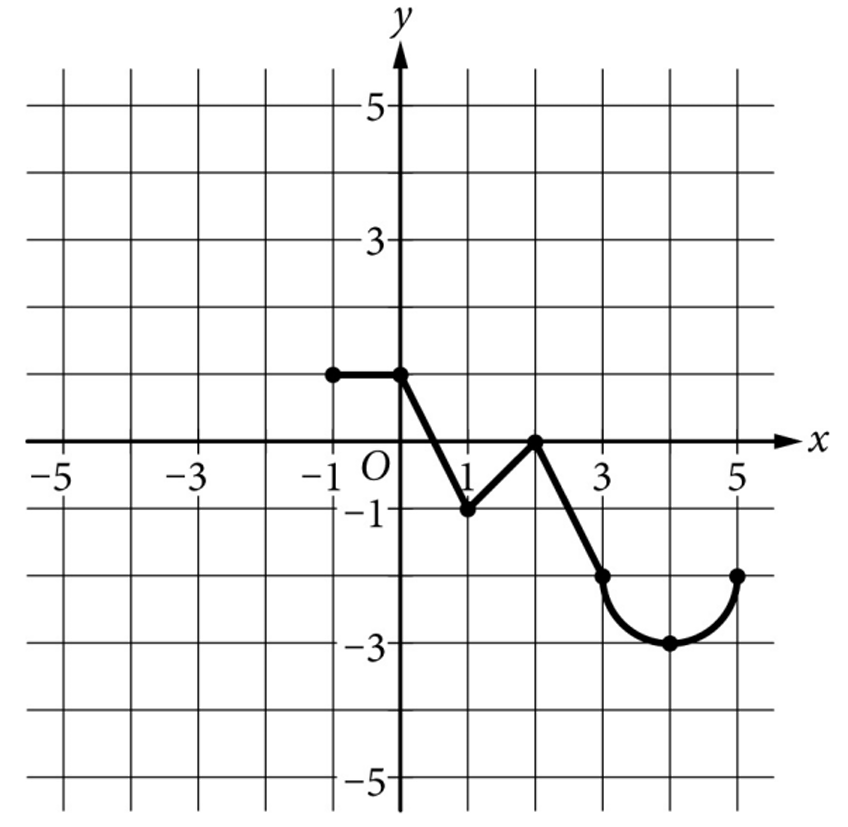
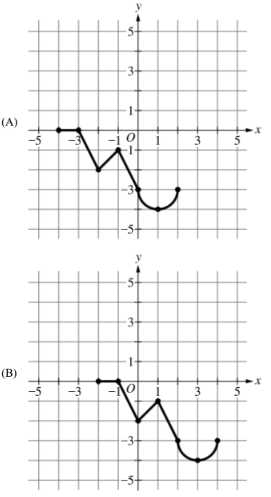
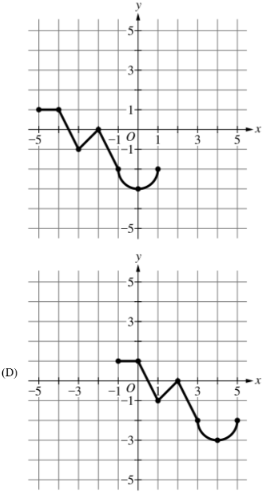
Which of the following is the transformed graph for \( y = f(x + 1) – 2 \)?

▶️ Answer/Explanation
Detailed solution

The transformation \( y = f(x + 1) – 2 \) represents:
– Horizontal shift: \( x + 1 \) ⇒ shift left by 1 unit.
– Vertical shift: \( -2 \) ⇒ shift down by 2 units.
Thus the entire original graph (line segments and semicircle) moves 1 unit left and 2 units down.
The only choice showing this translated shape is option (A).
Answer: (A)

Question 

The polynomial function \( f \) is given by \( f(x) = ax^4 + bx^3 + cx^2 + dx + k \), where \( a \neq 0 \) and \( b, c, d, \) and \( k \) are constants. Which of the following statements about \( f \) is true?
(A) \( f \) has both a global maximum and a global minimum.
(B) \( f \) has either a global maximum or a global minimum, but not both.
(C) \( f \) has neither a global maximum nor a global minimum.
(D) The nature of a global maximum or a global minimum for \( f \) cannot be determined without more information about \( b, c, d, \) and \( k \).
▶️ Answer/Explanation
Detailed solution

\( f \) is a quartic polynomial (degree 4, even).
For even-degree polynomials with leading coefficient \( a \neq 0 \):
– If \( a > 0 \), as \( x \to \pm\infty \), \( f(x) \to +\infty \) ⇒ global minimum exists, no global maximum.
– If \( a < 0 \), as \( x \to \pm\infty \), \( f(x) \to -\infty \) ⇒ global maximum exists, no global minimum.
Thus \( f \) has either a global max or a global min, but not both.
Answer: (B)

Question 


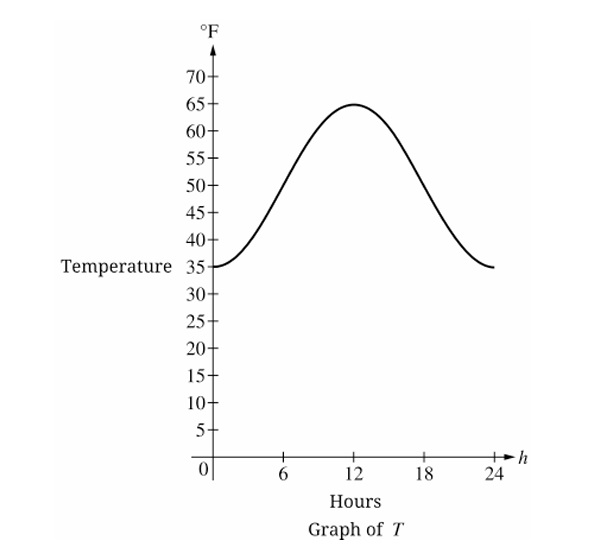
During a month in a certain town, the temperature increases and decreases over the course of a day. A graph of the average temperatures during that month for any given day is shown. The data in the graph can be modeled by the function \( T \), where \( T(h) \) gives the temperature, in degrees Fahrenheit (°F), at time \( h \) hours after midnight. At a certain point in that month, there is an adjustment to clocks for daylight saving time, at which point clocks are adjusted 1 hour forward. For example, 6 a.m. instantly becomes 7 a.m. The function \( D \) models the same data as function \( T \), after the shift to daylight saving time. If \( h \) still represents the number of hours after midnight, which of the following defines \( D(h) \) in terms of \( T \)?
(A) \( D(h) = T(h + 1) \)
(B) \( D(h) = T(h – 1) \)
(C) \( D(h) = T(h) + 1 \)
(D) \( D(h) = T(h) – 1 \)
▶️ Answer/Explanation
Detailed solution

After daylight saving time starts, clocks move forward 1 hour.
This means the temperature at a given clock time \( h \) (hours after midnight) used to occur at time \( h – 1 \) before the shift.
Thus \( D(h) = T(h – 1) \).
Example: At new time 7 a.m. (\( h = 7 \)), the temperature is what it used to be at old time 6 a.m. (\( h = 6 \)), so \( D(7) = T(6) \).
Answer: (B)

Question 

The functions \( f \) and \( g \) are defined for all real numbers such that \( g(x) = f(2(x – 4)) \). Which of the following sequences of transformations maps the graph of \( f \) to the graph of \( g \) in the same \( xy \)-plane?
(A) A horizontal dilation of the graph of \( f \) by a factor of 2, followed by a horizontal translation of the graph of \( f \) by \(-8\) units
(B) A horizontal dilation of the graph of \( f \) by a factor of 2, followed by a horizontal translation of the graph of \( f \) by 8 units
(C) A horizontal dilation of the graph of \( f \) by a factor of \(\frac{1}{2}\), followed by a horizontal translation of the graph of \( f \) by \(-4\) units
(D) A horizontal dilation of the graph of \( f \) by a factor of \(\frac{1}{2}\), followed by a horizontal translation of the graph of \( f \) by 4 units
▶️ Answer/Explanation
Detailed solution

Inside \( f \): argument is \( 2(x – 4) \).
Factor inside: \( 2(x – 4) = 2x – 8 \).
Transformation form: \( f(bx + c) \) with \( b = 2, c = -8 \).
Order: horizontal dilation by factor \( \frac{1}{|b|} = \frac{1}{2} \) (compression), then horizontal shift by \( -\frac{c}{b} = -\frac{-8}{2} = 4 \) units right.
So sequence: horizontal dilation factor \( \frac{1}{2} \) → horizontal translation right 4 units.
Answer: (D)

Question 

The function \( f \) is given by \( f(x) = x^2 + 2 \). The function \( g \) is the result of a transformation of \( f \) and is given by \( g(x) = \frac{x^2}{4} + 2 \). Which of the following describes the transformation of the graph of \( f \) whose image is the graph of \( g \)?
(A) A vertical dilation by a factor of \(\frac{1}{4}\)
(B) A horizontal dilation by a factor of \(\frac{1}{2}\)
(C) A horizontal dilation by a factor of 2
(D) A horizontal dilation by a factor of 4
▶️ Answer/Explanation
Detailed solution

Compare: \( f(x) = x^2 + 2 \), \( g(x) = \frac{x^2}{4} + 2 = \left(\frac{x}{2}\right)^2 + 2 \).
Thus \( g(x) = f\left(\frac{x}{2}\right) \).
Inside \( f \): input multiplied by \( \frac{1}{2} \) ⇒ horizontal dilation by factor \( \frac{1}{1/2} = 2 \) (stretch).
Answer: (C)

Question 

The function \( f \) has domain \([-2, 2]\) and range \([1, 5]\). The function \( g \) is given by \( g(x) = -2f(x + 3) + 4 \). What are the domain and range of \( g \)?
(A) domain: \([-5, -1]\), range: \([-6, 2]\)
(B) domain: \([-5, -1]\), range: \([-2, 6]\)
(C) domain: \([1, 5]\), range: \([-2, 6]\)
(D) domain: \([1, 5]\), range: \([-6, 2]\)
▶️ Answer/Explanation
Detailed solution

Domain transformation: \( x+3 \) inside \( f \) means shift left 3.
Domain of \( f \): \( -2 \leq x \leq 2 \).
For \( g \), require \( -2 \leq x+3 \leq 2 \) ⇒ \( -5 \leq x \leq -1 \).
Domain of \( g \): \([-5, -1]\).
Range transformation: \( -2f(x+3) + 4 \).
Range of \( f \): \( 1 \leq f \leq 5 \).
Multiply by \(-2\) (reflect over \(x\)-axis and stretch by 2):
Max \( f = 5 \) → \( -2 \cdot 5 = -10 \) (becomes min after reflection).
Min \( f = 1 \) → \( -2 \cdot 1 = -2 \) (becomes max after reflection).
Then add 4: \( -10 + 4 = -6 \), \( -2 + 4 = 2 \).
So range of \( g \): \([-6, 2]\).
Answer: (A)

Question 

\(x\)
0
1
2
3
4
5
6
7
8
9
10
11
12
\(f(x)\)
0
1
4
9
4
1
0
1
4
9
4
1
0
\(g(x)\)
0
2
2
0
2
2
0
2
2
0
2
2
0

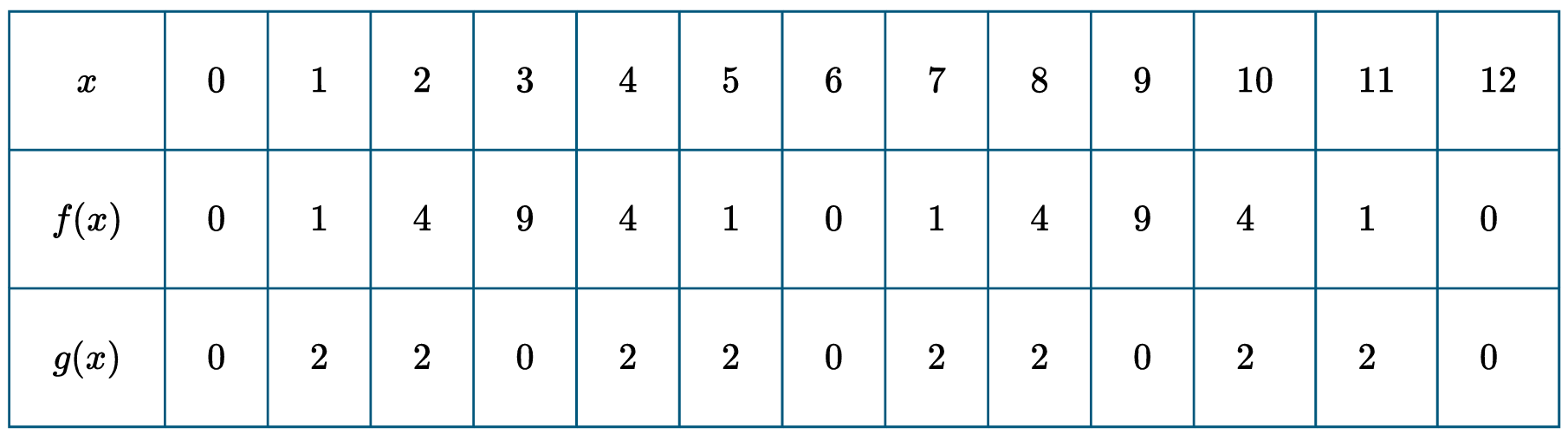
 The table gives values of the functions \(f\) and \(g\) for selected values of \(x\). The pattern of the values of \(f\) and \(g\) continue, repeating every interval of width 6, for \(0 \leq x \leq 48\). The graph of the function \(g\) is the result of a sequence of dilations of the graph of the function \(f\). Which of the following could describe those dilations?

(A) A horizontal dilation by a factor of \(\frac{1}{3}\) and a vertical dilation by a factor of \(\frac{1}{2}\)
(B) A horizontal dilation by a factor of \(\frac{1}{2}\) and a vertical dilation by a factor of \(\frac{1}{3}\)
(C) A horizontal dilation by a factor of \(\frac{1}{2}\) and a vertical dilation by a factor of \(\frac{1}{2}\)
(D) A horizontal dilation by a factor of 3 and a vertical dilation by a factor of 2
▶️ Answer/Explanation
Detailed solution

From the table, \( f \) has period 6: pattern \( 0, 1, 4, 9, 4, 1 \) repeats.
\( g \) has period 6: pattern \( 0, 2, 2, 0, 2, 2 \) repeats.
We check if \( g(x) = a f(bx) \) fits.
Try \( b = 2 \) (horizontal dilation factor \( 1/b = 1/2 \)): Compare values:
For \( x = 0 \): \( g(0) = 0 \), \( f(2\cdot0) = f(0) = 0 \).
\( x = 1 \): \( g(1) = 2 \), \( f(2) = 4 \). If \( a = 1/2 \), \( \frac12 f(2) = 2 \) ✔.
\( x = 2 \): \( g(2) = 2 \), \( f(4) = 4 \), \( \frac12 f(4) = 2 \) ✔.
\( x = 3 \): \( g(3) = 0 \), \( f(6) = 0 \), \( \frac12 \cdot 0 = 0 \) ✔.
Continues to match.
Thus \( g(x) = \frac12 f(2x) \), meaning:
– Horizontal dilation by factor \( 1/2 \) (since \( 2x \) compresses horizontally).
– Vertical dilation by factor \( 1/2 \) (multiply by 1/2).
Answer: (C)

Question 

The function \( f \) is not explicitly given. In the \( xy \)-plane, the graph of the function \( g \) is the result of a sequence of transformations to the graph of \( f \). The graph of \( g \) is the result of dilating the graph of \( f \) vertically by a factor of 2, then horizontally by a factor of 3, then translating the result up by 7 units, and then left by 11 units. Which of the following defines \( g \) in terms of \( f \)?
(A) \( g(x) = \frac{1}{3} f(2(x – 7)) – 11 \)
(B) \( g(x) = \frac{1}{2} f(3(x – 11)) – 7 \)
(C) \( g(x) = 2f\left(\frac{x+11}{3}\right) + 7 \)
(D) \( g(x) = 3f\left(\frac{x+7}{2}\right) + 11 \)
▶️ Answer/Explanation
Detailed solution

Transformations in order:
1. Vertical dilation by 2 ⇒ multiply \( f \) by 2.
2. Horizontal dilation by 3 ⇒ multiply input by \( \frac{1}{3} \) (since dilation factor \( k \) means \( x \) replaced by \( x/k \)).
3. Translate up 7 ⇒ add 7 outside.
4. Translate left 11 ⇒ replace \( x \) by \( x + 11 \).
Combine: Start with \( f(x) \).
After step 1: \( 2f(x) \).
After step 2: \( 2f\left(\frac{x}{3}\right) \) (horizontal dilation by factor 3 ⇒ input divided by 3).
After step 3: \( 2f\left(\frac{x}{3}\right) + 7 \).
After step 4: replace \( x \) with \( x+11 \) ⇒ \( 2f\left(\frac{x+11}{3}\right) + 7 \).
Answer: (C)

Question 

The function \( f \) is given by \( f(x) = x^4 – 3x^2 + 2 \). In the \( xy \)-plane, the graph of the function \( g \) is a vertical translation of the graph of the function \( f \) downward by 3 units. Which of the following defines \( g \)?
(A) \( g(x) = x^4 – 3x^2 – 1 \)
(B) \( g(x) = x^4 – 3x^2 + 5 \)
(C) \( g(x) = (x – 3)^4 – 3(x – 3)^2 + 2 \)
(D) \( g(x) = (x + 3)^4 – 3(x + 3)^2 + 2 \)
▶️ Answer/Explanation
Detailed solution

Vertical translation downward by 3 units ⇒ subtract 3 from \( f(x) \):
\( g(x) = f(x) – 3 = (x^4 – 3x^2 + 2) – 3 = x^4 – 3x^2 – 1 \).
Answer: (A)

Question 


The graph of \( y = f(x) \), consisting of four line segments and a semicircle, is shown for \(-3 \leq x \leq 3\). Which of the following is the transformed graph for \( y = f(x+1) – 2 \)?
▶️ Answer/Explanation
Detailed solution

The transformation \( y = f(x+1) – 2 \) consists of:
• \( f(x+1) \): horizontal shift left by 1 unit.
• \( -2 \) outside: vertical shift down by 2 units.
Thus, every point on the original graph moves 1 unit left and 2 units down.
From the original domain \([-3,3]\), the new domain becomes \([-4,2]\).
Among the choices, only one graph matches this left-and-down translation of the original shape.

Answer: (A)

Question 

The function \( f \) is given by \( f(x) = 3x^2 + 2x + 1 \). The graph of which of the following functions is the image of the graph of \( f \) after a vertical dilation of the graph of \( f \) by a factor of 2?
(A) \( m(x) = 12x^2 + 4x + 1 \), because this is a multiplicative transformation of \( f \) that results from multiplying each input value \( x \) by 2.
(B) \( k(x) = 6x^2 + 4x + 2 \), because this is a multiplicative transformation of \( f \) that results from multiplying \( f(x) \) by 2.
(C) \( p(x) = 3(x + 2)^2 + 2(x + 2) + 1 \), because this is an additive transformation of \( f \) that results from adding 2 to each input value \( x \).
(D) \( n(x) = 3x^2 + 2x + 3 \), because this is an additive transformation of \( f \) that results from adding 2 to \( f(x) \).
▶️ Answer/Explanation
Detailed solution

A vertical dilation by a factor of 2 means multiplying the output (\( f(x) \)) by 2.
So the transformed function is \( 2f(x) = 2(3x^2 + 2x + 1) = 6x^2 + 4x + 2 \).
This matches option (B) and the given reason: multiplying \( f(x) \) by 2.
Answer: (B)

Question 

The functions \( f \) and \( g \) are defined for all real numbers such that \( g(x) = f(2(x – 4)) \). Which of the following sequences of transformations maps the graph of \( f \) to the graph of \( g \) in the same \( xy \)-plane?
(A) A horizontal dilation of the graph of \( f \) by a factor of 2, followed by a horizontal translation of the graph of \( f \) by \(-8\) units
(B) A horizontal dilation of the graph of \( f \) by a factor of 2, followed by a horizontal translation of the graph of \( f \) by 8 units
(C) A horizontal dilation of the graph of \( f \) by a factor of \(\frac{1}{2}\), followed by a horizontal translation of the graph of \( f \) by \(-4\) units
(D) A horizontal dilation of the graph of \( f \) by a factor of \(\frac{1}{2}\), followed by a horizontal translation of the graph of \( f \) by 4 units
▶️ Answer/Explanation
Detailed solution

Given \( g(x) = f(2(x – 4)) \).
This is in the form \( f(b(x – h)) \) with \( b = 2 \), \( h = 4 \).

Transformations (in order applied to \( x \)):
1. Horizontal dilation by factor \( \frac{1}{b} = \frac{1}{2} \) (compression).
2. Horizontal translation right by \( h = 4 \) units.

Thus: horizontal dilation by factor \( \frac{1}{2} \), then horizontal translation right 4 units.
Answer: (D)

Question 

A function $g(x) = \frac{x-5}{x+2}$ has been transformed from the parent function $f(x) = \frac{1}{x}$. Which of the following correctly describes the transformations from the parent function $f(x)$ to $g(x)$?
a. Vertical Dilation of $7$, Up $1$, Right $2$, Flip over $y$-axis.
b. Vertical Dilation of $7$, Up $1$, Right $2$, Flip over $x$-axis.
c. Vertical Dilation of $7$, Up $1$, Left $2$, Flip over $y$-axis.
d. Vertical Dilation of $7$, Up $1$, Left $2$, Flip over $x$-axis.
▶️ Answer/Explanation
Detailed solution

First, use polynomial long division to rewrite $g(x) = \frac{x-5}{x+2}$ as $1 – \frac{7}{x+2}$.
This can be expressed in transformation form as $g(x) = -7 \left( \frac{1}{x+2} \right) + 1$.
The term $(x+2)$ in the denominator indicates a horizontal shift Left $2$ units.
The multiplier of $7$ indicates a Vertical Dilation (stretch) of $7$.
The negative sign in front of the $7$ represents a Flip (reflection) over the $x$-axis.
The $+1$ at the end indicates a vertical shift Up $1$ unit.
Comparing these steps to the given options, the correct choice is d.

Scroll to Top