
AP Precalculus -1.13 Function Models: Selection and Assumptions- FRQ Exam Style Questions - Effective Fall 2023
AP Precalculus -1.13 Function Models: Selection and Assumptions- FRQ Exam Style Questions – Effective Fall 2023
AP Precalculus -1.13 Function Models: Selection and Assumptions- FRQ Exam Style Questions – AP Precalculus- per latest AP Precalculus Syllabus.
Question
Most-appropriate topic codes (AP Precalculus CED):
• 1.2: Rates of Change – part B(i), B(ii)
• 2.3: Exponential Functions – part B(iii)
• 1.13: Function Model Selection and Assumption Articulation – part C
▶️ Answer/Explanation
(A)(i) Equations
Substituting the points \((1, 3)\) and \((5, 89)\) into \(H(t) = ab^t\):
1. \(3 = ab^1\) (or \(3 = ab\))
2. \(89 = ab^5\)
(A)(ii) Values for a and b
Dividing equation 2 by equation 1: \(\frac{ab^5}{ab} = \frac{89}{3} \implies b^4 = 29.67\).
Solving for \(b\): \(b = (29.67)^{0.25} \approx 2.33\).
Solving for \(a\): \(a = \frac{3}{2.33} \approx 1.29\).
(B)(i) Average Rate of Change
\(\text{Rate} = \frac{H(5) – H(1)}{5 – 1} = \frac{89 – 3}{4} = \frac{86}{4} = 21.5\)
Answer: 21.5 feet per week.
(B)(ii) Interpretation
The answer indicates that between the first and fifth weeks, the bamboo tree grew at an average speed of 21.5 feet per week.
(B)(iii) Comparison
Greater. The function represents exponential growth (\(b > 1\)), which is concave up. This means the rate of growth increases over time, so the rate after week 5 will be steeper than the rate before week 5.
(C) Confidence
\(t = 4\) weeks.
The biologists should be more confident in \(t=4\) because it is an interpolation (within the observed data range). \(t=11\) is an extrapolation; biological growth cannot remain exponential indefinitely, so the model is likely inaccurate that far out.
Question

Most-appropriate topic codes (AP Precalculus CED):
• 2.8: Inverse Functions – part A(ii)
• 1.8: Rational Functions and Zeros – part B(i)
• 1.7: Rational Functions and End Behavior – part B(ii)
• 1.13: Function Model Selection and Assumption Articulation – part C
▶️ Answer/Explanation
(A) (i)
First, evaluate the inner function \(f(5)\) using the table: \(f(5) = 34\).
Next, substitute this value into \(g(x)\) to find \(h(5) = g(34)\).
\(g(34) = \frac{34^3 – 14(34) – 27}{34 + 2}\)
\(g(34) = \frac{39304 – 476 – 27}{36} = \frac{38801}{36}\)
\(h(5) \approx 1077.806\)
(A) (ii)
To find \(f^{-1}(4)\), we look for the input value \(x\) in the table that produces an output of \(4\).
The table shows that \(f(3) = 4\).
Therefore, \(f^{-1}(4) = 3\).
(B) (i)
Set \(g(x) = 3\) and solve for \(x\):
\(\frac{x^3 – 14x – 27}{x + 2} = 3\)
Multiply both sides by \((x+2)\): \(x^3 – 14x – 27 = 3(x + 2)\)
Simplify: \(x^3 – 14x – 27 = 3x + 6\)
Rearrange into polynomial form: \(x^3 – 17x – 33 = 0\)
Using a graphing calculator to find the zero of this polynomial:
\(x \approx 4.879\)
(B) (ii)
We evaluate the limit as \(x \to -\infty\) for \(g(x)\).
\(\lim_{x \to -\infty} \frac{x^3 – 14x – 27}{x + 2}\)
By examining the leading terms, the function behaves like \(\frac{x^3}{x} = x^2\) for large absolute values of \(x\).
As \(x \to -\infty\), \(x^2 \to \infty\).
\(\lim_{x \to -\infty} g(x) = \infty\)
(C) (i)
Calculate the first differences of \(f(x)\): \((-5) – (-10) = 5\), \(4 – (-5) = 9\), \(17 – 4 = 13\), \(34 – 17 = 17\).
Calculate the second differences: \(9 – 5 = 4\), \(13 – 9 = 4\), \(17 – 13 = 4\).
Since the second differences are constant, \(f\) is best modeled by a quadratic function.
(C) (ii)
The model is quadratic because for equal intervals of the input values \(x\) (step size of \(1\)), the rate of change of the output values increases by a constant amount (constant second difference of \(4\)).
Question
An ecologist began studying a certain type of plant species in a wetlands area in 2013. In 2015 ($t=2$), there were 59 plants. In 2021 ($t=8$), there were 118 plants.
The number of plants in this species can be modeled by the function $P$ given by $P(t)=ab^t$, where $P(t)$ is the number of plants during year $t$, and $t$ is the number of years since 2013.
(i) Use the given data to write two equations that can be used to find the values for constants $a$ and $b$ in the expression for $P(t)$.
(ii) Find the values for $a$ and $b$ as decimal approximations.
(i) Use the given data to find the average rate of change of the number of plants, in plants per year, from $t=2$ to $t=8$ years. Express your answer as a decimal approximation. Show the computations that lead to your answer.
(ii) Use the average rate of change found in (i) to estimate the number of plants for $t=10$ years. Show the work that leads to your answer.
(iii) The average rate of change found in (i) can be used to estimate the number of plants during year $t$ for $t>10$ years. Will these estimates, found using the average rate of change, be less than or greater than the number of plants predicted by the model $P$ during year $t$ for $t>10$ years? Explain your reasoning.
For which $t$-value, $t=6$ years or $t=20$ years, should the ecologist have more confidence in when using the model $P$? Give a reason for your answer in the context of the problem.
Most-appropriate topic codes (AP Precalculus CED):
• 1.2: Rates of Change – part B
• 1.3: Rates of Change in Linear and Quadratic Functions – part B(ii), B(iii)
• 1.13: Function Model Selection and Assumption Articulation – part C
▶️ Answer/Explanation
A (i)
Because $P(2)=59$ and $P(8)=118$, the two equations to find $a$ and $b$ are $ab^2=59$ and $ab^8=118$.
✅ Answer: $\boxed{ab^2=59 \text{ and } ab^8=118}$
A (ii)
Divide the second equation by the first: $\frac{ab^8}{ab^2} = \frac{118}{59} \implies b^6 = 2$.
$b = (2)^{1/6} \approx 1.122462$.
Substitute $b$ back into the first equation: $a = \frac{59}{b^2} \approx 46.828331$.
✅ Answer: $\boxed{a \approx 46.828, \; b \approx 1.122}$
B (i)
Average Rate of Change = $\frac{P(8)-P(2)}{8-2}$.
Calculation: $\frac{118-59}{6} = \frac{59}{6} \approx 9.833$.
✅ Answer: The average rate of change is $\boxed{9.833 \text{ plants per year}}$.
B (ii)
We can model this estimation using the point-slope form of the secant line: $y = P(2) + r(x-2)$, where $r \approx 9.833$.
For $t=10$: $y = 59 + 9.833(10-2) = 137.667$.
✅ Answer: The number of plants for $t=10$ years was approximately $\boxed{137 \text{ or } 138}$.
B (iii)
The estimate is less than the predicted model value.
Reasoning: The estimate using the average rate of change corresponds to the $y$-coordinate of a point on the secant line that passes through $(2, P(2))$ and $(8, P(8))$. Because an exponential growth graph like $P$ is concave up on the interval $(-\infty, \infty)$, the secant line lies below the curve outside of the interval $(2,8)$. Thus, for $t>10$, the secant line estimate represents an underprediction.
C
The ecologist should have more confidence in using the model for $t=6$ years.
Reasoning: It is appropriate to use the regression model to interpolate values at times that fall between the minimum time ($t=2$) and the maximum time ($t=8$) provided in the data. However, there is insufficient information to know how many years the exponential model can be reliably extended beyond $t=8$ to make reasonable predictions (extrapolation involves more risk and uncertainty).
Question
(i) Use the given data to write two equations that can be used to find the values for constants \(a\) and \(b\) in the expression \(S(t)\).
(ii) Find the values for \(a\) and \(b\).
(i) Use the given data to find the average rate of change of the scores in points per week, from \(t = 0\) to \(t = 4\) weeks. Express your answer as a decimal approximation. Show the computations that lead to your answer.
(ii) Interpret the meaning of your answer from (i) in the context of the problem.
(iii) Consider the average rates of change of \(S\) from \(t = 4\) to \(t = p\) weeks, where \(p > 4\). Are these average rates of change less than or greater than the average rate of change from \(t = 0\) to \(t = 4\) months found in (i)? Explain your reasoning.
Most-appropriate topic codes (AP Precalculus CED):
• 1.2: Rates of Change – part B
• 2.11: Logarithmic Functions – part B(iii)
• 1.13: Function Model Selection and Assumption Articulation – part C
▶️ Answer/Explanation
A (i)
Given \(S(0) = 60\) and \(S(4) = 81\). The equations are: \[ a + b\ln(0+1) = 60 \] \[ a + b\ln(4+1) = 81 \]
✅ Answer: \(a + b\ln(1) = 60\) and \(a + b\ln(5) = 81\).
A (ii)
Since \(\ln(1) = 0\): From the first equation, \(a = 60\). Substituting into the second: \(60 + b\ln(5) = 81 \implies b\ln(5) = 21\). \[ b = \frac{21}{\ln 5} \approx \frac{21}{1.6094} \approx 13.048 \]
✅ Answer: \(a = 60\), \(b \approx 13.048\).
B (i)
The average rate of change from \(t=0\) to \(t=4\): \[ \frac{S(4) – S(0)}{4 – 0} = \frac{81 – 60}{4} = \frac{21}{4} = 5.25 \]
✅ Answer: \(5.25\) points per week.
B (ii)
The value 5.25 represents the average increase in the group’s score per week over the first 4 weeks.
✅ Answer: On average, the students’ scores increased by 5.25 points per week over the first 4 weeks.
B (iii)
The function \(S(t) = a + b\ln(t+1)\) with \(b > 0\) is a logarithmic function. Logarithmic functions are concave down. The average rate of change of a concave down function decreases as the input interval shifts to larger values.
✅ Answer: The average rates of change for \(t = 4\) to \(t = p\) (where \(p > 4\)) will be less than the AROC from \(t=0\) to \(t=4\), because the logarithmic model is concave down, resulting in decreasing rates of change.
C
Time in weeks cannot be negative. Additionally, the context implies a maximum score of 100 on the test. The model predicts scores exceeding 100 for large \(t\) (e.g., \(t > 20.4\)), which is impossible for the context.
✅ Answer: The domain should be limited to non-negative weeks up to the point where the score reaches 100. (Example: \(0 \le t \le 20\)).
Question
(i) Use the given data to write three equations that can be used to find the values for constants \(a, b,\) and \(c\) in the expression for \(C(t)\).
(ii) Find the values for \(a, b,\) and \(c\) as decimal approximations.
(i) Use the given data to find the average rate of change of the number of cheesecakes sold, in cheesecakes per day, from \(t = 40\) to \(t = 52\). Express your answer as a decimal approximation. Show the computations that lead to your answer.
(ii) Use the average rate of change found in (i) to estimate the number of cheesecakes sold on day \(t = 45\). Show the work that leads to your answer.
(iii) Compare the estimate found in (ii) to the value given by the model \(C(t)\). Using characteristics of the average rate of change and characteristics of the quadratic model, explain why the two estimates differ.
Most-appropriate topic codes (AP Precalculus CED):
• 1.3: Rates of Change in Linear and Quadratic Functions – part B
• 1.13: Function Model Selection and Assumption Articulation – part C
▶️ Answer/Explanation
A (i)
Given \(C(0) = 11\), \(C(40) = 62\), and \(C(52) = 49\). The three equations are: \[ a(0)^2 + b(0) + c = 11 \] \[ a(40)^2 + b(40) + c = 62 \] \[ a(52)^2 + b(52) + c = 49 \]
✅ Answer: \(c = 11\), \(1600a + 40b + c = 62\), \(2704a + 52b + c = 49\).
A (ii)
From the first equation, \(c = 11\). Substituting \(c=11\) into the other equations: \(1600a + 40b = 51\) \(2704a + 52b = 38\) Solving this system (using a calculator or elimination): Subtract equations: \(-1104a + (-12b) = 13\) or solve directly. Using linear regression or system solving yields: \(a = -0.04535… \approx -0.045\) \(b = 3.08910… \approx 3.089\) \(c = 11\)
✅ Answer: \(a \approx -0.045\), \(b \approx 3.089\), \(c = 11\).
B (i)
The average rate of change from \(t=40\) to \(t=52\) is: \[ \frac{C(52) – C(40)}{52 – 40} = \frac{49 – 62}{12} = -\frac{13}{12} \approx -1.083 \]
✅ Answer: \(-1.083\) cheesecakes per day.
B (ii)
Using the estimated AROC to predict sales at \(t=45\), which is 5 days after \(t=40\): \[ C(45) \approx C(40) + (\text{AROC}) \times (45 – 40) \] \[ C(45) \approx 62 + (-1.083…)(5) = 62 – 5.41666… = 56.5833… \]
✅ Answer: Approximately 56 or 57 cheesecakes.
B (iii)
The actual model value: \(C(45) = -0.045(45)^2 + 3.089(45) + 11 \approx 58.171\). The estimate from the AROC (56.583) is less than the model’s value (58.171). The quadratic model \(C(t)\) opens downward (\(a < 0\)), so it is concave down. For a concave down function, the secant line connecting two points lies below the graph of the function on the interval. Since the estimate uses the linear secant line, it underestimates the true value of the function.
✅ Answer: The AROC estimate (≈56.6) is less than the model value (≈58.2). This is because the quadratic model is concave down, so the secant line is below the curve, producing an underestimate.
C
In the context, the restaurant cannot sell a negative number of cheesecakes. The range of \(C(t)\) should be limited to non-negative values. The model yields a maximum value and eventually decreases, but only values of \(C(t) \ge 0\) are meaningful.
✅ Answer: The range should be limited to \([0, \text{maximum}]\) or non-negative values, as you cannot sell a negative number of cheesecakes.
Question
(i) Use the given data to write two equations that can be used to find the values for constants \(a\) and \(b\) in the expression for \(P(t)\).
(ii) Find the values for \(a\) and \(b\) as decimal approximations.
(i) Use the given data to find the average rate of change of the number of bacteria, in bacteria per hour, from \(t = 2\) to \(t = 6\) hours. Express your answer as a decimal approximation. Show the computations that lead to your answer.
(ii) Use the average rate of change in (i) to estimate the number of bacteria for \(t = 9\) hours. Show the computations that lead to your answer.
(iii) The average rate of change found in (i) can be used to estimate the number of bacteria during hour \(t\) for \(t > 9\) hours. Will these estimates, found using the average rate of change, be less than or greater than the number of bacteria predicted by the model during the hour \(t\) for \(t > 9\) hours? Explain your reasoning.
Most-appropriate topic codes (AP Precalculus CED):
• 1.2: Rates of Change – part B
• 1.3: Rates of Change in Linear and Quadratic Functions – part B(ii), B(iii)
• 1.13: Function Model Selection and Assumption Articulation – part C
▶️ Answer/Explanation
A (i)
Using the model \(P(t) = ab^t\): From the data, \(P(2) = 32\) and \(P(6) = 115\).
The two equations are: \[ ab^2 = 32 \] \[ ab^6 = 115 \]
✅ Answer: The system of equations is \(ab^2 = 32\) and \(ab^6 = 115\).
A (ii)
Divide the second equation by the first: \[ \frac{ab^6}{ab^2} = \frac{115}{32} \implies b^4 = \frac{115}{32} \] Taking the positive fourth root (since \(b > 0\)): \[ b = \left(\frac{115}{32}\right)^{1/4} \approx 1.377 \] Substitute \(b\) into the first equation: \[ a(1.377)^2 = 32 \implies a \approx \frac{32}{1.896} \approx 16.880 \]
✅ Answer: \(a \approx 16.880\), \(b \approx 1.377\).
B (i)
The average rate of change (AROC) of \(P\) from \(t=2\) to \(t=6\) is: \[ \frac{P(6) – P(2)}{6 – 2} = \frac{115 – 32}{4} = \frac{83}{4} = 20.75 \]
✅ Answer: The average rate of change is \(20.75\) bacteria per hour.
B (ii)
Using the AROC, the change in bacteria from \(t=2\) to \(t=9\) is approximated by \(20.75 \times (9-2) = 20.75 \times 7 = 145.25\). Estimated number of bacteria at \(t=9\): \[ P(9) \approx P(2) + 145.25 = 32 + 145.25 = 177.25 \] Since bacteria count is discrete, this is approximately 177 or 178 bacteria.
✅ Answer: Approximately 177 bacteria.
B (iii)
The model \(P(t)=ab^t\) is an exponential growth function. Exponential functions are concave up. The secant line used for the AROC estimate lies below the graph of a concave up function. Therefore, linear estimates based on the secant line will be less than the actual values predicted by the model.
✅ Answer: The estimates using the average rate of change will be less than the number of bacteria predicted by the model, because the exponential model is concave up, placing the secant line below the curve.
C
Interpolation (estimating between known data points) is generally more reliable than extrapolation (estimating beyond the range of data). The value \(t=4\) lies within the interval \([2, 6]\) used to build the model, while \(t=15\) lies far outside this interval. The behavior of the bacteria may change over longer periods, making the model less reliable.
✅ Answer: The scientist should have more confidence at \(t = 4\) hours because 4 is between the given data points (interpolation), whereas 15 is outside the known range (extrapolation).
Question

(i) Use the given data to write three equations that can be used to find the values for constants \( a \), \( b \), and \( c \) in the expression for \( D(t) \).
(ii) Find the values for \( a \), \( b \), and \( c \) as decimal approximations.
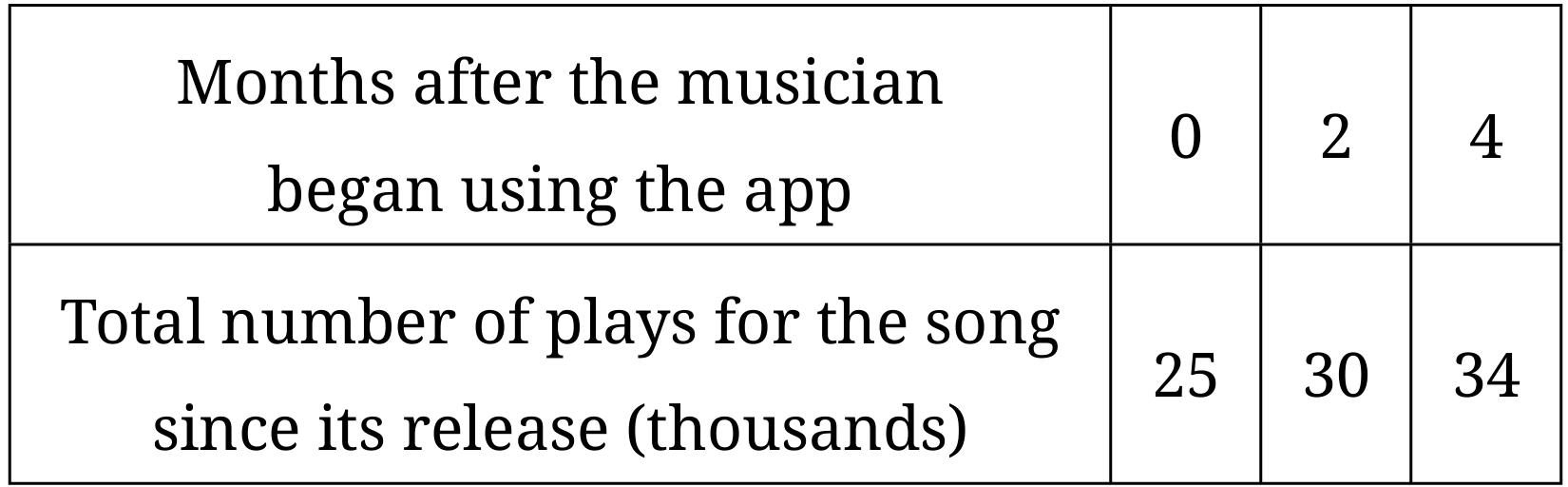
(i)Use the given data to find the average rate of change of the total number of plays for the song, in thousands per month, from \( t = 0 \) to \( t = 4 \) months. Express your answer as a decimal approximation. Show the computations that lead to your answer.
(ii) Use the average rate of change found in part B (i) to estimate the total number of plays for the song, in thousands, for \( t = 1.5 \) months. Show the work that leads to your answer.
(iii) Let \( A_t \) represent the estimate of the total number of plays for the song, in thousands, using the average rate of change found in part B (i). For \( A_{1.5} \) found in part B (ii), it can be shown that \( A_{1.5} < D(1.5) \). Explain why, in general, \( A_t < D(t) \) for all \( t \), where \( 0 < t < 4 \). Your explanation should include a reference to the graph of \( D \) and its relationship to \( A_t \).
Most-appropriate topic codes (AP Precalculus 2024):
• 1.2: Compare rates of change using average rates of change — part B(i)
• 2.5: Construct a model for situations involving proportional output values — part B(ii)
• 1.3: Determine the change in average rates of change for quadratic functions — part B(iii)
• 1.13: Articulate model assumptions and domain restrictions — part C
▶️ Answer/Explanation
A.
(i)
Because \( D(0) = 25 \), \( D(2) = 30 \), and \( D(4) = 34 \), the three equations are: \[ \begin{align*} a(0)^2 + b(0) + c &= 25 \\ a(2)^2 + b(2) + c &= 30 \\ a(4)^2 + b(4) + c &= 34 \end{align*} \] These simplify to: \[ \begin{align*} c &= 25 \quad \text{(1)} \\ 4a + 2b + c &= 30 \quad \text{(2)} \\ 16a + 4b + c &= 34 \quad \text{(3)} \end{align*} \] ✅ Answer: \(\boxed{c=25, \; 4a+2b+c=30, \; 16a+4b+c=34}\)
(ii)
Substitute \( c = 25 \) into (2) and (3): \[ \begin{align*} 4a + 2b &= 5 \quad \text{(2′)} \\ 16a + 4b &= 9 \quad \text{(3′)} \end{align*} \] Multiply (2′) by 2: \( 8a + 4b = 10 \).
Subtract this from (3′): \( (16a+4b) – (8a+4b) = 9 – 10 \) gives \( 8a = -1 \), so \( a = -\frac{1}{8} = -0.125 \).
Substitute into (2′): \( 4(-0.125) + 2b = 5 \) gives \( -0.5 + 2b = 5 \), so \( 2b = 5.5 \), \( b = 2.75 \).
✅ Answer: \(\boxed{a = -0.125, \; b = 2.75, \; c = 25}\)
Thus, \( D(t) = -0.125t^2 + 2.75t + 25 \).
B.
(i)
Average rate of change from \( t=0 \) to \( t=4 \): \[ \frac{D(4)-D(0)}{4-0} = \frac{34 – 25}{4} = \frac{9}{4} = 2.25 \] ✅ Answer: \(\boxed{2.25}\) thousand plays per month.
(ii)
Using the average rate of change, the linear estimate is \( A_t = D(0) + 2.25t = 25 + 2.25t \).
For \( t = 1.5 \): \[ A_{1.5} = 25 + 2.25(1.5) = 25 + 3.375 = 28.375 \] ✅ Answer: \(\boxed{28.375}\) thousand plays.
(iii)
The estimate \( A_t \) is the \( y \)-coordinate of a point on the secant line passing through \( (0, D(0)) \) and \( (4, D(4)) \).
Since \( D(t) \) is a quadratic with \( a = -0.125 < 0 \), its graph is concave down on \( 0 < t < 4 \).
For a concave-down function over an interval, the secant line connecting the endpoints lies below the graph of the function for all \( t \) in the open interval \( (0, 4) \).
Therefore, \( A_t < D(t) \) for all \( t \) where \( 0 < t < 4 \).
✅ Explanation: Concave-down shape places the secant line below the curve.
C.
The quadratic \( D(t) = -0.125t^2 + 2.75t + 25 \) has \( a < 0 \), so it has an absolute maximum (vertex).
Find vertex: \( t = -\frac{b}{2a} = -\frac{2.75}{2(-0.125)} = \frac{2.75}{0.25} = 11 \) months.
In the context, \( D(t) \) models the total number of plays since release, which cannot decrease. However, the quadratic model decreases after \( t = 11 \) (its maximum), which would imply the total plays go down—impossible in reality.
Therefore, the model is only valid up to the time it reaches its maximum. The domain of \( D \) should be restricted to \( t \le 11 \) months (or until the maximum is reached) to ensure the total plays are non-decreasing.
✅ Explanation: The absolute maximum at \( t = 11 \) gives a right endpoint for the domain because the total plays cannot decrease after that time.
Question

▶️ Answer/Explanation
Part A
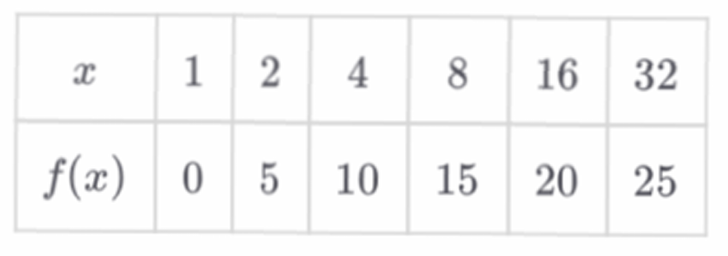
(i) From the table, we find $f(8) = 15$.
Substitute $15$ into the function $g(x)$: $h(8) = g(15) = 0.25(15)^3 – 9.5(15)^2 + 110(15) – 399$.
$h(8) = 0.25(3375) – 9.5(225) + 1650 – 399$.
$h(8) = 843.75 – 2137.5 + 1650 – 399$.
$h(8) = -42.75$.
(ii) To find $f^{-1}(20)$, we look for the $x$ value where $f(x) = 20$.
From the table, $f(16) = 20$.
Therefore, $f^{-1}(20) = 16$.
Part B
(i) We solve the equation $0.25x^3 – 9.5x^2 + 110x – 399 = -45$.
Set the equation to zero: $0.25x^3 – 9.5x^2 + 110x – 354 = 0$.
Using numerical methods or a graphing calculator, the real solutions are approximately:
$x \approx 5.242$
$x \approx 12.188$
$x \approx 20.570$
(ii) The end behavior of a polynomial is determined by its leading term, $0.25x^3$.
Since the leading coefficient is positive and the degree is odd, as $x \to \infty$, $g(x) \to \infty$.
The limit notation is $\lim_{x \to \infty} g(x) = \infty$.
Part C
(i) The function $f$ is best modeled by a logarithmic function.
(ii) In a logarithmic model, constant changes in the output values correspond to proportional changes in the input values.
As the output $f(x)$ increases by a constant $5$ ($0, 5, 10, 15 \dots$),
The input $x$ values are multiplied by a constant factor of $2$ ($1, 2, 4, 8 \dots$).
This constant ratio of inputs for constant additions of outputs is the hallmark of logarithmic growth.
Question

▶️ Answer/Explanation
(A) (i)
First, evaluate the inner function \(f(5)\) using the table: \(f(5) = 34\).
Next, substitute this value into \(g(x)\) to find \(h(5) = g(34)\).
\(g(34) = \frac{34^3 – 14(34) – 27}{34 + 2}\)
\(g(34) = \frac{39304 – 476 – 27}{36} = \frac{38801}{36}\)
\(h(5) \approx 1077.806\)
(A) (ii)
To find \(f^{-1}(4)\), we look for the input value \(x\) in the table that produces an output of \(4\).
The table shows that \(f(3) = 4\).
Therefore, \(f^{-1}(4) = 3\).
(B) (i)
Set \(g(x) = 3\) and solve for \(x\):
\(\frac{x^3 – 14x – 27}{x + 2} = 3\)
Multiply both sides by \((x+2)\): \(x^3 – 14x – 27 = 3(x + 2)\)
Simplify: \(x^3 – 14x – 27 = 3x + 6\)
Rearrange into polynomial form: \(x^3 – 17x – 33 = 0\)
Using a graphing calculator to find the zero of this polynomial:
\(x \approx 4.879\)
(B) (ii)
We evaluate the limit as \(x \to -\infty\) for \(g(x)\).
\(\lim_{x \to -\infty} \frac{x^3 – 14x – 27}{x + 2}\)
By examining the leading terms, the function behaves like \(\frac{x^3}{x} = x^2\) for large absolute values of \(x\).
As \(x \to -\infty\), \(x^2 \to \infty\).
\(\lim_{x \to -\infty} g(x) = \infty\)
(C) (i)
Calculate the first differences of \(f(x)\): \((-5) – (-10) = 5\), \(4 – (-5) = 9\), \(17 – 4 = 13\), \(34 – 17 = 17\).
Calculate the second differences: \(9 – 5 = 4\), \(13 – 9 = 4\), \(17 – 13 = 4\).
Since the second differences are constant, \(f\) is best modeled by a quadratic function.
(C) (ii)
The model is quadratic because for equal intervals of the input values \(x\) (step size of \(1\)), the rate of change of the output values increases by a constant amount (constant second difference of \(4\)).
