
Identifying an Appropriate Function Type for a Given Scenario
When modeling a real-world scenario or data set, the choice of function type depends on how the input and output quantities vary together.
Mathematical expressions help justify why a particular model is appropriate by describing the underlying pattern of change.
Linear Functions
Linear functions are appropriate when the rate of change is approximately constant.
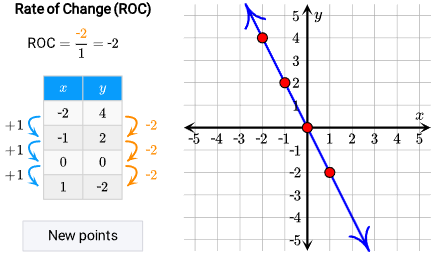
Mathematically, a constant rate of change means
\( \mathrm{ \displaystyle \dfrac{f(x_2) – f(x_1)}{x_2 – x_1} = m } \)
for all input values, where \( \mathrm{m} \) is constant.
The general linear model is
\( \mathrm{ \displaystyle f(x) = mx + b } \)
Quadratic Functions
Quadratic functions are used when the rate of change varies linearly, meaning the first differences are not constant but the second differences are.
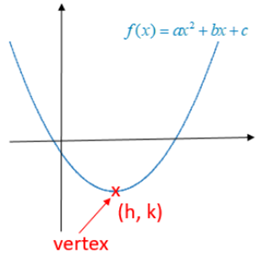
This is expressed numerically as
\( \mathrm{ \displaystyle \Delta^2 f(x) = \text{constant} } \)
The general quadratic model is
\( \mathrm{ \displaystyle f(x) = ax^2 + bx + c } \)
Quadratic graphs are symmetric and have a single maximum or minimum.
Geometric Contexts
In geometric modeling, the number of dimensions often determines the degree of the polynomial.
For area-based contexts (two dimensions):
\( \mathrm{ \displaystyle A(x) = kx^2 } \)
For volume-based contexts (three dimensions):
\( \mathrm{ \displaystyle V(x) = kx^3 } \)
Here, \( \mathrm{k} \) is a constant determined by the shape of the object.
Polynomial Functions with Multiple Features
Polynomial functions are appropriate when a scenario involves multiple real zeros or multiple turning points.
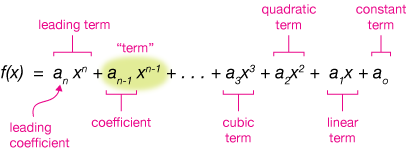
A general polynomial model is
\( \mathrm{ \displaystyle f(x) = a_n x^n + a_{n-1} x^{n-1} + \dots + a_1 x + a_0 } \)
A polynomial of degree \( \mathrm{n} \) can have up to \( \mathrm{n} \) real zeros and up to \( \mathrm{n-1} \) local extrema.
Constant nth Differences
If a data set has constant nonzero nth differences, then it can be modeled by a polynomial of degree \( \mathrm{n} \).
Symbolically, this is expressed as
\( \mathrm{ \displaystyle \Delta^n f(x) = \text{constant}, \; \Delta^{n-1} f(x) \ne \text{constant} } \)
Modeling a Finite Set of Points
A polynomial function of degree \( \mathrm{n} \) or less can be constructed to pass exactly through \( \mathrm{n+1} \) points with distinct input values.
This can be represented conceptually as
\( \mathrm{ \displaystyle f(x_i) = y_i \quad \text{for } i = 1,2,\dots,n+1 } \)
Piecewise-Defined Functions
When a scenario exhibits different behaviors on different intervals, a piecewise-defined function is appropriate.
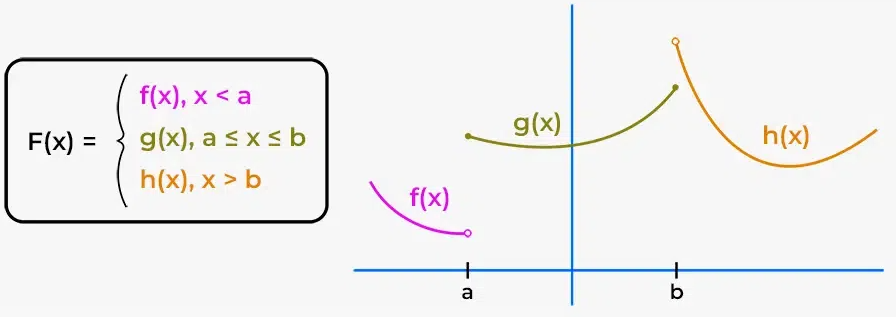
A general piecewise model is written as
\( \mathrm{ \displaystyle f(x) = \begin{cases} f_1(x), & x_1 \le x < x_2 \\ f_2(x), & x_2 \le x < x_3 \\ \vdots \end{cases} } \)
Each formula models the behavior of the scenario on its corresponding interval.
Selecting the correct function type ensures that the mathematical model accurately reflects the structure of the situation being studied.
Example
A cyclist travels at a steady speed, covering 12 kilometers every hour.
Which type of function is most appropriate to model the distance traveled as a function of time, and why?
▶️ Answer/Explanation
The distance increases at a constant rate, so a linear function is appropriate.
\( \mathrm{ \displaystyle d(t) = 12t } \)
Example
The height of a firework rises, slows down, reaches a maximum height, and then falls back to the ground.
Which type of function best models the height as a function of time?
▶️ Answer/Explanation
The motion is symmetric with a single maximum, so a quadratic function is appropriate.
\( \mathrm{ \displaystyle h(t) = at^2 + bt + c } \)
Example
The area of a circular garden depends on the radius of the garden.
Which type of function should be used to model the area in terms of the radius?
▶️ Answer/Explanation
Area is a two-dimensional quantity, so a quadratic model is appropriate.
\( \mathrm{ \displaystyle A(r) = \pi r^2 } \)
Example
A profit function crosses the horizontal axis three times and has two turning points.
Which type of function is suitable for modeling this situation?
▶️ Answer/Explanation
Multiple real zeros and multiple extrema suggest a higher-degree polynomial model.
\( \mathrm{ \displaystyle f(x) = a_3x^3 + a_2x^2 + a_1x + a_0 } \)
Example
A table of values has constant third differences.
What type of function should be used to model the data?
▶️ Answer/Explanation
Constant third differences indicate a polynomial of degree 3.
\( \mathrm{ \displaystyle f(x) = ax^3 + bx^2 + cx + d } \)
Example
Four data points with distinct x-values are given from an experiment.
What is the highest degree polynomial needed to model the data exactly?
▶️ Answer/Explanation
A polynomial of degree at most 3 can pass through four distinct points.
\( \mathrm{ \displaystyle f(x_i) = y_i,\; i=1,2,3,4 } \)
Example
A phone plan charges one rate for the first 2 GB of data and a different rate after that.
Which type of function best models the total cost?
▶️ Answer/Explanation
Different rules apply on different intervals, so a piecewise-defined function is appropriate.
\( \mathrm{ \displaystyle C(x)= \begin{cases} f_1(x), & 0 \le x \le 2 \\ f_2(x), & x > 2 \end{cases} } \)