
Question

Most-appropriate topic codes (AP Precalculus CED):
• 1.14: Function Model Construction and Application — parts (A), (B)(iii), (C)
• 2.2: Change in Linear and Exponential Functions — parts (B)(i), (B)(ii)
• 2.6: Competing Function Model Validation — part (B)(iii)
▶️ Answer/Explanation
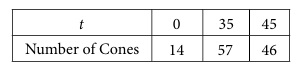
(A)
(i) Substituting the given data into the model \(I(t) = at^2 + bt + c\):
- When \(t = 0\), \(I(0) = 14\): \(a(0)^2 + b(0) + c = 14 \Rightarrow c = 14\).
- When \(t = 35\), \(I(35) = 57\): \(a(35)^2 + b(35) + c = 57 \Rightarrow 1225a + 35b + c = 57\).
- When \(t = 45\), \(I(45) = 46\): \(a(45)^2 + b(45) + c = 46 \Rightarrow 2025a + 45b + c = 46\).
The three equations are:
\(c = 14\)
\(1225a + 35b + 14 = 57\)
\(2025a + 45b + 14 = 46\)
✅ Answer: The three equations are \(c = 14\), \(1225a + 35b = 43\), and \(2025a + 45b = 32\).
(ii) Solve the system:
- \(1225a + 35b = 43\)
- \(2025a + 45b = 32\)
Multiply equation (1) by 9 and equation (2) by 7 to eliminate \(b\): \[ 11025a + 315b = 387 \] \[ 14175a + 315b = 224 \] Subtract the first from the second: \[ 3150a = -163 \Rightarrow a = -\frac{163}{3150} \approx -0.051746\ldots \] Substitute \(a\) into \(1225a + 35b = 43\): \[ 1225(-0.051746) + 35b = 43 \Rightarrow -63.38885 + 35b = 43 \Rightarrow 35b = 106.38885 \Rightarrow b \approx 3.039681 \] Thus, \[ a \approx -0.052, \quad b \approx 3.040, \quad c = 14 \] ✅ Answer: \(\boxed{a \approx -0.052,\ b \approx 3.040,\ c = 14}\) (or \(a \approx -0.0517,\ b \approx 3.0397,\ c = 14\)).
(B)
(i) Average rate of change from \(t = 35\) to \(t = 45\): \[ \frac{I(45) – I(35)}{45 – 35} = \frac{46 – 57}{10} = \frac{-11}{10} = -1.1 \] ✅ Answer: \(\boxed{-1.1}\) cones per day.
(ii) Using the average rate of change: \[ I(40) \approx I(35) + (-1.1)(40 – 35) = 57 + (-1.1)(5) = 57 – 5.5 = 51.5 \] ✅ Answer: \(\boxed{51.5}\) cones (approximately 51 or 52 cones).
(iii) Using the model: \[ I(40) \approx -0.052(40)^2 + 3.040(40) + 14 = -0.052(1600) + 121.6 + 14 = -83.2 + 135.6 = 52.4 \] More precisely with stored values: \(I(40) \approx 52.794\).
The estimate from the average rate of change (51.5) is less than \(I(40) \approx 52.8\).
Explanation: The average rate of change gives the slope of the secant line between \(t = 35\) and \(t = 45\). Since the quadratic model has \(a < 0\), its graph is concave down. On the interval \((35, 45)\), the secant line lies below the graph. Therefore, the linear estimate using the average rate of change underestimates the actual value given by the concave-down quadratic at \(t = 40\).
✅ Answer: The secant-line estimate is lower because the quadratic is concave down.
(C) The range of \(I\) is limited by the context:
- The number of cones sold cannot be negative: \(I(t) \ge 0\).
- Since \(a < 0\), the quadratic has a maximum. From the model, the vertex gives the maximum number of cones sold. The vertex \(t = -\frac{b}{2a} \approx 29.23\) yields \(I_{\text{max}} \approx 58.64\).
Thus, a reasonable range is \(0 \le I(t) \le 59\) (whole cones).
✅ Answer: The range is limited to non‑negative integers up to about 59 cones.
▶️ Answer/Explanation
Part A
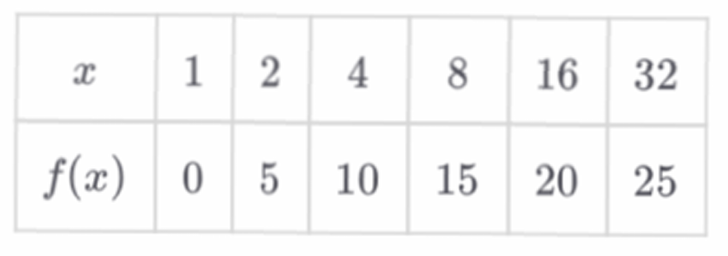
(i) From the table, we find $f(8) = 15$.
Substitute $15$ into the function $g(x)$: $h(8) = g(15) = 0.25(15)^3 – 9.5(15)^2 + 110(15) – 399$.
$h(8) = 0.25(3375) – 9.5(225) + 1650 – 399$.
$h(8) = 843.75 – 2137.5 + 1650 – 399$.
$h(8) = -42.75$.
(ii) To find $f^{-1}(20)$, we look for the $x$ value where $f(x) = 20$.
From the table, $f(16) = 20$.
Therefore, $f^{-1}(20) = 16$.
Part B
(i) We solve the equation $0.25x^3 – 9.5x^2 + 110x – 399 = -45$.
Set the equation to zero: $0.25x^3 – 9.5x^2 + 110x – 354 = 0$.
Using numerical methods or a graphing calculator, the real solutions are approximately:
$x \approx 5.242$
$x \approx 12.188$
$x \approx 20.570$
(ii) The end behavior of a polynomial is determined by its leading term, $0.25x^3$.
Since the leading coefficient is positive and the degree is odd, as $x \to \infty$, $g(x) \to \infty$.
The limit notation is $\lim_{x \to \infty} g(x) = \infty$.
Part C
(i) The function $f$ is best modeled by a logarithmic function.
(ii) In a logarithmic model, constant changes in the output values correspond to proportional changes in the input values.
As the output $f(x)$ increases by a constant $5$ ($0, 5, 10, 15 \dots$),
The input $x$ values are multiplied by a constant factor of $2$ ($1, 2, 4, 8 \dots$).
This constant ratio of inputs for constant additions of outputs is the hallmark of logarithmic growth.

▶️ Answer/Explanation
(A) (i)
First, evaluate the inner function \(f(5)\) using the table: \(f(5) = 34\).
Next, substitute this value into \(g(x)\) to find \(h(5) = g(34)\).
\(g(34) = \frac{34^3 – 14(34) – 27}{34 + 2}\)
\(g(34) = \frac{39304 – 476 – 27}{36} = \frac{38801}{36}\)
\(h(5) \approx 1077.806\)
(A) (ii)
To find \(f^{-1}(4)\), we look for the input value \(x\) in the table that produces an output of \(4\).
The table shows that \(f(3) = 4\).
Therefore, \(f^{-1}(4) = 3\).
(B) (i)
Set \(g(x) = 3\) and solve for \(x\):
\(\frac{x^3 – 14x – 27}{x + 2} = 3\)
Multiply both sides by \((x+2)\): \(x^3 – 14x – 27 = 3(x + 2)\)
Simplify: \(x^3 – 14x – 27 = 3x + 6\)
Rearrange into polynomial form: \(x^3 – 17x – 33 = 0\)
Using a graphing calculator to find the zero of this polynomial:
\(x \approx 4.879\)
(B) (ii)
We evaluate the limit as \(x \to -\infty\) for \(g(x)\).
\(\lim_{x \to -\infty} \frac{x^3 – 14x – 27}{x + 2}\)
By examining the leading terms, the function behaves like \(\frac{x^3}{x} = x^2\) for large absolute values of \(x\).
As \(x \to -\infty\), \(x^2 \to \infty\).
\(\lim_{x \to -\infty} g(x) = \infty\)
(C) (i)
Calculate the first differences of \(f(x)\): \((-5) – (-10) = 5\), \(4 – (-5) = 9\), \(17 – 4 = 13\), \(34 – 17 = 17\).
Calculate the second differences: \(9 – 5 = 4\), \(13 – 9 = 4\), \(17 – 13 = 4\).
Since the second differences are constant, \(f\) is best modeled by a quadratic function.
(C) (ii)
The model is quadratic because for equal intervals of the input values \(x\) (step size of \(1\)), the rate of change of the output values increases by a constant amount (constant second difference of \(4\)).