AP Precalculus -1.14 Function Models: Construction and Application- MCQ Exam Style Questions - Effective Fall 2023
AP Precalculus -1.14 Function Models: Construction and Application- MCQ Exam Style Questions – Effective Fall 2023
AP Precalculus -1.14 Function Models: Construction and Application- MCQ Exam Style Questions – AP Precalculus- per latest AP Precalculus Syllabus.
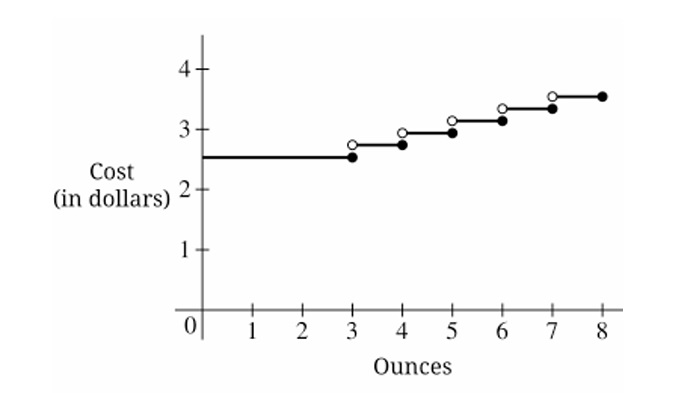
Question
(B) The range is positive integers.
(C) The range is values of the form \( 2.54 + 0.2x \), where \( x \) is a nonnegative real number.
(D) The range is values of the form \( 2.54 + 0.2x \), where \( x \) is a nonnegative integer.
▶️ Answer/Explanation
Cost structure: $2.54 for up to 3 ounces, then $0.20 for each additional ounce or portion of an ounce less than a full ounce. This means weight exceeding 3 ounces is rounded up to the next integer ounce for pricing beyond 3 ounces.
Let \( w \) = weight in ounces, \( w > 3 \). Additional ounces counted = \( \lceil w – 3 \rceil \) (ceiling function). Let \( x = \lceil w – 3 \rceil \), a nonnegative integer.
Cost = \( 2.54 + 0.20x \), \( x \) ∈ {0, 1, 2, …}. Thus the range is a set of discrete values of that form, not all real numbers, because \( x \) is integer.
✅ Answer: (D)
Question
(B) \( C(d) = \begin{cases} 79.95 & \text{for } 0 \leq d \leq 5 \\ 79.95 + 10d & \text{for } d > 5 \end{cases} \)
(C) \( C(d) = \begin{cases} 79.95 & \text{for } 0 \leq d \leq 5 \\ 79.95d + 10 & \text{for } d > 5 \end{cases} \)
(D) \( C(d) = 79.95 + 10d \)
▶️ Answer/Explanation
For \( 0 \leq d \leq 5 \), cost = base price $79.95.
For \( d > 5 \), extra data = \( d – 5 \) GB, charged at $10 per extra GB, so cost = \( 79.95 + 10(d – 5) \).
The piecewise function matches this.
✅ Answer: (A)
Question

▶️ Answer/Explanation
1. Analyze Parameters:
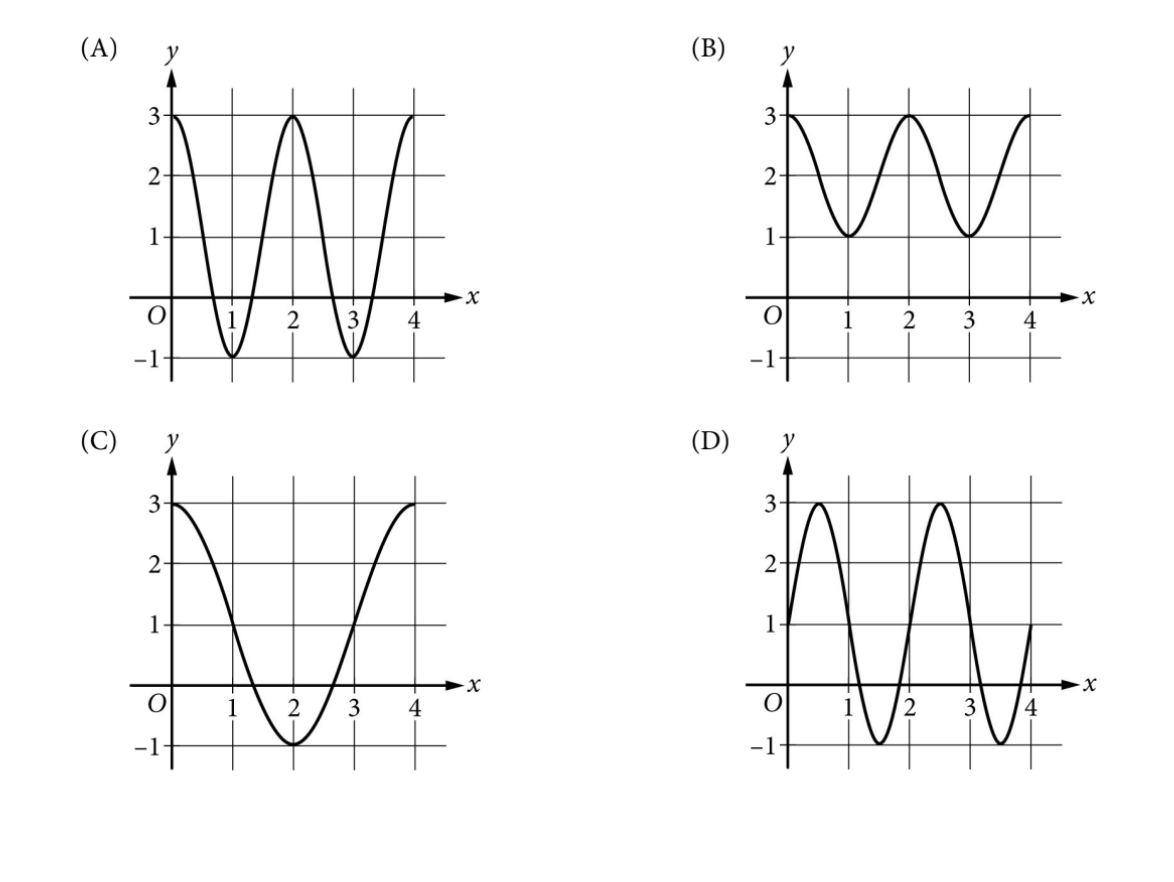
Amplitude = 2, Midline = 1. Max = 3, Min = -1.
Period = \(2\pi / \pi = 2\).
2. Check Key Points:
At \(x=0\), \(g(0) = 2\cos(0)+1 = 3\).
At \(x=1\) (half period), \(g(1) = 2\cos(\pi)+1 = -1\).
At \(x=2\) (full period), \(g(2) = 3\).
3. Match Graph:
Graph (A) starts at 3, drops to -1 at \(x=1\), and returns to 3 at \(x=2\).
✅ Answer: (A)
Question

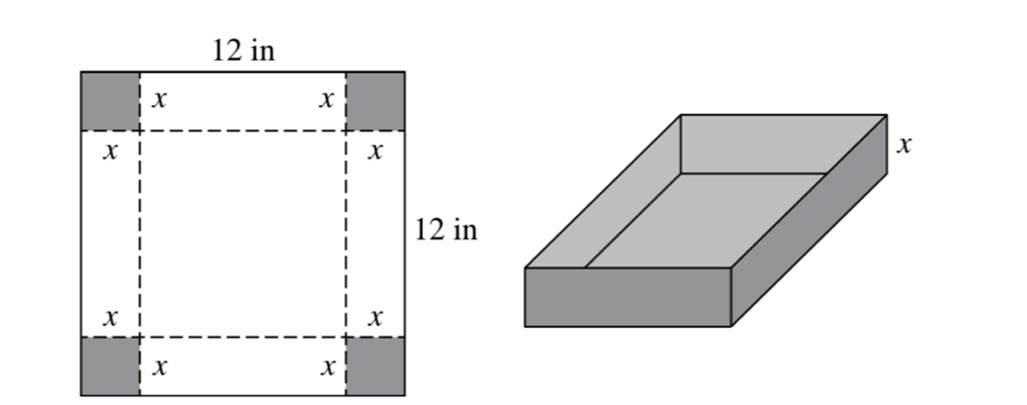
The figure shows a square sheet of cardboard on the left and an open box on the right. The square sheet has side length $12$ inches (in) and is used to make the open box by removing from each of the four corners a square of side length $x$ inches, and folding up the sides. For what value of $x$ does the box have the maximum possible volume?
Note: The volume of a rectangular solid with length $l$, width $w$, and height $h$ is $V = lwh$.
▶️ Answer/Explanation
The side of the box base is $l = w = 12 – 2x$ and the height is $h = x$.
The volume function is $V(x) = x(12 – 2x)^2 = 4x^3 – 48x^2 + 144x$.
To find the maximum, find the derivative: $V'(x) = 12x^2 – 96x + 144$.
Set the derivative to zero: $12(x^2 – 8x + 12) = 0$.
Factor the quadratic: $12(x – 6)(x – 2) = 0$.
Critical values are $x = 2$ and $x = 6$.
Since $x = 6$ results in a volume of $0$, the maximum occurs at $x = 2$.
The correct option is (A).
Question

B) $347$
C) $354$
D) $362$
▶️ Answer/Explanation
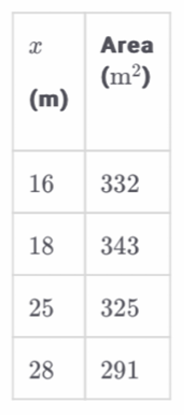
The quadratic regression for the points $(16, 332), (18, 343), (25, 325), (28, 291)$ is $A(x) = -0.932x^2 + 35.85x + -2.48$.
The $x$-coordinate of the vertex (maximum) is found using $x = \frac{-b}{2a} = \frac{-35.85}{2(-0.932)} \approx 19.23$.
Substituting $x \approx 19.23$ back into the model: $A(19.23) = -0.932(19.23)^2 + 35.85(19.23) – 2.48$.
Calculating the value gives $A(19.23) \approx 342.22 + 689.39 – 2.48 \approx 342.3$.
Alternatively, checking a simplified model $A(x) = x(L-x)$, where $P=2L \approx 77$, yields a peak near $19.25$.
Since $18$ and $20$ are symmetric around the peak and $A(18)=343$, the maximum must be slightly higher than $343$.
The regression results confirm the nearest integer maximum value is approximately $347$.
Therefore, the correct choice is B) $347$.
Question
▶️ Answer/Explanation
As $t \to \infty$, $e^{-0.0149t} \to 0$, so $\lim_{t \to \infty} L(t) = b$, which means $b = 1$.
Using $L(0) = 15$, we get $a e^0 + 1 = 15$, which simplifies to $a + 1 = 15$, so $a = 14$.
The function is $L(t) = 14e^{-0.0149t} + 1$.
To find $t$ when $L(t) = 6$, set $14e^{-0.0149t} + 1 = 6$.
Subtract 1 and divide by 14 to get $e^{-0.0149t} = \frac{5}{14}$.
Take the natural log: $-0.0149t = \ln\left(\frac{5}{14}\right)$.
Solve for $t = \frac{\ln(5/14)}{-0.0149} \approx 69.102$.
The correct option is (C).
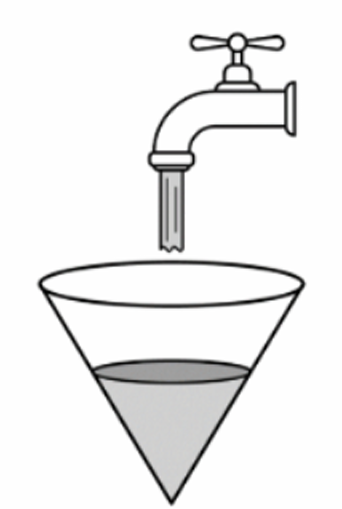
Question


▶️ Answer/Explanation
The correct option is (B).
The volume \(V\) of a cone is defined by the formula \(V = \frac{1}{3}\pi r^2 h\).
Since the tank is conical, the radius \(r\) is directly proportional to the depth \(h\); we can write \(r = k \cdot h\).
Substituting \(r = kh\) into the volume formula gives \(V = \frac{1}{3}\pi (kh)^2 h = \frac{1}{3}\pi k^2 h^3\).
This simplifies to \(V = C \cdot h^3\), where \(C\) is a positive constant.
This equation indicates that Volume is a cubic function of Depth.
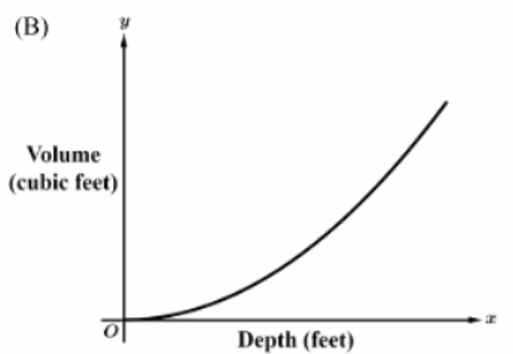
A cubic function \(y = x^3\) (for \(x > 0\)) starts at the origin and increases with an increasing slope (concave up).
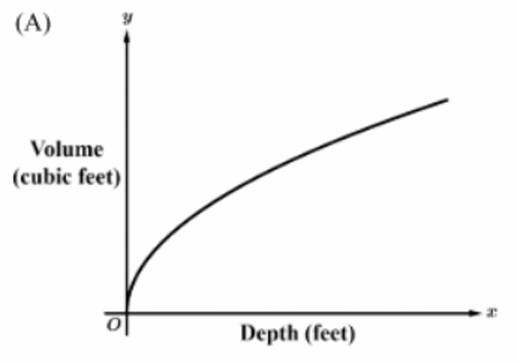
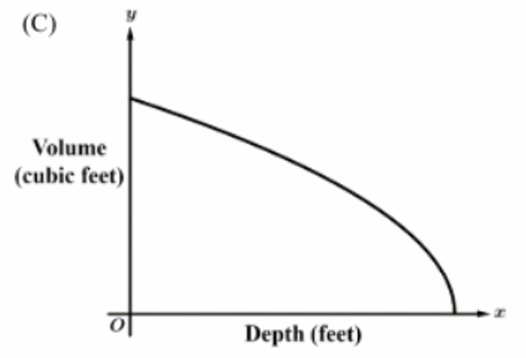
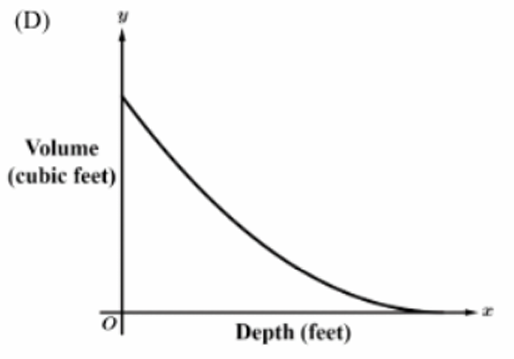
Graphs (C) and (D) are incorrect because volume must increase as depth increases.
Graph (A) is concave down, whereas Graph (B) is concave up, matching the cubic relationship.

Question
▶️ Answer/Explanation
The correct option is (A).
For data usage $0 \le d \le 5$, the cost is a constant flat rate of $\$79.95$.
For data usage $d > 5$, the “additional” data used is calculated as $(d – 5)$.
The extra charge is the rate of $\$10$ multiplied by these additional gigabytes: $10(d – 5)$.
The total cost for $d > 5$ is the base cost plus the extra charge: $79.95 + 10(d – 5)$.
This matches the piecewise structure shown in Option (A).
Question (Calc Allowed)

(B) $V(P) = 1650P$
(C) $V(P) = \frac{11.458}{P}$
(D) $V(P) = \frac{1650}{P}$
▶️ Answer/Explanation
Boyle’s Law implies an inverse relationship: $P \cdot V = k$, where $k$ is a constant.
Using the first data point from the table: $P = 137.500$ and $V = 12$.
Calculate the constant: $k = 137.500 \times 12 = 1650$.
Verify with another point: $103.125 \times 16 = 1650$.
Rearranging the equation $P \cdot V = 1650$ to solve for $V$ gives $V(P) = \frac{1650}{P}$.
Therefore, the correct model matching the data is option (D).
Question (Calc Allowed)
(B) The ball begins at its maximum height of $15.240$ meters. The height of the ball decreases until it reaches the ground $2.269$ seconds after it leaves the window.
(C) After leaving the window, the height of the ball increases to its maximum height of $16.228$ meters. Then the height of the ball decreases until it reaches the ground $1.820$ seconds after reaching its maximum height.
(D) After leaving the window, the height of the ball increases to its maximum height of $16.228$ meters. Then the height of the ball decreases until it reaches the ground $2.269$ seconds after reaching its maximum height.
▶️ Answer/Explanation
The initial velocity is $v_0 = 4.4$ m/s (positive), so the ball first moves upward.
The time to reach maximum height is $t = \frac{-b}{2a} = \frac{-4.4}{2(-4.9)} \approx 0.449$ seconds.
The maximum height is $h(0.449) = -4.9(0.449)^2 + 4.4(0.449) + 15.24 \approx 16.228$ meters.
To find when it hits the ground, set $h(t) = 0$ and solve $-4.9t^2 + 4.4t + 15.24 = 0$ using the quadratic formula.
The total time $t \approx 2.269$ seconds is the time from $t=0$ until impact.
The time from maximum height to the ground is $2.269 – 0.449 = 1.820$ seconds.
Therefore, Option (C) correctly describes the upward motion to $16.228$ m and the subsequent $1.820$ s fall.
Question (Calc Allowed)
(B) $29.176$
(C) $32.121$
(D) $38.935$
▶️ Answer/Explanation
The relationship is given as $I \propto \frac{1}{d^2}$, which implies $I \cdot d^2 = k$.
Using the initial values, calculate the constant: $k = 26.5 \cdot 4^2 = 26.5 \cdot 16 = 424$.
Set up the equation for the new distance: $I_{new} \cdot (3.3)^2 = 424$.
Calculate the new distance squared: $(3.3)^2 = 10.89$.
Solve for the new intensity: $I_{new} = \frac{424}{10.89}$.
Perform the division: $I_{new} \approx 38.9348$.
The result rounds to $38.935$, which matches option (D).
Question

▶️ Answer/Explanation
Part A
(i) From the table, we find $f(8) = 15$.
Substitute $15$ into the function $g(x)$: $h(8) = g(15) = 0.25(15)^3 – 9.5(15)^2 + 110(15) – 399$.
$h(8) = 0.25(3375) – 9.5(225) + 1650 – 399$.
$h(8) = 843.75 – 2137.5 + 1650 – 399$.
$h(8) = -42.75$.
(ii) To find $f^{-1}(20)$, we look for the $x$ value where $f(x) = 20$.
From the table, $f(16) = 20$.
Therefore, $f^{-1}(20) = 16$.
Part B
(i) We solve the equation $0.25x^3 – 9.5x^2 + 110x – 399 = -45$.
Set the equation to zero: $0.25x^3 – 9.5x^2 + 110x – 354 = 0$.
Using numerical methods or a graphing calculator, the real solutions are approximately:
$x \approx 5.242$
$x \approx 12.188$
$x \approx 20.570$
(ii) The end behavior of a polynomial is determined by its leading term, $0.25x^3$.
Since the leading coefficient is positive and the degree is odd, as $x \to \infty$, $g(x) \to \infty$.
The limit notation is $\lim_{x \to \infty} g(x) = \infty$.
Part C
(i) The function $f$ is best modeled by a logarithmic function.
(ii) In a logarithmic model, constant changes in the output values correspond to proportional changes in the input values.
As the output $f(x)$ increases by a constant $5$ ($0, 5, 10, 15 \dots$),
The input $x$ values are multiplied by a constant factor of $2$ ($1, 2, 4, 8 \dots$).
This constant ratio of inputs for constant additions of outputs is the hallmark of logarithmic growth.
Question

▶️ Answer/Explanation
(A) (i)
First, evaluate the inner function \(f(5)\) using the table: \(f(5) = 34\).
Next, substitute this value into \(g(x)\) to find \(h(5) = g(34)\).
\(g(34) = \frac{34^3 – 14(34) – 27}{34 + 2}\)
\(g(34) = \frac{39304 – 476 – 27}{36} = \frac{38801}{36}\)
\(h(5) \approx 1077.806\)
(A) (ii)
To find \(f^{-1}(4)\), we look for the input value \(x\) in the table that produces an output of \(4\).
The table shows that \(f(3) = 4\).
Therefore, \(f^{-1}(4) = 3\).
(B) (i)
Set \(g(x) = 3\) and solve for \(x\):
\(\frac{x^3 – 14x – 27}{x + 2} = 3\)
Multiply both sides by \((x+2)\): \(x^3 – 14x – 27 = 3(x + 2)\)
Simplify: \(x^3 – 14x – 27 = 3x + 6\)
Rearrange into polynomial form: \(x^3 – 17x – 33 = 0\)
Using a graphing calculator to find the zero of this polynomial:
\(x \approx 4.879\)
(B) (ii)
We evaluate the limit as \(x \to -\infty\) for \(g(x)\).
\(\lim_{x \to -\infty} \frac{x^3 – 14x – 27}{x + 2}\)
By examining the leading terms, the function behaves like \(\frac{x^3}{x} = x^2\) for large absolute values of \(x\).
As \(x \to -\infty\), \(x^2 \to \infty\).
\(\lim_{x \to -\infty} g(x) = \infty\)
(C) (i)
Calculate the first differences of \(f(x)\): \((-5) – (-10) = 5\), \(4 – (-5) = 9\), \(17 – 4 = 13\), \(34 – 17 = 17\).
Calculate the second differences: \(9 – 5 = 4\), \(13 – 9 = 4\), \(17 – 13 = 4\).
Since the second differences are constant, \(f\) is best modeled by a quadratic function.
(C) (ii)
The model is quadratic because for equal intervals of the input values \(x\) (step size of \(1\)), the rate of change of the output values increases by a constant amount (constant second difference of \(4\)).