

▶️ Answer/Explanation
From the given answer and typical AP graph problems: Graph has zeros at \( x = 5 \) (touch/bounce, so multiplicity even), \( x = 1 \) (cross), \( x = -8 \) (cross). Degree is even (since both ends go in the same direction) and positive leading coefficient (both ends up).
Thus factors: \( (x – 5)^2 \) for the even-multiplicity zero, \( (x – 1) \) and \( (x + 8) \) for the simple zeros. Leading coefficient positive and scaled appropriately → matches \( 0.25(x – 5)^2(x – 1)(x + 8) \).
✅ Answer: (C)
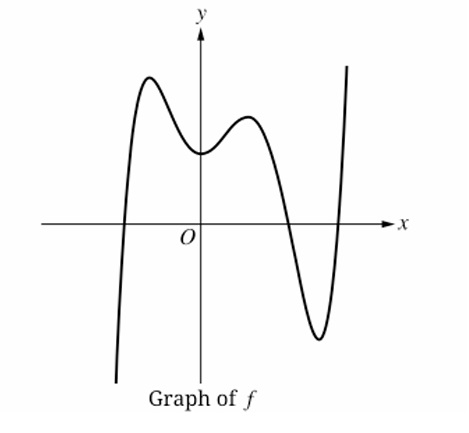
▶️ Answer/Explanation
Points of inflection occur where concavity changes (i.e., \( f” \) changes sign).
From typical AP problems, the given graph likely shows a polynomial with three changes in concavity within the visible domain.
✅ Answer: (B)

▶️ Answer/Explanation
From answer explanation: \( f \) has interior local extrema at \( x = 1 \) and \( x = 2.4 \) (approx), plus the endpoints \( x = 0 \) and \( x = 3 \) can be local extrema on a closed interval.
That’s 4 total (two local mins/maxs inside, two at endpoints).
✅ Answer: (B)
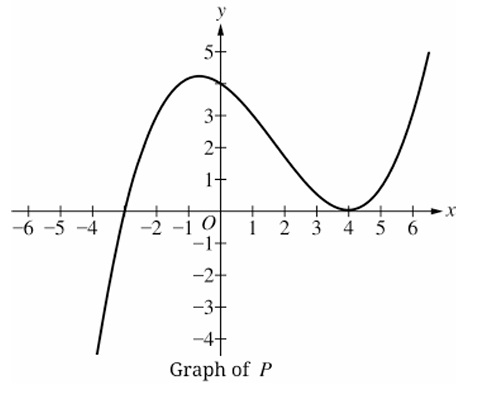
▶️ Answer/Explanation
From answer explanation: zero at \( x = 4 \) has even multiplicity (graph tangent to x-axis), zero at \( x = -3 \) has odd multiplicity (graph crosses x-axis).
Thus: factor \( (x – 4)^2 \) (even), factor \( (x + 3) \) (odd).
Positive leading coefficient ⇒ \( P(x) = \frac{(x-4)^2(x+3)}{12} \).
✅ Answer: (B)
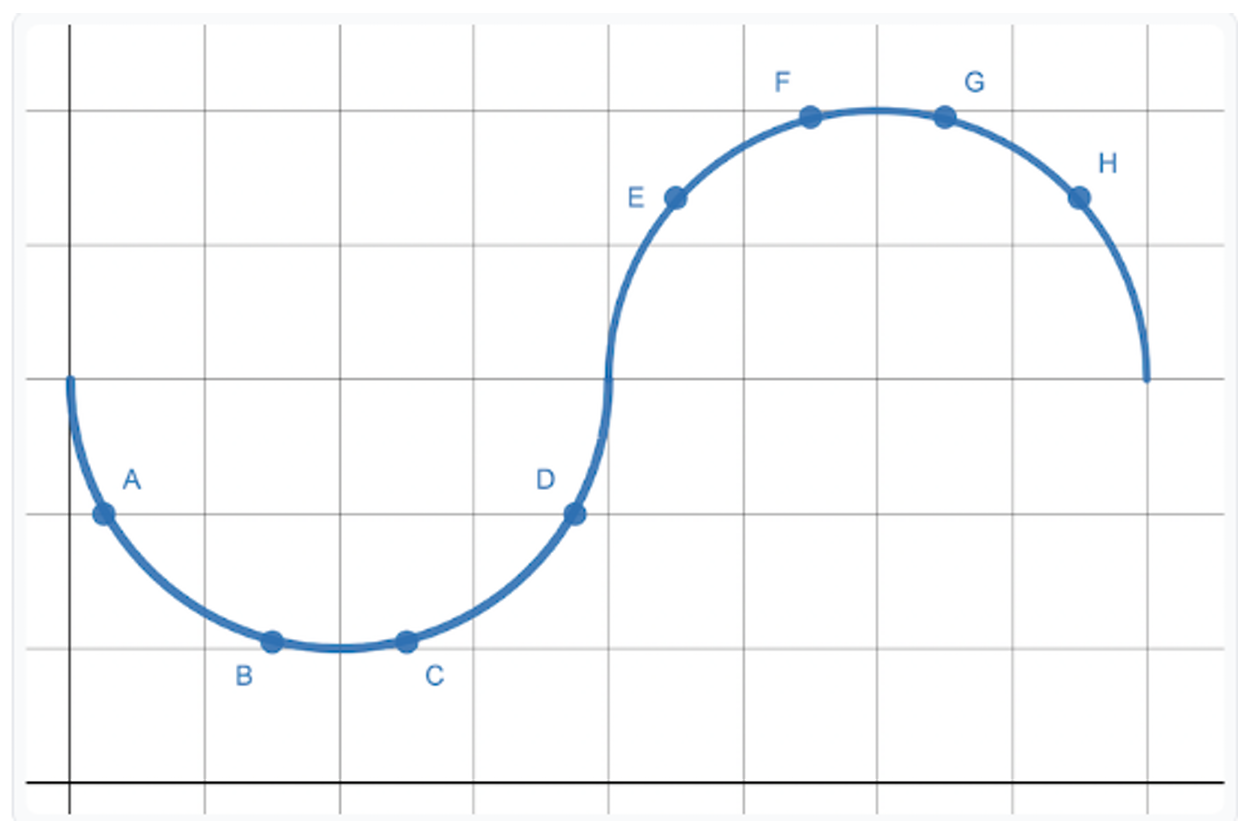
▶️ Answer/Explanation
A point of inflection is a point on a curve at which the concavity changes (from concave up to concave down, or vice versa). This occurs where the second derivative $g”(x)$ changes sign.
- In interval $[B, C]$: The graph is strictly concave down (the “frown” shape), meaning $g”(x) < 0$. No change occurs.
- In interval $[D, E]$: The graph is strictly concave up (the “cup” shape), meaning $g”(x) > 0$. No change occurs.
- In interval $[G, H]$: The curve transitions from being concave up (after the local minimum at F) to concave down (as it approaches the peak after H). Because the “bend” of the graph reverses direction within this window, a point of inflection must exist here.
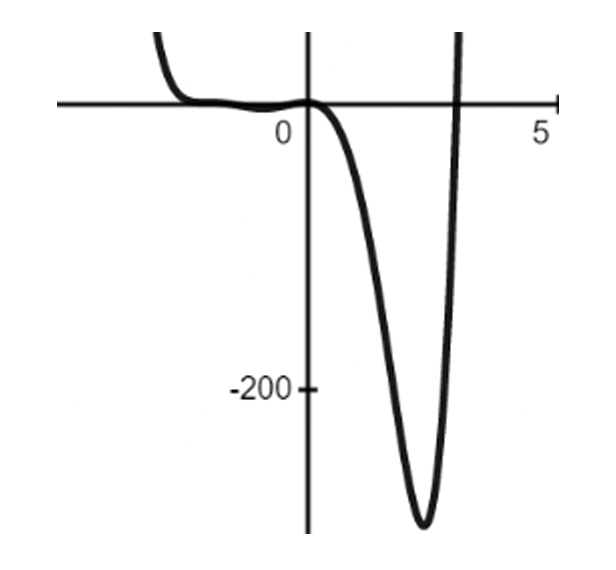
▶️ Answer/Explanation
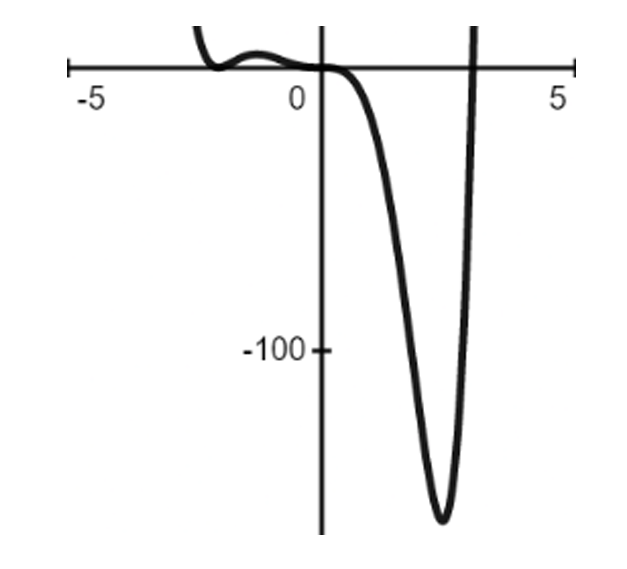
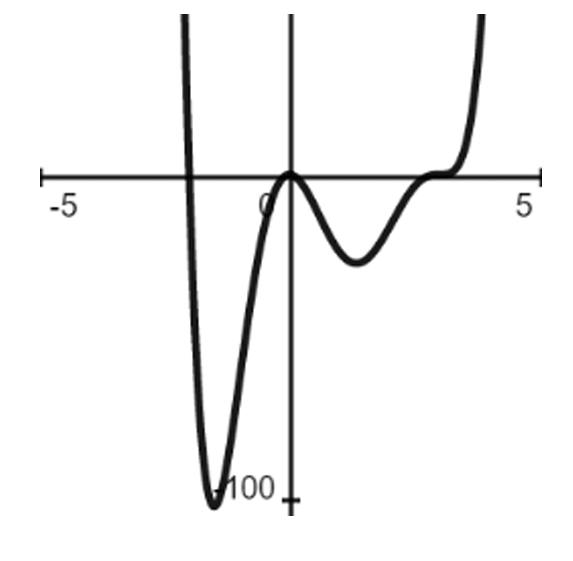
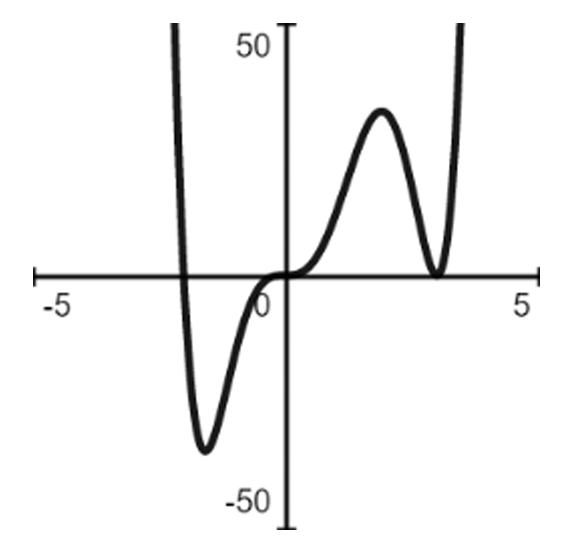
The correct answer is c.
Identify roots: $x = -2$ (multiplicity $3$), $x = 0$ (multiplicity $2$), and $x = 3$ (multiplicity $1$).
Determine degree: The total degree is $2 + 3 + 1 = 6$, which is an even number.
Leading coefficient: Since it is positive ($+1$), the end behavior is $y \to \infty$ as $x \to \pm\infty$.
At $x = -2$, the graph crosses the x-axis with an “S-curve” (inflection) due to the cubic power.
At $x = 0$, the graph touches and bounces off the x-axis because the power is even ($2$).
At $x = 3$, the graph crosses the axis linearly because the power is odd ($1$).
Graph c is the only one showing the correct bounce at $x = 0$ and the correct end behavior.

▶️ Answer/Explanation
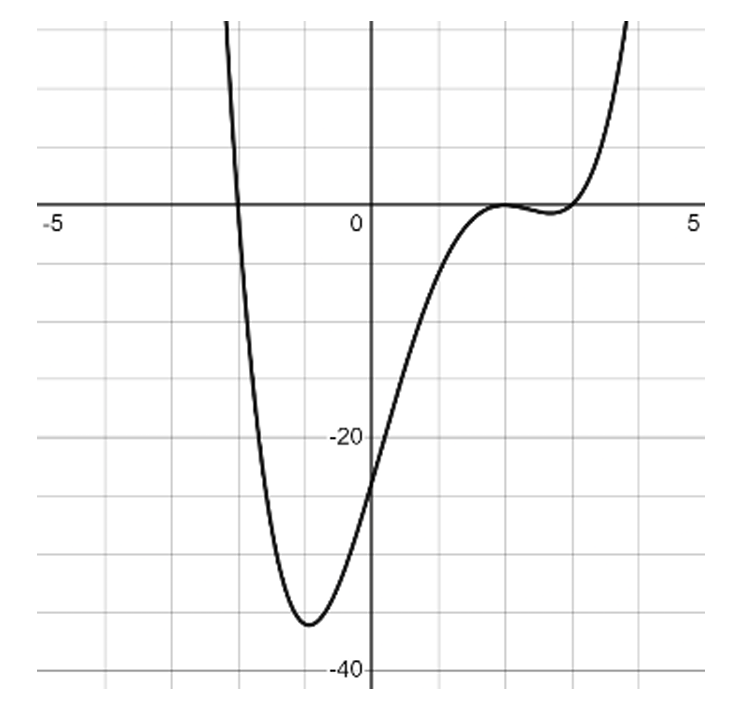
For $f(x)$, the highest power of $x$ is $5$, so the degree is $5$.
For $g(x)$, the values change sign/direction $3$ times (roots exist between $-18$ and $-12$, $-12$ and $-6$, $-6$ and $0$), implying at least degree $4$.
For $h(x)$, the graph shows $3$ turning points and $2$ x-intercepts (one being a touch/bounce point).
A bounce at an x-intercept indicates a multiplicity of at least $2$, and another crossing indicates at least $1$.
The $3$ turning points on $h(x)$ suggest a minimum degree of $4$.
Both $g(x)$ and $h(x)$ have a minimum degree of $4$, which is lower than $f(x)$’s degree of $5$.
Therefore, both $g(x)$ and $h(x)$ share the lowest potential degree among the choices.
Correct Option: d
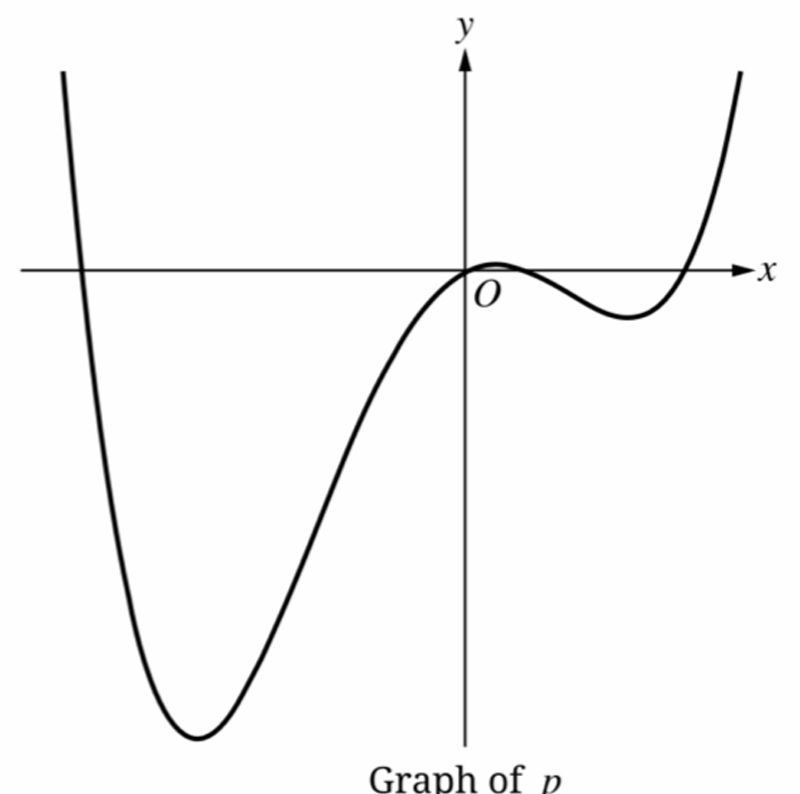
▶️ Answer/Explanation
The correct option is (B) Two.
A point of inflection occurs where the concavity of the function changes (from concave up to concave down, or vice versa).
Observing the graph of the quartic polynomial \(p\):
1. The curve is concave up around the first local minimum on the left.
2. It changes to concave down around the local maximum near the origin. This change requires one point of inflection.
3. The curve changes back to concave up around the second local minimum on the right. This change requires a second point of inflection.
Therefore, there are exactly two points where the concavity changes.
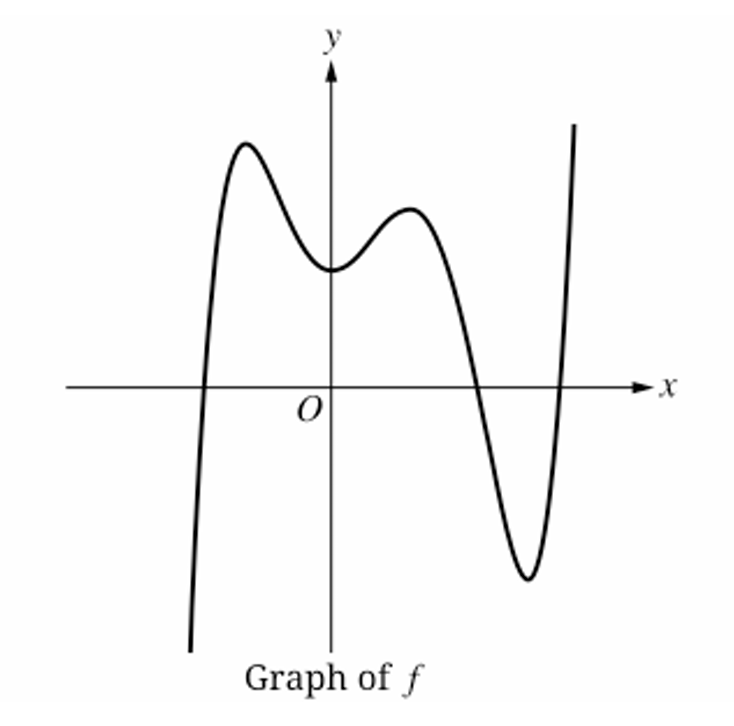
▶️ Answer/Explanation
A point of inflection occurs where the graph changes concavity (from concave up to concave down, or vice-versa).
Starting from the left, the graph begins concave down as it rises toward the first local maximum.
It switches to concave up to form the first local minimum near the $y$-axis (Point $1$).
It switches back to concave down to form the second local maximum (Point $2$).
It then switches to concave up to form the deep local minimum on the right (Point $3$).
Finally, it switches to concave down very briefly or stays concave up? Looking closely, the final upward stroke suggests a $4^{th}$ change in curvature (Point $4$).
Counting the transitions between the peaks and valleys, there are four distinct inflection points.
Correct Option: (C)
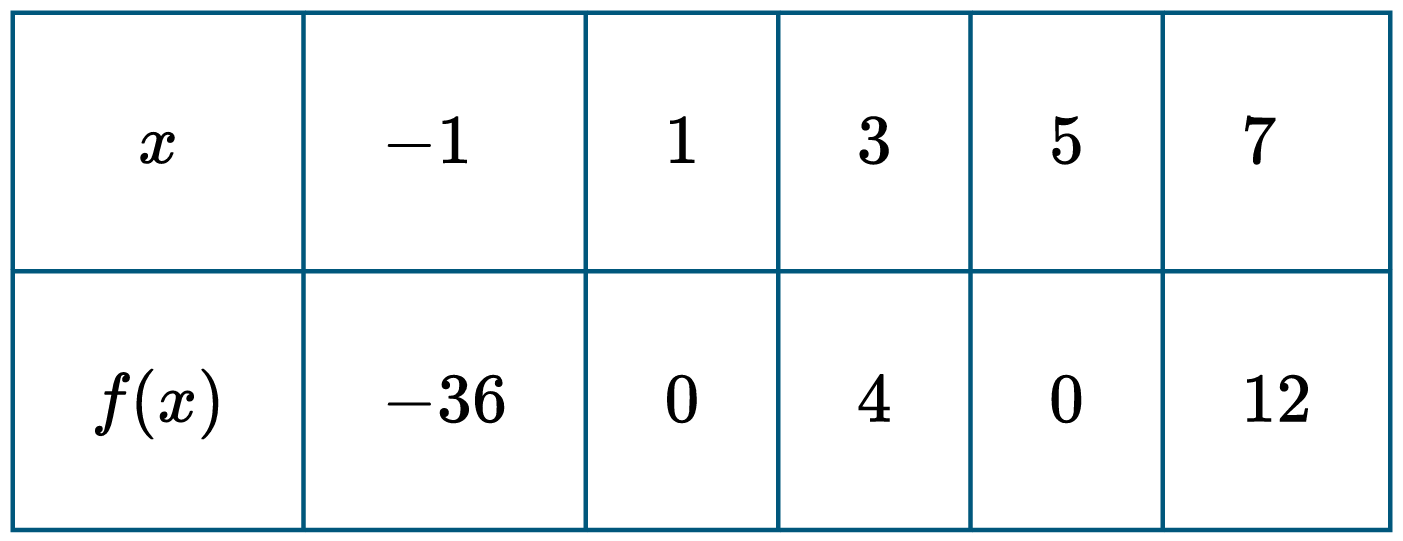
▶️ Answer/Explanation
The table shows zeros at $x = 1$ and $x = 5$, where $f(1) = 0$ and $f(5) = 0$.
Between these zeros, at $x = 3$, the function is positive ($f(3) = 4$).
For $x < 1$, specifically at $x = -1$, the function is negative ($f(-1) = -36$).
For $x > 5$, specifically at $x = 7$, the function is positive ($f(7) = 12$).
Since $f(x)$ must cross or touch the x-axis only at $x=1$ and $x=5$, the sign change at $x=1$ (negative to positive) indicates it is not a maximum.
However, at $x = 5$, the function goes from positive ($f(3)=4$) to zero ($f(5)=0$) and back to positive ($f(7)=12$).
This means $f(x)$ touches the x-axis at $(5, 0)$ without crossing it, staying $\ge 0$ in that interval.
Therefore, $(5, 0)$ must be a local minimum.
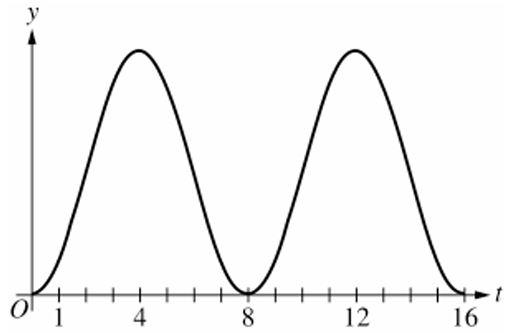
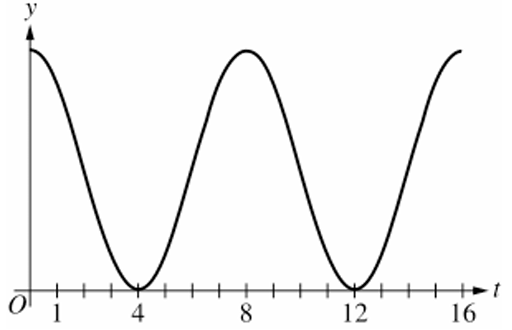
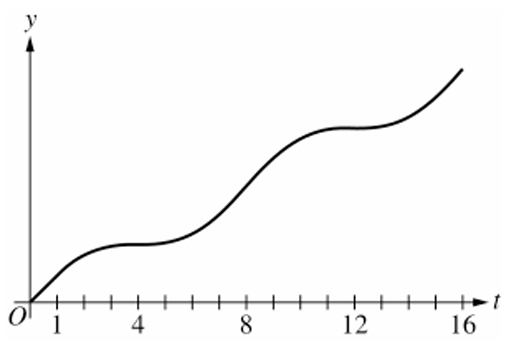
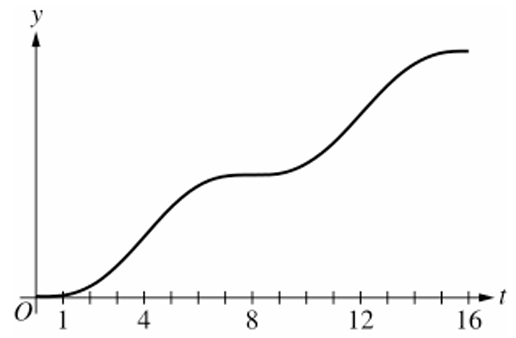
▶️ Answer/Explanation
The function $N(t)$ represents the total number of customers, so $N(t) = \int_{0}^{t} R(x) dx$.
Since $R(t)$ is a rate of arrival, $R(t) \ge 0$, which means $N(t)$ must be a non-decreasing function.
The derivative of the total accumulation is the rate, so $N'(t) = R(t)$ and $N”(t) = R'(t)$.
When $R(t)$ is increasing ($0 < t < 4$ and $8 < t < 12$), $N(t)$ is concave up ($N”(t) > 0$).
When $R(t)$ is decreasing ($4 < t < 8$ and $12 < t < 16$), $N(t)$ is concave down ($N”(t) < 0$).
Graph (D) starts at $(0,0)$, always increases, and switches concavity at $t = 4, 8, 12$.
Therefore, the correct graph is (D).
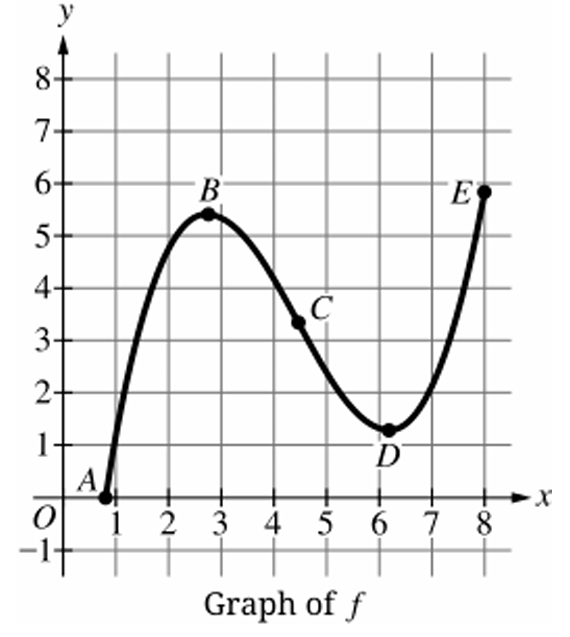
▶️ Answer/Explanation
(A) The interval from \( A \) to \( B \)
1. A function is increasing where \( f'(x) > 0 \), meaning the graph rises from left to right.
2. From \( A \) to \( B \), the graph rises to a local maximum at \( B \), so \( f'(x) > 0 \).
3. The point \( C \) is labeled as the point of inflection, so concavity changes at \( C \).
4. Therefore, for all \( x < C \), the graph is concave down (\( f”(x) < 0 \)).
5. Since the interval \( A \) to \( B \) lies entirely before \( C \), it is concave down.
6. Hence, \( f \) is increasing and concave down on \( (A, B) \).
▶️ Answer/Explanation
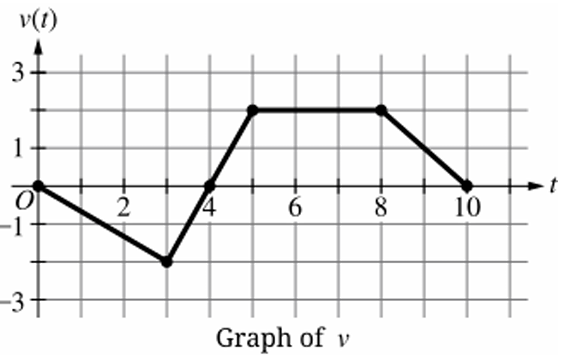
(D) \(0 < t < 3\) and \(8 < t < 10\)
Velocity is decreasing where the graph of \(v(t)\) has a negative slope. From \(t=0\) to \(t=3\), the graph slopes downward continuously. From \(t=3\) to \(t=5\), the slope is positive (velocity increasing). From \(t=5\) to \(t=8\), the slope is zero (constant velocity). From \(t=8\) to \(t=10\), the slope is negative again. Therefore, velocity decreases only on \(0 < t < 3\) and \(8 < t < 10\).
1. Velocity decreases when the slope of \(v(t)\) is negative.
2. From \(0 < t < 3\), the line segment slopes downward ⇒ decreasing.
3. From \(3 < t < 5\), the slope is positive ⇒ increasing.
4. From \(5 < t < 8\), the slope is \(0\) ⇒ constant velocity.
5. From \(8 < t < 10\), the slope is negative ⇒ decreasing.
6. Hence, the correct intervals are \(0 < t < 3\) and \(8 < t < 10\).
▶️ Answer/Explanation
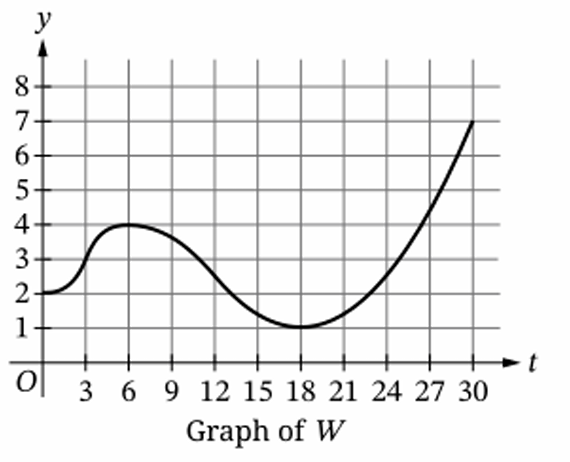
(A) \( (3,6) \) only
2. Thus the graph must be increasing and concave down.
3. From \( t = 0 \) to \( t = 6 \), the function increases.
4. However, from \( (0,3) \), the slope increases (concave up).
5. From \( (3,6) \), the slope decreases to \( 0 \) (concave down).
6. From \( (18,30) \), the function increases but is concave up.
7. Therefore, the only interval satisfying both conditions is \( (3,6) \).
▶️ Answer/Explanation
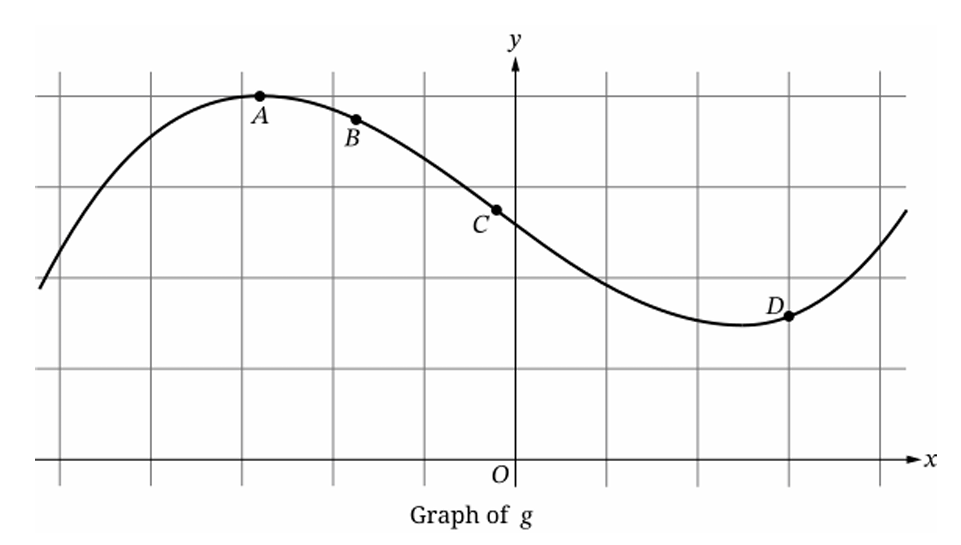
(C)
1. The rate of change of \( g \) at a point is the slope \( g'(x) \).
2. At \( A \), a relative maximum, \( g'(A) = 0 \).
3. At \( D \), near a minimum, the slope is approximately \( 0 \) (slightly positive).
4. At \( B \), the function is decreasing, so \( g'(B) < 0 \), but not steepest.
5. At \( C \), the only point of inflection, the graph changes concavity.
6. At an inflection point on a decreasing curve, the slope is most negative.
7. Therefore, \( g'(C) \) is the smallest (least) value.
8. Hence, the rate of change is least at \( C \).
▶️ Answer/Explanation
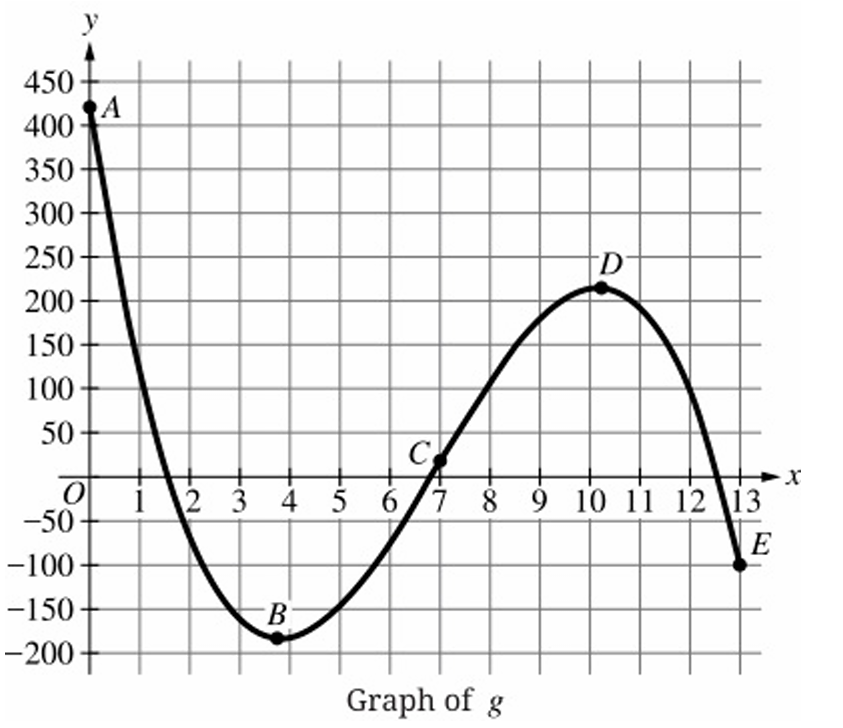
(D) \( [t_C, t_D] \) and \( [t_D, t_E] \)
1. The rate of change of \( g \) is \( g'(x) \). It is decreasing where \( g”(x) < 0 \).
2. \( g”(x) < 0 \) corresponds to the graph being concave down.
3. The graph has exactly one inflection point at \( C \), so concavity changes only at \( t_C \).
4. From \( t_A \) to \( t_C \), the graph is concave up (slope increasing).
5. From \( t_C \) to \( t_E \), the graph is concave down (slope decreasing).
6. Therefore, the rate of change of \( g \) is decreasing on \( [t_C, t_D] \) and \( [t_D, t_E] \).
7. Hence, the correct answer is (D).

▶️ Answer/Explanation
The correct answer is (B) 3.
From the table, we identify the extrema for \(x \ge 0\). The function decreases to a minimum value of \(f(2) = -3\) and then increases to a value of \(f(4) = 2\).
Since \(f\) is an odd function, it satisfies the property \(f(-x) = -f(x)\). This means the graph is symmetric with respect to the origin.
A local minimum on the positive side corresponds to a local maximum on the negative side. Therefore, the minimum at \(x = 2\) implies a maximum at \(x = -2\) given by \(f(-2) = -f(2) = -(-3) = 3\).
We must also check the endpoints. We know \(f(4) = 2\), which implies \(f(-4) = -f(4) = -2\).
Comparing the highest points on the entire domain \([-4, 4]\): the maximum value at \(x=4\) is \(2\), and the maximum value at \(x=-2\) is \(3\).
Thus, the absolute maximum value of \(f\) is \(3\).
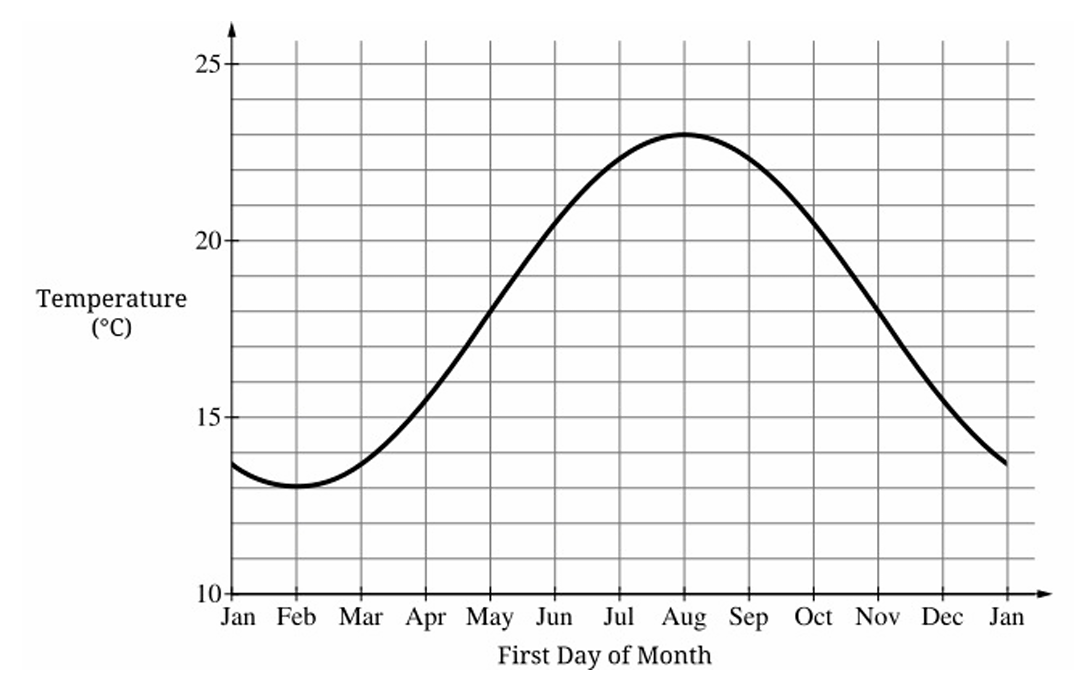
▶️ Answer/Explanation
(B) May
The rate of change corresponds to the slope of the temperature curve. The greatest rate of change occurs where the graph is increasing most steeply. From the graph, the temperature rises most rapidly during the spring months. Around May, the curve has its steepest positive slope. In February the slope is small and slightly negative, in August the slope is approximately \(0\) (near maximum), and in November the slope is negative. Therefore, the greatest rate of change occurs in May.
1. The rate of change equals the derivative, represented by the slope of the tangent line.
2. We look for the point where the curve is steepest upward (maximum positive slope).
3. In February, the graph is near a minimum, so slope \(\approx 0\).
4. In May, the graph is increasing rapidly, giving the largest positive slope.
5. In August, the graph is near a maximum, so slope \(\approx 0\).
6. In November, the graph is decreasing, so slope is negative.
7. Hence, the greatest rate of change occurs in May.