Home / AP® Exam / AP® PreCalculus / AP® Precalculus

AP Precalculus -1.5 Polynomial Functions and Complex Zeros- FRQ Exam Style Questions - Effective Fall 2023

AP Precalculus -Link- FRQ Exam Style Questions – Effective Fall 2023

AP Precalculus -Link- FRQ Exam Style Questions – AP Precalculus- per latest AP Precalculus Syllabus.

AP Precalculus – FRQ Exam Style Questions- All Topics

Question

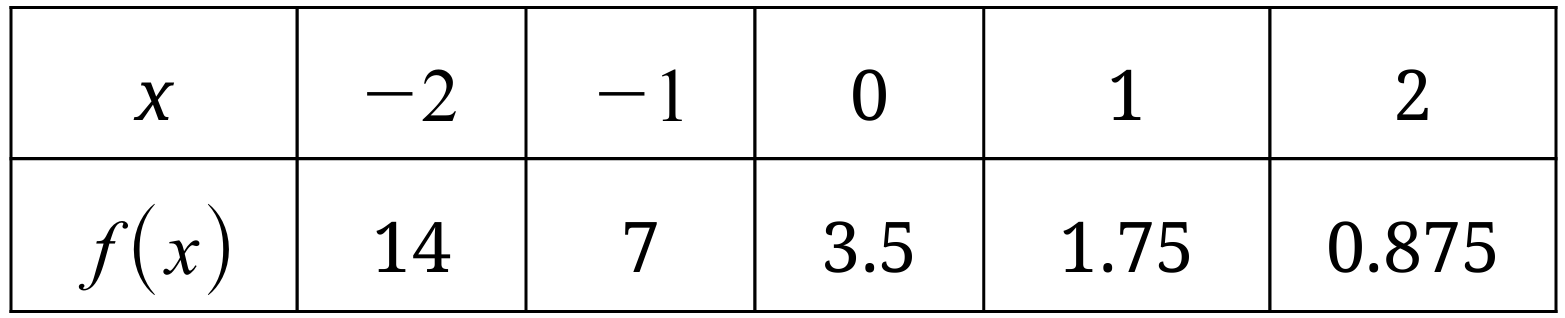
The function \( f \) is decreasing and is defined for all real numbers. The table gives values for \( f(x) \) at selected values of \( x \).
The function \( g \) is given by \( g(x) = -0.167x^3 + x^2 – 1.834 \).
(A)
(i) The function \( h \) is defined by \( h(x) = (g \circ f)(x) = g(f(x)) \). Find the value of \( h(1) \) as a decimal approximation, or indicate that it is not defined. Show the work that leads to your answer.
(ii) Find the value of \( f^{-1}(3.5) \), or indicate that it is not defined.
(B)
(i) Find all values of \( x \), as decimal approximations, for which \( g(x) = 0 \), or indicate that there are no such values.
(ii) Determine the end behavior of \( g \) as \( x \) increases without bound. Express your answer using the mathematical notation of a limit.
(C)
(i) Based on the table, which of the following function types best models function \( f \): linear, quadratic, exponential, or logarithmic?
(ii) Give a reason for your answer in part C (i) based on the relationship between the change in the output values of \( f \) and the change in the input values of \( f \). Refer to the values in the table in your reasoning.

Most-appropriate topic codes (AP Precalculus CED):

1.5: Polynomial Functions and Complex Zeros – part B(i)
1.6: Polynomial Functions and End Behavior – part B(ii)
2.3: Exponential Functions – part C(i), C(ii)
2.7: Composite Functions – part A(i)
2.8: The Inverse of a Function – part A(ii)
▶️ Answer/Explanation

A (i)
We have \( h(1) = g(f(1)) \).
From the table, \( f(1) = 1.75 \).
Then \( g(1.75) = -0.167(1.75)^3 + (1.75)^2 – 1.834 \).
Compute step by step:
\( (1.75)^3 = 5.359375 \)
\( -0.167 \times 5.359375 \approx -0.895 \) (using three decimal places for intermediate steps)
\( (1.75)^2 = 3.0625 \)
So, \( g(1.75) \approx -0.895 + 3.0625 – 1.834 = 0.3335 \).
Rounded to three decimal places: \( 0.333 \).
Answer: \(\boxed{0.333}\)

A (ii)
We want \( f^{-1}(3.5) \), which is the input value \( x \) such that \( f(x) = 3.5 \).
From the table, when \( x = 0 \), \( f(x) = 3.5 \).
Thus, \( f^{-1}(3.5) = 0 \).
Answer: \(\boxed{0}\)

B (i)
Solve \( g(x) = 0 \): \( -0.167x^3 + x^2 – 1.834 = 0 \).
Using a graphing calculator (as permitted in the original problem context):
• Graph \( y = -0.167x^3 + x^2 – 1.834 \) and find the x‑intercepts.
• Alternatively, use the calculator’s equation solver.
The three real roots (to three decimal places) are:
\( x \approx -1.233 \), \( x \approx 1.578 \), \( x \approx 5.643 \).
Answer: \(\boxed{-1.233, \; 1.578, \; 5.643}\)

B (ii)
For a polynomial, end behavior is determined by the leading term.
For \( g(x) = -0.167x^3 + x^2 – 1.834 \), the leading term is \( -0.167x^3 \).
As \( x \to \infty \), \( x^3 \to \infty \), so \( -0.167x^3 \to -\infty \).
Thus, \( \lim_{x \to \infty} g(x) = -\infty \).
Answer: \(\boxed{\lim_{x \to \infty} g(x) = -\infty}\)

C (i)
Examine the table: As \( x \) increases by 1 each time, \( f(x) \) is halved.
This constant multiplicative rate of change (ratio) indicates an exponential decay model.
Answer: \(\boxed{\text{Exponential}}\)

C (ii)
Reasoning: For equal-length input intervals of 1, the ratios of successive output values are constant:
\( \frac{f(-1)}{f(-2)} = \frac{7}{14} = 0.5 \),
\( \frac{f(0)}{f(-1)} = \frac{3.5}{7} = 0.5 \),
\( \frac{f(1)}{f(0)} = \frac{1.75}{3.5} = 0.5 \),
\( \frac{f(2)}{f(1)} = \frac{0.875}{1.75} = 0.5 \).
Since the output values change by a constant factor (0.5) over equal input intervals, the data are best modeled by an exponential function.
Scoring Note: The explanation must reference the constant ratio over equal input intervals.
Question

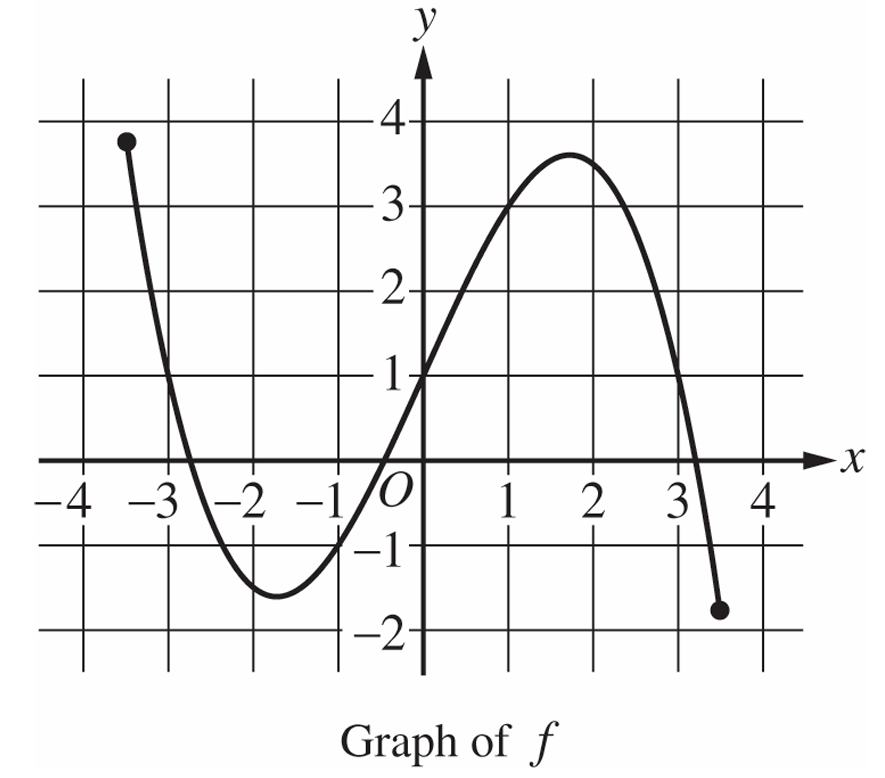
The figure shows the graph of the function \( f \) on its domain of \( -3.5 \le x \le 3.5 \). The points \( (-3,1) \), \( (0,1) \), and \( (3,1) \) are on the graph of \( f \). The function \( g \) is given by \( g(x)=2.916\cdot(0.7)^x \).
(A)
(i) The function \( h \) is defined by \( h(x)=(g\circ f)(x)=g(f(x)) \). Find the value of \( h(3) \) as a decimal approximation, or indicate that it is not defined.
(ii) Find all values of \( x \) for which \( f(x)=1 \), or indicate that there are no such values.
(B)
(i) Find all values of \( x \), as decimal approximations, for which \( g(x)=2 \), or indicate that there are no such values.
(ii) Determine the end behavior of \( g \) as \( x \) increases without bound. Express your answer using the mathematical notation of a limit.
(C)
(i) Determine if \( f \) has an inverse function.
(ii) Give a reason for your answer based on the definition of a function and the graph of \( y=f(x) \).

Most-appropriate topic codes (CED):

TOPIC 1.7: Composition of Functions — part (A)
TOPIC 2.3: Exponential Functions — part (B)
TOPIC 1.5: Inverse Functions — part (C)
▶️ Answer/Explanation
Concise solution

(A)(i)
From the graph, \( f(3)=1 \).
\( h(3)=g(f(3))=g(1)=2.916(0.7)=2.041 \).

(A)(ii)
From the graph, \( f(x)=1 \) at \( x=-3,0,3 \).

(B)(i)
\( 2.916(0.7)^x=2 \)
\( (0.7)^x=\frac{2}{2.916} \)
Taking logarithms,
\( x=\frac{\ln(\frac{2}{2.916})}{\ln(0.7)}\approx1.057 \).

(B)(ii)
Since \( 0.7<1 \), \( (0.7)^x \to 0 \) as \( x \to \infty \).
\( \lim_{x\to\infty} g(x)=0 \).

(C)
\( f \) does not have an inverse because it is not one-to-one.
For example, \( f(-3)=f(0)=f(3)=1 \).

Question 

A market analyst working for a small appliance manufacturer finds that if the firm produces and sells \(x\) blenders annually, the total profit (in dollars) is \(P(x) = -0.0013x^3 + 0.3507x^2 – 0.4591x – 421.888\). (4 marks each part)
a. Use a graphing device to help graph the polynomial function \(P\).
b. Find the average rate of change of \(P\) between two relative (local) extrema when \(0 < x < 200\).
c. Find the equation of the secant line of the graph of \(P\) between the two points in part b.
d. The inflection point of a function is the point on the graph where the graph changes concavity. Find out the inflection point of the graph of \(P\).
e. How will the rate of change vary before and after the inflection point?
▶️ Answer/Explanation
Detailed solution

a. Graphing the function
Using a graphing utility for \(P(x) = -0.0013x^3 + 0.3507x^2 – 0.4591x – 421.888\) on the interval \([0, 200]\) reveals a cubic curve shape.
The graph starts with a slight dip to a local minimum near \(x=0\), then rises steeply to a local maximum near \(x=180\), before falling again.

b. Average rate of change between extrema
First, find the derivative: \(P'(x) = -0.0039x^2 + 0.7014x – 0.4591\).
Set \(P'(x) = 0\) and use the quadratic formula to find the extrema: \(x \approx 0.66\) (local min) and \(x \approx 179.19\) (local max).
Calculate the profit at these points: \(P(0.66) \approx -422.04\) and \(P(179.19) \approx 3276.57\).
The average rate of change is: \(\frac{3276.57 – (-422.04)}{179.19 – 0.66} = \frac{3698.61}{178.53} \approx 20.72\).

c. Equation of the secant line
The slope \(m\) was found in part (b) to be approximately \(20.72\).
Using the point-slope form \(y – y_1 = m(x – x_1)\) with the minimum point \((0.66, -422.04)\):
\(y – (-422.04) = 20.72(x – 0.66)\)
\(y = 20.72x – 13.68 – 422.04\)
The equation is approximately \(y = 20.72x – 435.72\).

d. Inflection point
Find the second derivative: \(P”(x) = -0.0078x + 0.7014\).
Set \(P”(x) = 0\) to find the change in concavity: \(0 = -0.0078x + 0.7014 \Rightarrow x = \frac{0.7014}{0.0078} \approx 89.92\).
Find the corresponding y-value: \(P(89.92) \approx 1427.27\).
The inflection point is approximately \((89.92, 1427.27)\).

e. Variation of rate of change
The rate of change is represented by the derivative, \(P'(x)\).
Before the inflection point (\(x < 89.92\)), the graph is concave up (\(P”(x) > 0\)), so the rate of change is increasing.
After the inflection point (\(x > 89.92\)), the graph is concave down (\(P”(x) < 0\)), so the rate of change is decreasing.

Scroll to Top