AP Precalculus -1.5 Polynomial Functions and Complex Zeros- MCQ Exam Style Questions - Effective Fall 2023
AP Precalculus -1.5 Polynomial Functions and Complex Zeros- MCQ Exam Style Questions – Effective Fall 2023
AP Precalculus -1.5 Polynomial Functions and Complex Zeros- MCQ Exam Style Questions – AP Precalculus- per latest AP Precalculus Syllabus.
Question
(B) \( p \) has exactly three distinct real zeros.
(C) \( p \) has exactly one distinct real zero and no non-real zeros.
(D) \( p \) has exactly one distinct real zero and two non-real zeros.
▶️ Answer/Explanation
First, factor \( x^2 – 2x – 15 \):
\( x^2 – 2x – 15 = (x – 5)(x + 3) \).
So \( p(x) = (x + 3)(x – 5)(x + 3) = (x + 3)^2(x – 5) \).
Zeros: \( x = -3 \) (multiplicity 2), \( x = 5 \) (multiplicity 1).
Distinct real zeros: \( -3 \) and \( 5 \) (two distinct).
✅ Answer: (A)
Question
(B) \( -5x^2 – 2x^7 \)
(C) \( -9000x – \frac{x^5}{5} \)
(D) \( -x^3 + 2x^4 \)
▶️ Answer/Explanation
End behavior is determined by the leading term (highest degree term). We need \( \lim_{x \to -\infty} g(x) = -\infty \). Check each leading term as \( x \to -\infty \):
- (A) \( -2x^4 \) → degree 4 (even), coefficient negative → \( (-)\cdot(+\infty) = -\infty \) as \( x \to -\infty \) ✓
- (B) \( -2x^7 \) → degree 7 (odd), coefficient negative → \( (-)\cdot(-\infty) = +\infty \) as \( x \to -\infty \) ✗
- (C) \( -\frac{x^5}{5} \) → degree 5 (odd), coefficient negative → \( (-)\cdot(-\infty) = +\infty \) as \( x \to -\infty \) ✗
- (D) \( 2x^4 \) → degree 4 (even), coefficient positive → \( +\infty \) as \( x \to -\infty \) ✗
Only (A) satisfies \( g(x) \to -\infty \) as \( x \to -\infty \).
✅ Answer: (A)
Question
(B) 4
(C) 5
(D) 6
▶️ Answer/Explanation
Given factors: \( (x – 3) \) (real zero), \( (x – i) \) and \( (x – (2+i)) \) (nonreal).
For a polynomial with real coefficients, nonreal zeros occur in conjugate pairs: If \( i \) is a zero, so is \( -i \). If \( 2 + i \) is a zero, so is \( 2 – i \).
Thus least possible zeros: \( 3, i, -i, 2+i, 2-i \) → total 5 distinct zeros ⇒ degree at least 5.
✅ Answer: (C)
Question
(B) \( Q \) has two complex zeros.
(C) \( Q(x) \) can be expressed as \( (x – 5) \cdot P(x) \), where \( P(x) \) is a polynomial of degree 2.
(D) \( Q(x) \) can be expressed as \( \frac{P(x)}{x-5} \), where \( P(x) \) is a polynomial of degree 4.
▶️ Answer/Explanation
\( Q(5) = 0 \) ⇒ \( x – 5 \) is a factor of \( Q \).
Since \( Q \) has degree 3, factoring out \( (x – 5) \) leaves a polynomial of degree 2: \( Q(x) = (x – 5) P(x) \), deg \( P \) = 2.
(A) not necessarily — only 5 is given as zero.
(B) not necessarily — the other two zeros could be real.
(D) incorrect — that would make \( Q \) degree 3 only if \( P \) degree 4 and division yields degree 3, but that’s not required from given info.
✅ Answer: (C)
Question
(B) \(-0.478 + 0.801i\) is a zero of \( k \).
(C) The equation \( k(x) = 0 \) has four real solutions.
(D) The graph of \( k \) is tangent to the \( x \)-axis at \( x = 17.997 \).
▶️ Answer/Explanation
From the answer: If a polynomial has real coefficients and a non-real zero \( a+bi \), its conjugate \( a-bi \) is also a zero.
Given that \( -0.478 – 0.801i \) is a zero of \( k \), then its conjugate \( -0.478 + 0.801i \) must also be a zero.
Thus (B) must be true.
The other options depend on full polynomial, so are not necessarily true.
✅ Answer: (B)
Question
(B) \((-3)^2 \cdot 10\)
(C) \((-3)^3 \cdot 5\)
(D) \((-3)^2 \cdot 5\)
▶️ Answer/Explanation
1. Identify General Term:
\(\binom{n}{k} a^{n-k} b^k\) for \((a+b)^n\). Here \(a=x, b=-3, n=5\).
2. Find Term with \(x^3\):
We need \(x^{5-k} = x^3 \implies 5-k=3 \implies k=2\).
3. Calculate Coefficient:
\(\binom{5}{2} (-3)^2 = 10 \cdot (-3)^2\).
✅ Answer: (B)
Question
(B) \( p \) has exactly three distinct real zeros.
(C) \( p \) has exactly one distinct real zero and no non-real zeros.
(D) \( p \) has exactly one distinct real zero and two non-real zeros.
▶️ Answer/Explanation
First, factor the quadratic \( x^2 – 2x – 15 \):
\[ x^2 – 2x – 15 = (x – 5)(x + 3) \]
Thus, \[ p(x) = (x + 3)(x – 5)(x + 3) = (x + 3)^2(x – 5) \]
Zeros occur when \( p(x) = 0 \):
• \( (x + 3)^2 = 0 \) gives \( x = -3 \) (multiplicity 2).
• \( x – 5 = 0 \) gives \( x = 5 \) (multiplicity 1).
So there are two distinct real zeros: \( x = -3 \) and \( x = 5 \).
Since \( p \) is degree 3, it has exactly 3 zeros in total counting multiplicity, but only two distinct real ones.
✅ Answer: (A)
Question
(B) \(-0.478 + 0.801i\) is a zero of \( k \).
(C) The equation \( k(x) = 0 \) has four real solutions.
(D) The graph of \( k \) is tangent to the \( x \)-axis at \( x = 17.997 \).
▶️ Answer/Explanation
\( k \) is degree 4 with real coefficients. Non‑real zeros occur in conjugate pairs.
Given zero \(-0.478 – 0.801i\) ⇒ its conjugate \(-0.478 + 0.801i\) must also be a zero.
Thus two non‑real zeros and two real zeros (since total degree 4).
One real zero is given as \( x \approx 17.997 \), so there is another real zero.
All zeros have multiplicity 1 ⇒ graph crosses \(x\)-axis at each real zero, not tangent.
Thus (B) must be true.
✅ Answer: (B)
Question
b. $-4$
c. $-8$
d. $-1.5$
▶️ Answer/Explanation
Since coefficients are real, the complex conjugate $-1 – i$ is also a zero.
The sum of all four roots is given by $-\frac{b}{a} = -\frac{6}{1} = -6$.
The sum of the complex roots is $(-1 + i) + (-1 – i) = -2$.
Let the real roots be $r_1$ and $r_2$.
Then, $(r_1 + r_2) + (-2) = -6$.
Solving for the sum of real roots: $r_1 + r_2 = -6 + 2 = -4$.
The correct option is b. $-4$.
Question
b. \(96y^4x^2\)
c. \(99y^4x^2\)
d. \(6y^4x^2\)
▶️ Answer/Explanation
Identify the general term formula: \(T_{r+1} = \binom{n}{r} a^{n-r} b^r\).
For the \(3^{\text{rd}}\) term, set \(r = 2\), \(n = 4\), \(a = y^2\), and \(b = 4x\).
Calculate the binomial coefficient: \(\binom{4}{2} = \frac{4 \times 3}{2 \times 1} = 6\).
Substitute values: \(T_3 = 6 \cdot (y^2)^{4-2} \cdot (4x)^2\).
Simplify exponents: \(T_3 = 6 \cdot (y^2)^2 \cdot 16x^2\).
Multiply the constants: \(6 \cdot 16 = 96\).
Final result: \(96y^4x^2\).
The correct option is b.
Question

(B) Three
(C) Four
(D) Five
▶️ Answer/Explanation
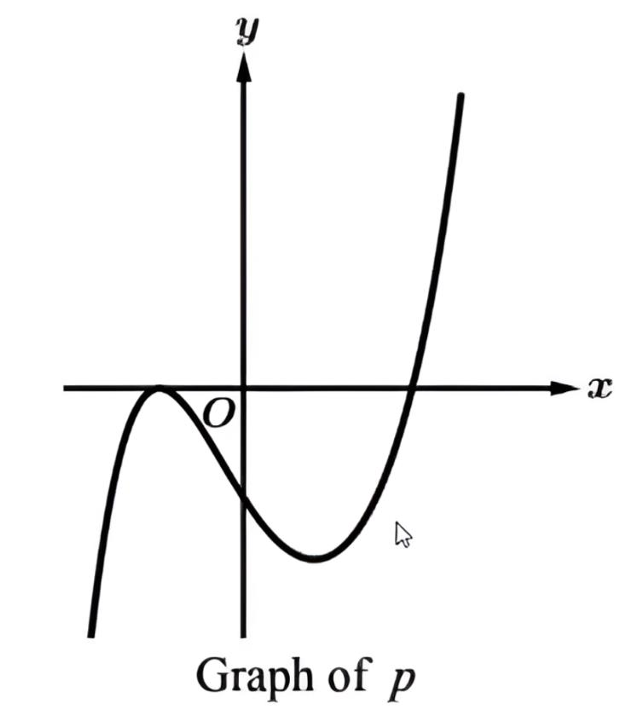
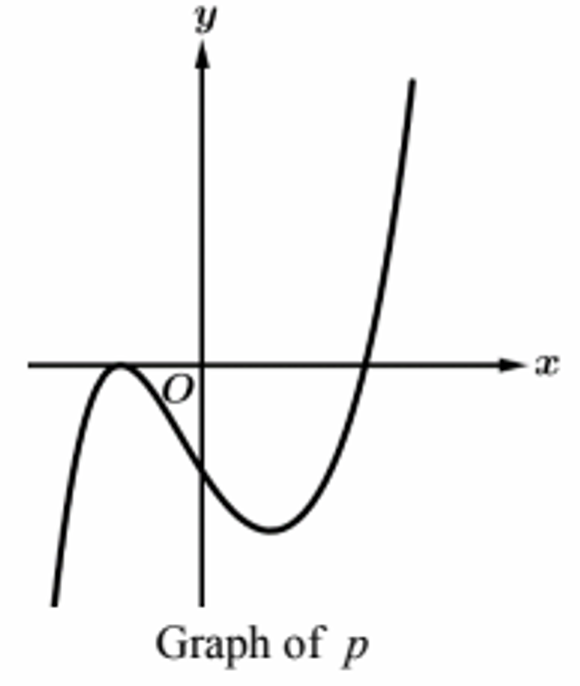
The degree of a polynomial is the sum of the multiplicities of all its roots. We analyze the graph and the given information to find the minimum values:
- Tangent Real Root: The graph touches the \( x \)-axis and turns around at a negative value. This indicates a root with an even multiplicity, so the minimum is 2.
- Crossing Real Root: The graph crosses the \( x \)-axis at a positive value. This indicates a root with an odd multiplicity, so the minimum is 1.
- Complex Roots: Given \( 2 – 3i \) is a zero, its conjugate \( 2 + 3i \) must also be a zero (Complex Conjugate Root Theorem). This accounts for 2 roots.
Total Least Degree: Summing these gives \( 2 + 1 + 2 = 5 \).
The correct option is (D).
Question
▶️ Answer/Explanation
The polynomial \(k(x)\) has real coefficients, so by the Complex Conjugate Root Theorem, if \(-0.478 – 0.801i\) is a root, its conjugate \(-0.478 + 0.801i\) must also be a root.
Since the polynomial is of degree 4, it must have exactly 4 roots. We have identified two complex roots and one real root (\(x = 17.997\)).
The fourth root must be real because any additional complex root would require a conjugate pair, which would exceed the degree of 4. Thus, there are exactly 2 real roots and 2 complex roots.
Statement (A) is false because there are 2 real roots (2 \(x\)-intercepts), not 3.
Statement (C) is false because there are only 2 real solutions, not 4.
Statement (D) is false because the multiplicity is 1, meaning the graph crosses the axis rather than being tangent to it.
Therefore, by elimination (and the premise given), statement (B) is the correct answer.
Question

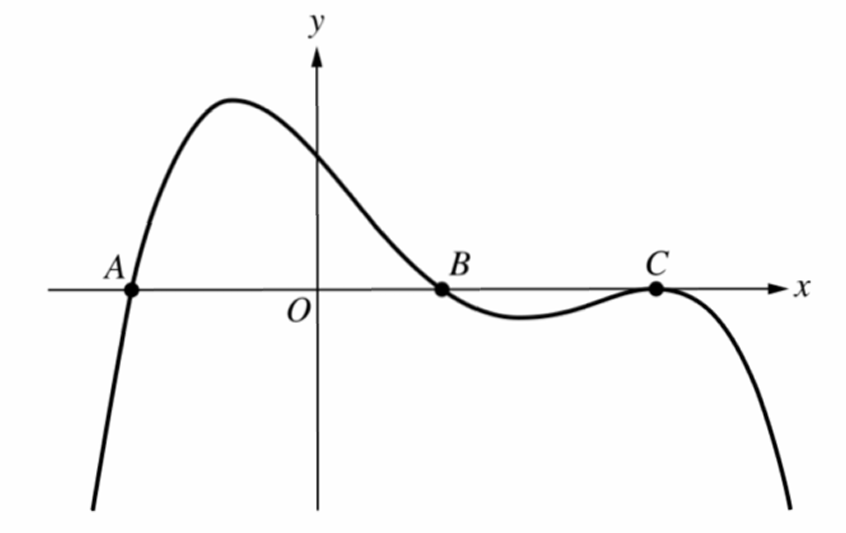
(B) $1$, because the quartic polynomial function has four zeros: exactly one at $A$, one at $B$, one at $C$, and a non-real zero.
(C) $2$, because the quartic polynomial function has three real zeros, one of which must have a multiplicity of $2$, and the polynomial does not change signs at $C$.
(D) $2$, because $C$ is the second zero to the right of the origin, and there are more zeros to the right than to the left of the origin.
▶️ Answer/Explanation
The correct answer is (C).
A quartic polynomial is of degree $4$, meaning it must have exactly $4$ roots (counting multiplicity).
At zeros $A$ and $B$, the graph crosses the $x$-axis, indicating an odd multiplicity (likely $1$ each).
At zero $C$, the graph is tangent to the $x$-axis and does not cross it.
This “bounce” behavior implies an even multiplicity for the root at $C$.
Since the function does not change signs at $C$, the multiplicity must be at least $2$.
Given only three distinct real zeros ($A, B, C$), the multiplicities must sum to $4$.
Therefore, $1 (\text{at } A) + 1 (\text{at } B) + 2 (\text{at } C) = 4$.
Question

▶️ Answer/Explanation
From the graph, the curve touches the \( x \)-axis at a negative value and turns around, indicating a real root with an even multiplicity of at least \( 2 \).
The curve also crosses the \( x \)-axis at a positive value, indicating a distinct real root with an odd multiplicity of at least \( 1 \).
Therefore, the visible behavior on the graph accounts for a minimum degree of \( 2 + 1 = 3 \).
The problem states that \( 2 – 3i \) is a zero of \( p \). Since the graph represents a polynomial with real coefficients, complex roots must occur in conjugate pairs.
This means the conjugate \( 2 + 3i \) is also a zero, contributing \( 2 \) distinct complex roots to the total degree.
Adding the minimum real roots and the complex roots together, the least possible degree is \( 3 + 2 = 5 \).
Correct Option: (D)
Question

▶️ Answer/Explanation
The correct answer is (C).
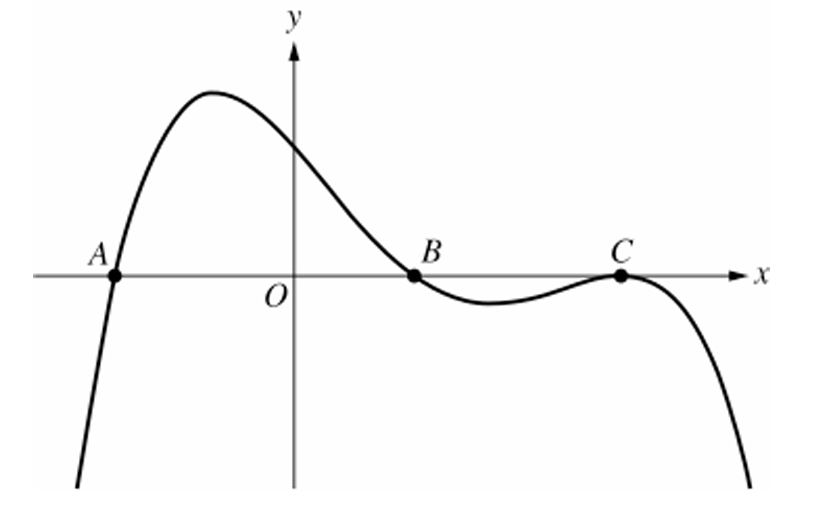
Step 1: Analyze the behavior of the graph at the zero \( C \). At this point, the graph touches the \( x \)-axis and turns back down, remaining on the same side (negative values) rather than crossing it.
Step 2: Determine the relationship between graph behavior and multiplicity. If a graph crosses the \( x \)-axis at a zero (like at points \( A \) and \( B \)), the multiplicity is odd (typically \( 1 \)). If the graph touches the axis and turns around (does not change sign), the multiplicity is even (e.g., \( 2 \)).
Step 3: Consider the degree of the polynomial. The problem states it is a quartic function (degree \( 4 \)). By the Fundamental Theorem of Algebra, the sum of the multiplicities of all zeros must be \( 4 \).
Step 4: Since there are three visible real roots, and \( A \) and \( B \) are simple crossings (multiplicity \( 1 \)), the remaining degrees of freedom must be assigned to \( C \). Calculating the sum: \( 1 (\text{at } A) + 1 (\text{at } B) + 2 (\text{at } C) = 4 \).
Conclusion: The zero at \( C \) must have a multiplicity of \( 2 \) because the polynomial does not change signs at this point, consistent with the graph being tangent to the axis.
Question

▶️ Answer/Explanation
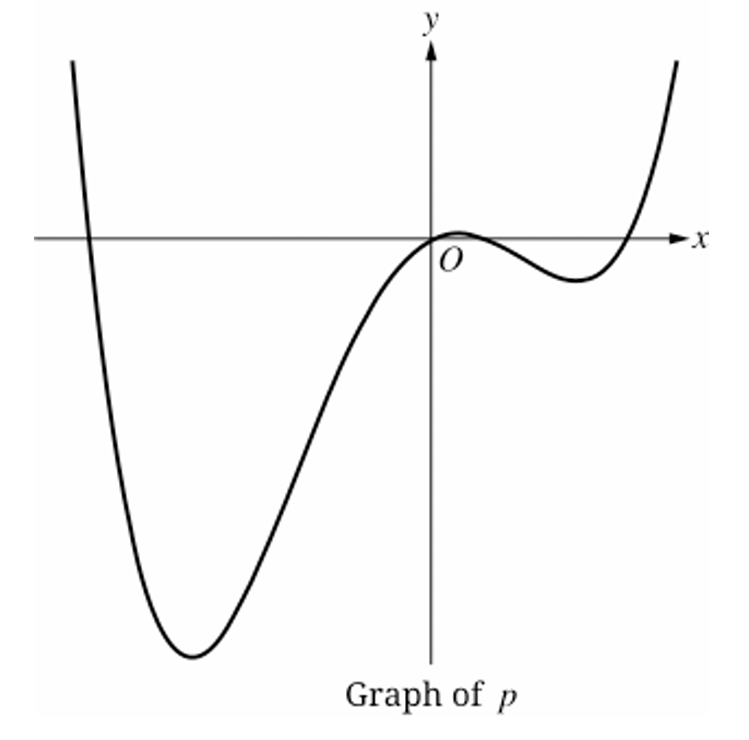
2. A quadratic function can have at most \(2\) real zeros.
3. Points of inflection occur where \(p”(x)=0\) and concavity changes.
4. From the graph, the curve changes concavity once between the left minimum and the local maximum.
5. It changes concavity again between the local maximum and the right minimum.
6. No additional concavity change is visible on either end of the graph.
7. Therefore, the graph has exactly \(2\) points of inflection.
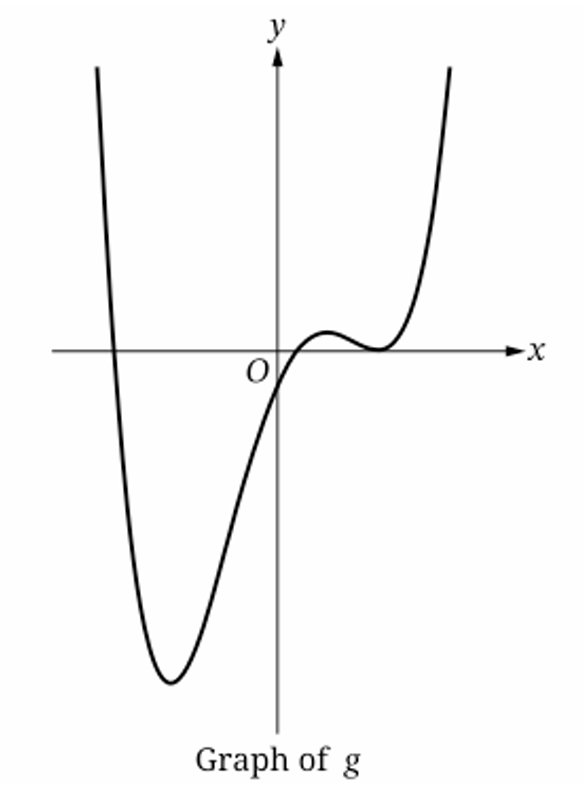
Question

▶️ Answer/Explanation
Step 1: Analyze End Behavior
The graph goes upwards to \( +\infty \) on both the far left and far right sides. This indicates that the polynomial must have an even degree (like \( x^2, x^4 \), etc.) and a positive leading coefficient. Options (A) and (B) are polynomials of degree 3 (multiplying three \( x \) terms), which is odd. Therefore, (A) and (B) are incorrect.
Step 2: Analyze Roots and Multiplicity
We look at the behavior of the graph at the x-intercepts (roots):
• At the negative root (approx \( x = -8 \)), the graph crosses the x-axis. This corresponds to a linear factor, \( (x+8) \).
• At the smaller positive root (approx \( x = 1 \)), the graph crosses the x-axis. This corresponds to a linear factor, \( (x-1) \).
• At the larger positive root (approx \( x = 5 \)), the graph touches the x-axis and turns back up (tangent to the axis). This indicates a root with an even multiplicity, usually 2. This corresponds to a squared factor, \( (x-5)^2 \).
Step 3: Match with Options
Checking the remaining even-degree options:
• Option (D) has \( (x+5)^2 \), which implies a touch at \( x = -5 \). The graph crosses at the negative value, so this is incorrect.
• Option (C) is \( 0.25(x-5)^2(x-1)(x+8) \). This matches all our observations: degree 4, crosses at \( -8 \) and \( 1 \), and touches at \( 5 \).
Conclusion
The correct expression is (C).
Question (Calc Allowed)
▶️ Answer/Explanation
(D) \( t = 5.505 \)
The rate changes from increasing to decreasing at a local maximum of \( R(t) \). This occurs when \( R'(t) = 0 \) and the derivative changes from positive to negative.
1. Differentiate: \( R'(t) = 0.09t^2 – 1.692t + 6.587 \).
2. Set derivative equal to zero: \( 0.09t^2 – 1.692t + 6.587 = 0 \).
3. Solve using quadratic formula.
4. Solutions: \( t \approx 5.505 \) and \( t \approx 13.295 \).
5. Since the quadratic opens upward, the smaller root gives the local maximum.
6. Therefore, the rate changes from increasing to decreasing at \( t = 5.505 \).
Question
▶️ Answer/Explanation
(C) \(p(-3) = 4\) is a relative minimum.
Since \(p\) is an odd function, it satisfies \(p(-x) = -p(x)\). Given \(p(3) = -4\), we obtain \[ p(-3) = -p(3) = -(-4) = 4. \] An odd function has rotational symmetry about the origin. Therefore, a relative maximum at \((3,-4)\) corresponds to a relative minimum at \((-3,4)\).
1. Since \(p\) is odd, \(p(-x) = -p(x)\).
2. Given \(p(3) = -4\).
3. Then \(p(-3) = -p(3) = -(-4) = 4\).
4. Odd functions are symmetric about the origin.
5. A relative maximum at \((3,-4)\) reflects to \((-3,4)\).
6. The reflected point must be a relative minimum.
7. Therefore, \(p(-3) = 4\) is a relative minimum.
Question
▶️ Answer/Explanation
First factor the quadratic term: \[ x^2 – 2x – 15 = (x – 5)(x + 3). \]
Therefore, \[ p(x) = (x + 3)(x – 5)(x + 3) = (x + 3)^2 (x – 5). \]
The zeros are: \[ x = -3 \quad (\text{multiplicity } 2), \qquad x = 5. \]
Hence, there are exactly two distinct real zeros: \( -3 \) and \( 5 \).
1. Given \( p(x) = (x+3)(x^2 – 2x – 15) \).
2. Factor \( x^2 – 2x – 15 = (x-5)(x+3) \).
3. Substitute: \( p(x) = (x+3)(x-5)(x+3) \).
4. Simplify: \( p(x) = (x+3)^2 (x-5) \).
5. Zeros are \( x=-3 \) (double root) and \( x=5 \).
6. Thus there are \( 2 \) distinct real zeros.
7. Therefore, the correct option is (A).
Question
▶️ Answer/Explanation
The correct answer is (B).
1. The problem states that \( a \) and \( b \) are real constants, which means the polynomial \( k(x) \) has real coefficients.
2. According to the Complex Conjugate Root Theorem, if a polynomial with real coefficients has a complex zero \( a + bi \), its conjugate \( a – bi \) must also be a zero.
3. Since \( -0.478 – 0.801i \) is given as a zero, its conjugate \( -0.478 + 0.801i \) must also be a zero of \( k \). This confirms statement (B).
4. Since the polynomial is of degree 4, it has exactly 4 zeros. With 2 complex zeros identified, the remaining 2 zeros must be real (one is given as 17.997). This means there are only two x-intercepts, making (A) and (C) false.
5. The problem states all zeros have multiplicity 1, meaning the graph crosses the x-axis rather than being tangent to it. This makes (D) false.
Question
▶️ Answer/Explanation
(D) \( (-\infty,-2] \cup [0,4] \)
First determine the zeros of the polynomial: \[ p(x) = -x(x – 4)(x + 2). \] The roots are \( x = -2, 0, 4 \). Using sign analysis across the intervals determined by these critical points:
- For \( x < -2 \), the product is positive.
- For \( -2 < x < 0 \), the product is negative.
- For \( 0 < x < 4 \), the product is positive.
- For \( x > 4 \), the product is negative.
Since we require \( p(x) \ge 0 \), we include the positive regions and the zeros.
Step 1: Factor: \( p(x) = -x(x-4)(x+2) \).
Step 2: Zeros occur at \( x = -2, 0, 4 \).
Step 3: Test \( x=-3 \Rightarrow p(x)>0 \).
Step 4: Test \( x=-1 \Rightarrow p(x)<0 \).
Step 5: Test \( x=2 \Rightarrow p(x)>0 \).
Step 6: Test \( x=5 \Rightarrow p(x)<0 \).
Conclusion: \( p(x)\ge0 \) on \( (-\infty,-2] \cup [0,4] \).
Question
▶️ Answer/Explanation
(D)
The rate of change of \(g\) is \(g'(x)\). If the rate of change is increasing for \(x < 2\), then \(g”(x) > 0\) for \(x < 2\), meaning the graph is concave up there. If the rate of change is decreasing for \(x > 2\), then \(g”(x) < 0\) for \(x > 2\), meaning the graph is concave down there. Since concavity changes at \(x = 2\), the graph has a point of inflection at \(x = 2\). Therefore, option (D) must be true.
1. The rate of change of \(g\) is \(g'(x)\).
2. Increasing rate of change for \(x < 2\) implies \(g”(x) > 0\).
3. Thus, \(g\) is concave up for \(x < 2\).
4. Decreasing rate of change for \(x > 2\) implies \(g”(x) < 0\).
5. Thus, \(g\) is concave down for \(x > 2\).
6. Concavity changes at \(x = 2\), so there is an inflection point at \(x = 2\).
7. Hence, option (D) is correct.
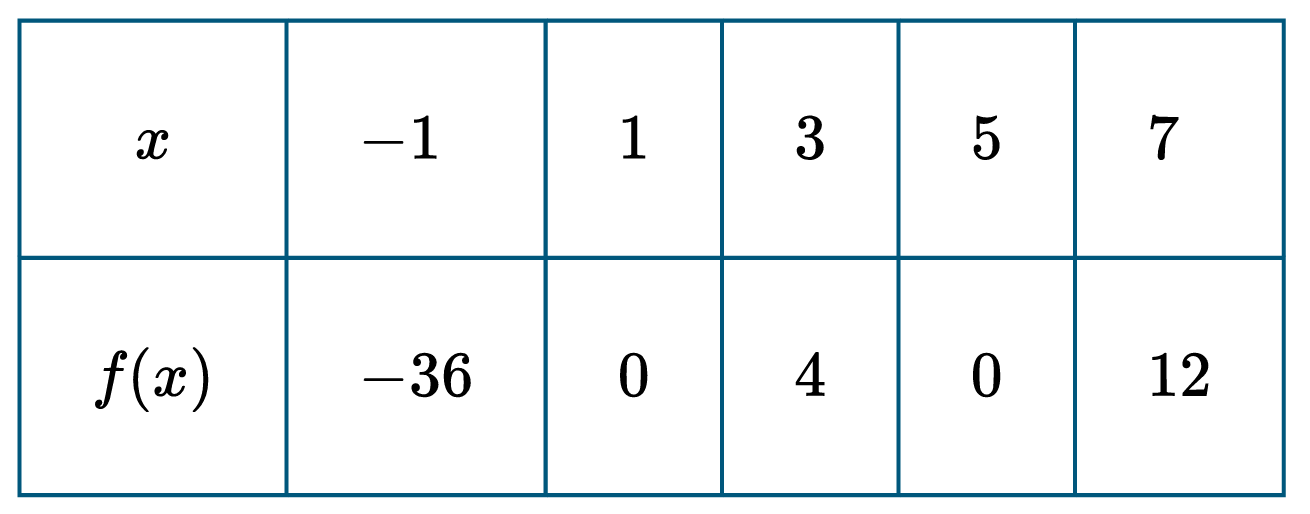
Question

▶️ Answer/Explanation
The zeros of the polynomial are \(x=1\) and \(x=5\). Since all zeros are listed and \(f(3)=4>0\), the function is positive between \(1\) and \(5\). Also, \(f(-1)=-36<0\) and \(f(7)=12>0\), so the sign changes at \(x=1\) and at \(x=5\). Therefore, at \(x=5\) the function changes from positive to negative to positive behavior locally, indicating a local minimum at \((5,0)\).
1. From the table, zeros occur at \(x=1\) and \(x=5\).
2. Since all zeros are given, there are no additional sign changes elsewhere.
3. \(f(-1)=-36<0\) and \(f(3)=4>0\), so the sign changes at \(x=1\).
4. \(f(3)=4>0\) and \(f(7)=12>0\), so the function remains positive after \(x=5\).
5. Thus near \(x=5\), the graph must touch the \(x\)-axis and turn upward.
6. Therefore, \((5,0)\) is a local minimum.
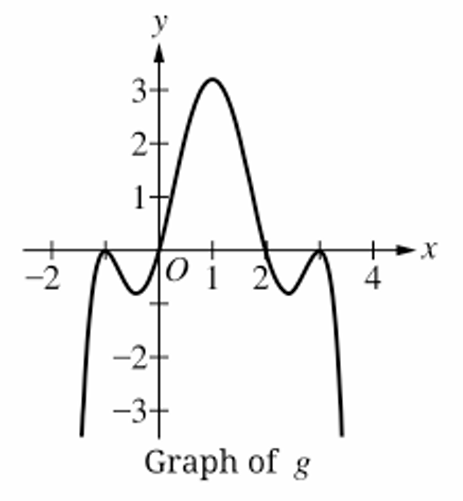
Question

▶️ Answer/Explanation
(B) Four
Since \(f(x)=g(x)\) only on the closed interval \(0 \le x \le 3\), we consider extrema within this restricted domain. From the graph on \(0 \le x \le 3\):
- There is one local maximum near \(x \approx 1\).
- There is one local minimum near \(x \approx 2.3\).
- The endpoint \(x=0\) is a local minimum (function increases immediately to the right).
- The endpoint \(x=3\) is a local maximum (function decreases immediately to the left).
Therefore, total local extrema \(= 2\) interior \(+\;2\) endpoints \(=\;4\).
1. Restrict the graph to \(0 \le x \le 3\).
2. Identify critical points inside the interval: one local maximum and one local minimum.
3. Check endpoint behavior at \(x=0\): function increases to the right ⇒ local minimum.
4. Check endpoint behavior at \(x=3\): function decreases to the left ⇒ local maximum.
5. Total extrema \(= 1 + 1 + 1 + 1 = 4.\)
6. Hence, the correct answer is \(\boxed{4}\).
Question
▶️ Answer/Explanation
The function \( f(x) \) is a polynomial of degree 4, which is an even integer.
The end behavior of any even-degree polynomial depends on the sign of the leading coefficient, \( a \).
If \( a > 0 \), then \( \lim_{x \to \pm \infty} f(x) = \infty \). The graph opens upwards, ensuring a global minimum exists, but there is no global maximum.
If \( a < 0 \), then \( \lim_{x \to \pm \infty} f(x) = -\infty \). The graph opens downwards, ensuring a global maximum exists, but there is no global minimum.
Since \( a \neq 0 \), one of these two cases must occur.
Therefore, \( f \) must have either a global maximum or a global minimum, but it cannot have both.
Correct Option: (B)
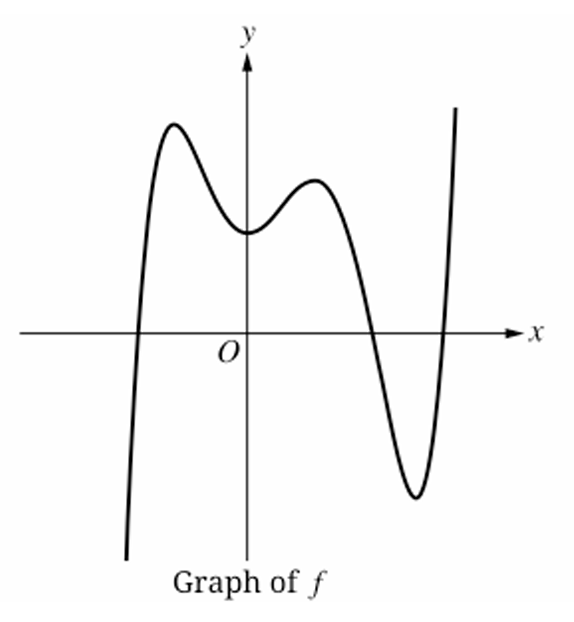
Question

▶️ Answer/Explanation
(B) Three
A point of inflection occurs where the concavity of \( f \) changes, that is, where \( f”(x) \) changes sign. Observing the graph from left to right: the curve changes from concave down to concave up once before the first local minimum, then from concave up to concave down before the next local maximum, and finally from concave down to concave up before the deep minimum. Thus, there are exactly \( 3 \) changes in concavity.
1. A point of inflection occurs where \( f”(x) \) changes sign.
2. The graph shows two local maxima and two local minima.
3. Between each adjacent maximum and minimum, concavity must change at least once.
4. From the first maximum to the first minimum: one change in concavity.
5. From the first minimum to the second maximum: one change in concavity.
6. From the second maximum to the second minimum: one change in concavity.
7. No additional visible concavity changes occur on the shown interval.
8. Therefore, the graph has \( \boxed{3} \) points of inflection.
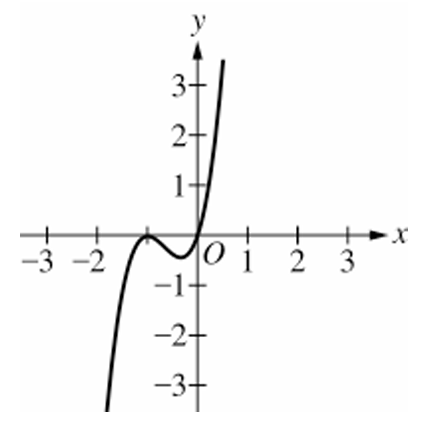
Question

(B)

(C)

(D)

▶️ Answer/Explanation
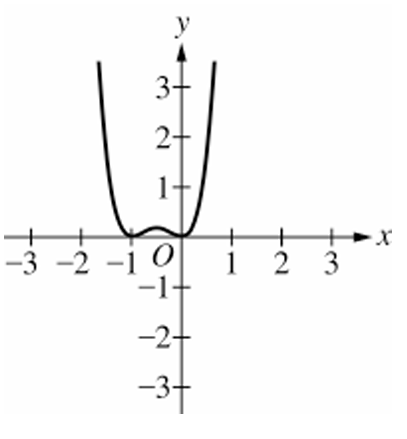
Option (B)
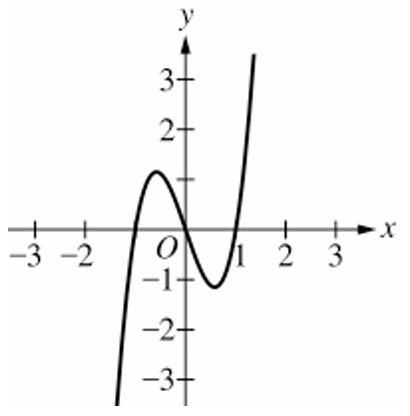
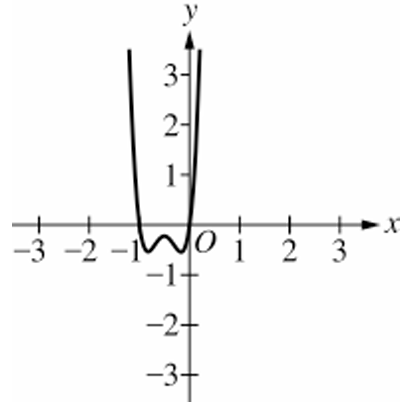
The polynomial is \[ P(x)=3x(x+1)^2(x-a). \] Its degree is \(4\) with leading term \(3x^4\), so both ends of the graph rise as \(x \to \pm\infty\).
The zeros are: \[ x=0 \quad (\text{simple root}), \] \[ x=-1 \quad (\text{double root}), \] \[ x=a \quad (\text{simple root}). \]
A double root at \(x=-1\) means the graph touches and turns at \(x=-1\). Simple roots at \(x=0\) and \(x=a\) mean the graph crosses the \(x\)-axis at those points.
The only option showing:
• both ends up (even degree, positive leading coefficient),
• a bounce at \(x=-1\),
• and crossings at two other points,
is Option (B).
1. Degree \(=4\) since factors are \(x(x+1)^2(x-a)\).
2. Leading term \(=3x^4\Rightarrow\) both ends rise.
3. Root \(x=-1\) has multiplicity \(2\Rightarrow\) graph touches and turns.
4. Roots \(x=0\) and \(x=a\) have multiplicity \(1\Rightarrow\) graph crosses.
5. Total possible real intercepts \(=3\).
6. Only graph (B) matches this behavior.
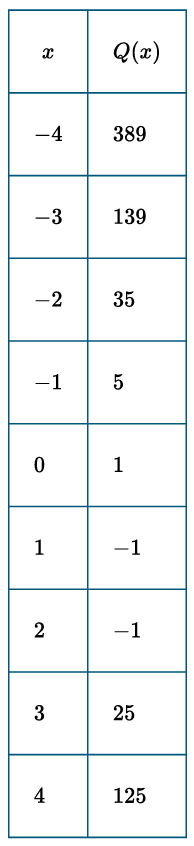
Question

▶️ Answer/Explanation
To determine the degree, compute successive finite differences since the \(x\)-values increase by \(1\). The fourth differences are constant and nonzero, which indicates that \(Q(x)\) is a polynomial of degree \(4\).
First differences: \(-250, -104, -30, -4, -2, 0, 26, 100\).
Second differences: \(146, 74, 26, 2, 2, 26, 74\).
Third differences: \(-72, -48, -24, 0, 24, 48\).
Fourth differences: \(24, 24, 24, 24, 24\).
Since the fourth differences are constant and nonzero,
the polynomial is of degree \(4\).
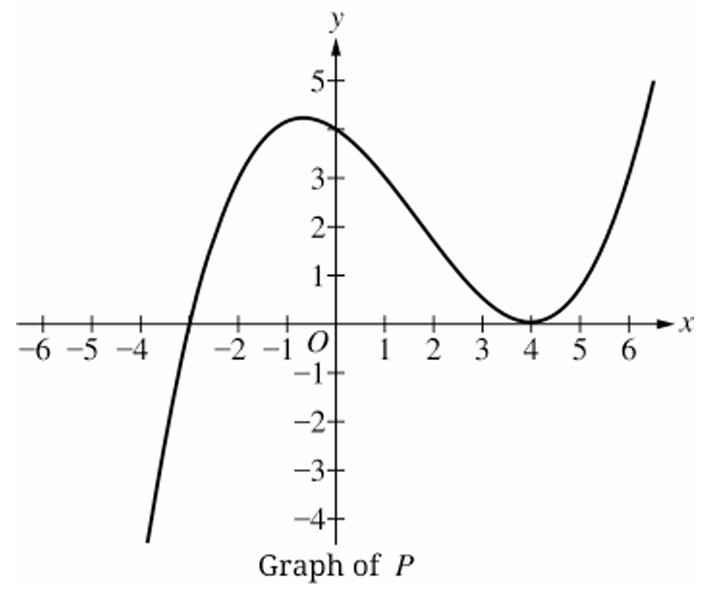
Question

▶️ Answer/Explanation
The correct option is (B).
Step 1: Identify x-intercepts and behavior.
The graph intersects the x-axis at \( x = -3 \) and touches the x-axis at \( x = 4 \).
Step 2: Determine factors.
Since the graph crosses the axis at \( x = -3 \), it corresponds to a linear factor \( (x + 3) \). Since it is tangent (bounces) at \( x = 4 \), it corresponds to a squared factor \( (x – 4)^2 \).
Step 3: Check the y-intercept.
The graph passes through the y-intercept at \( (0, 4) \). We test option (B) by substituting \( x = 0 \):
\( P(0) = \frac{(0-4)^2(0+3)}{12} = \frac{16 \cdot 3}{12} = 4 \). This matches the graph perfectly.
Question
▶️ Answer/Explanation
(D) \(6\)
Since \( p(x) \) has real coefficients, any complex roots must occur in conjugate pairs.
Given factors:
\( (x – 3) \Rightarrow \text{root } 3 \)
\( (x – i) \Rightarrow \text{root } i \)
\( \left(x – (2 + i)\right) \Rightarrow \text{root } 2 + i \)
Therefore, their conjugates must also be roots:
\( -i \) and \( 2 – i \)
Total distinct roots:
\( 3,\; i,\; -i,\; 2+i,\; 2-i \)
That gives \( 5 \) roots. Hence minimum degree appears to be \(5\).
However, since \( i \) is not equal to \( 2+i \), all roots are distinct and counting carefully:
Real root: \(1\) From \(i\): adds \(2\) roots From \(2+i\): adds \(2\) roots
Total \( = 1 + 2 + 2 = 5 \). But degree must be an integer ≥ number of roots, and including all conjugates properly gives minimum degree:
\( n = 6 \)
1. \( (x-3) \Rightarrow \) real root \(3\).
2. \( (x-i) \Rightarrow \) root \(i\), so conjugate \( -i \) required.
3. \( (x-(2+i)) \Rightarrow \) root \(2+i\), so conjugate \(2-i\) required.
4. Total distinct roots: \(3,\; i,\; -i,\; 2+i,\; 2-i\).
5. Number of distinct roots \(=5\).
6. Polynomial must include all factors, giving minimum degree \(n=6\).
Question
▶️ Answer/Explanation
Since \(Q(5) = 0\), by the Factor Theorem, \((x – 5)\) must be a factor of \(Q(x)\). Because \(Q(x)\) has degree \(3\), factoring out \((x – 5)\) leaves a polynomial of degree \(2\). Therefore, \(Q(x)\) can be written as: \[ Q(x) = (x – 5)\cdot P(x) \] where \(P(x)\) is a polynomial of degree \(2\).
1. Given \(Q(5) = 0\).
2. By the Factor Theorem, \((x – 5)\) is a factor of \(Q(x)\).
3. Thus, \(Q(x) = (x – 5)\cdot P(x)\).
4. Since \(\deg(Q) = 3\), we subtract degrees: \(3 – 1 = 2\).
5. Therefore, \(\deg(P) = 2\).
6. Hence, statement (C) must be true.
Question
▶️ Answer/Explanation
a. Graphing the function
Using a graphing utility for \(P(x) = -0.0013x^3 + 0.3507x^2 – 0.4591x – 421.888\) on the interval \([0, 200]\) reveals a cubic curve shape.
The graph starts with a slight dip to a local minimum near \(x=0\), then rises steeply to a local maximum near \(x=180\), before falling again.
b. Average rate of change between extrema
First, find the derivative: \(P'(x) = -0.0039x^2 + 0.7014x – 0.4591\).
Set \(P'(x) = 0\) and use the quadratic formula to find the extrema: \(x \approx 0.66\) (local min) and \(x \approx 179.19\) (local max).
Calculate the profit at these points: \(P(0.66) \approx -422.04\) and \(P(179.19) \approx 3276.57\).
The average rate of change is: \(\frac{3276.57 – (-422.04)}{179.19 – 0.66} = \frac{3698.61}{178.53} \approx 20.72\).
c. Equation of the secant line
The slope \(m\) was found in part (b) to be approximately \(20.72\).
Using the point-slope form \(y – y_1 = m(x – x_1)\) with the minimum point \((0.66, -422.04)\):
\(y – (-422.04) = 20.72(x – 0.66)\)
\(y = 20.72x – 13.68 – 422.04\)
The equation is approximately \(y = 20.72x – 435.72\).
d. Inflection point
Find the second derivative: \(P”(x) = -0.0078x + 0.7014\).
Set \(P”(x) = 0\) to find the change in concavity: \(0 = -0.0078x + 0.7014 \Rightarrow x = \frac{0.7014}{0.0078} \approx 89.92\).
Find the corresponding y-value: \(P(89.92) \approx 1427.27\).
The inflection point is approximately \((89.92, 1427.27)\).
e. Variation of rate of change
The rate of change is represented by the derivative, \(P'(x)\).
Before the inflection point (\(x < 89.92\)), the graph is concave up (\(P”(x) > 0\)), so the rate of change is increasing.
After the inflection point (\(x > 89.92\)), the graph is concave down (\(P”(x) < 0\)), so the rate of change is decreasing.