
▶️ Answer/Explanation
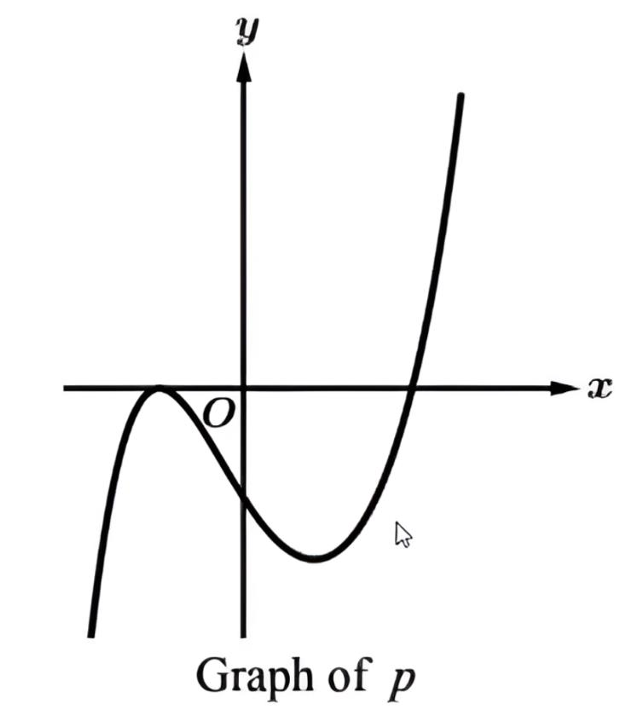
The degree of a polynomial is the sum of the multiplicities of all its roots. We analyze the graph and the given information to find the minimum values:
- Tangent Real Root: The graph touches the \( x \)-axis and turns around at a negative value. This indicates a root with an even multiplicity, so the minimum is 2.
- Crossing Real Root: The graph crosses the \( x \)-axis at a positive value. This indicates a root with an odd multiplicity, so the minimum is 1.
- Complex Roots: Given \( 2 – 3i \) is a zero, its conjugate \( 2 + 3i \) must also be a zero (Complex Conjugate Root Theorem). This accounts for 2 roots.
Total Least Degree: Summing these gives \( 2 + 1 + 2 = 5 \).
The correct option is (D).
▶️ Answer/Explanation
The correct answer is (C).
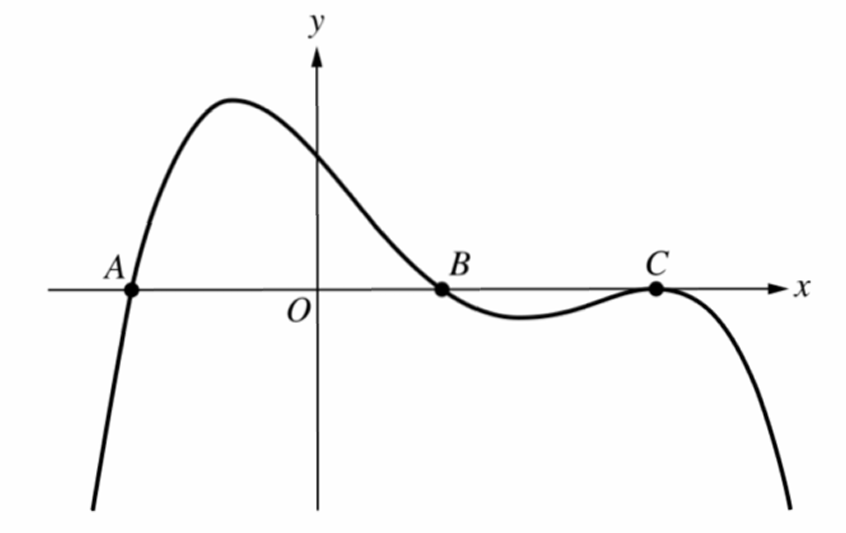
A quartic polynomial is of degree $4$, meaning it must have exactly $4$ roots (counting multiplicity).
At zeros $A$ and $B$, the graph crosses the $x$-axis, indicating an odd multiplicity (likely $1$ each).
At zero $C$, the graph is tangent to the $x$-axis and does not cross it.
This “bounce” behavior implies an even multiplicity for the root at $C$.
Since the function does not change signs at $C$, the multiplicity must be at least $2$.
Given only three distinct real zeros ($A, B, C$), the multiplicities must sum to $4$.
Therefore, $1 (\text{at } A) + 1 (\text{at } B) + 2 (\text{at } C) = 4$.
▶️ Answer/Explanation
From the graph, the curve touches the \( x \)-axis at a negative value and turns around, indicating a real root with an even multiplicity of at least \( 2 \).
The curve also crosses the \( x \)-axis at a positive value, indicating a distinct real root with an odd multiplicity of at least \( 1 \).
Therefore, the visible behavior on the graph accounts for a minimum degree of \( 2 + 1 = 3 \).
The problem states that \( 2 – 3i \) is a zero of \( p \). Since the graph represents a polynomial with real coefficients, complex roots must occur in conjugate pairs.
This means the conjugate \( 2 + 3i \) is also a zero, contributing \( 2 \) distinct complex roots to the total degree.
Adding the minimum real roots and the complex roots together, the least possible degree is \( 3 + 2 = 5 \).
Correct Option: (D)
▶️ Answer/Explanation
The correct answer is (C).
Step 1: Analyze the behavior of the graph at the zero \( C \). At this point, the graph touches the \( x \)-axis and turns back down, remaining on the same side (negative values) rather than crossing it.
Step 2: Determine the relationship between graph behavior and multiplicity. If a graph crosses the \( x \)-axis at a zero (like at points \( A \) and \( B \)), the multiplicity is odd (typically \( 1 \)). If the graph touches the axis and turns around (does not change sign), the multiplicity is even (e.g., \( 2 \)).
Step 3: Consider the degree of the polynomial. The problem states it is a quartic function (degree \( 4 \)). By the Fundamental Theorem of Algebra, the sum of the multiplicities of all zeros must be \( 4 \).
Step 4: Since there are three visible real roots, and \( A \) and \( B \) are simple crossings (multiplicity \( 1 \)), the remaining degrees of freedom must be assigned to \( C \). Calculating the sum: \( 1 (\text{at } A) + 1 (\text{at } B) + 2 (\text{at } C) = 4 \).
Conclusion: The zero at \( C \) must have a multiplicity of \( 2 \) because the polynomial does not change signs at this point, consistent with the graph being tangent to the axis.
▶️ Answer/Explanation
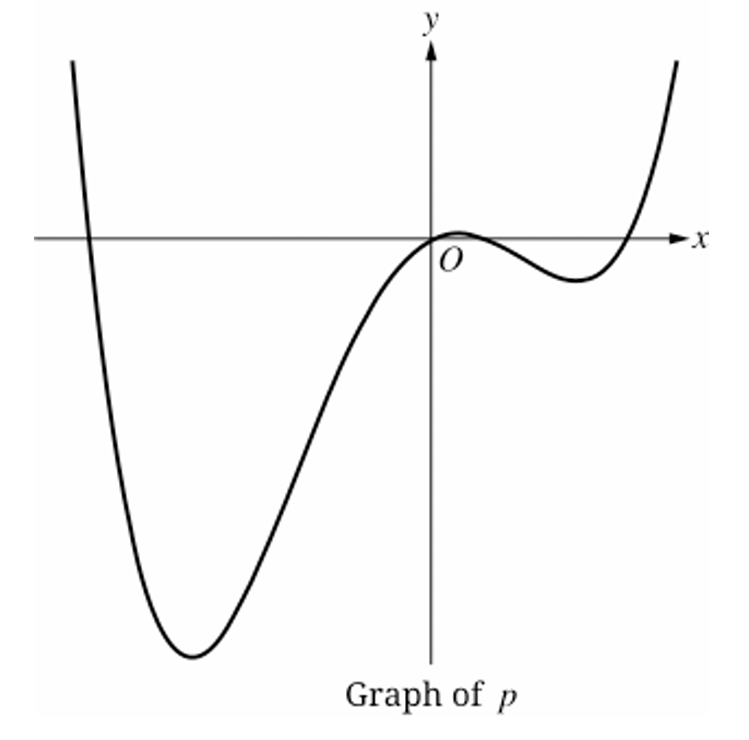
2. A quadratic function can have at most \(2\) real zeros.
3. Points of inflection occur where \(p”(x)=0\) and concavity changes.
4. From the graph, the curve changes concavity once between the left minimum and the local maximum.
5. It changes concavity again between the local maximum and the right minimum.
6. No additional concavity change is visible on either end of the graph.
7. Therefore, the graph has exactly \(2\) points of inflection.
▶️ Answer/Explanation
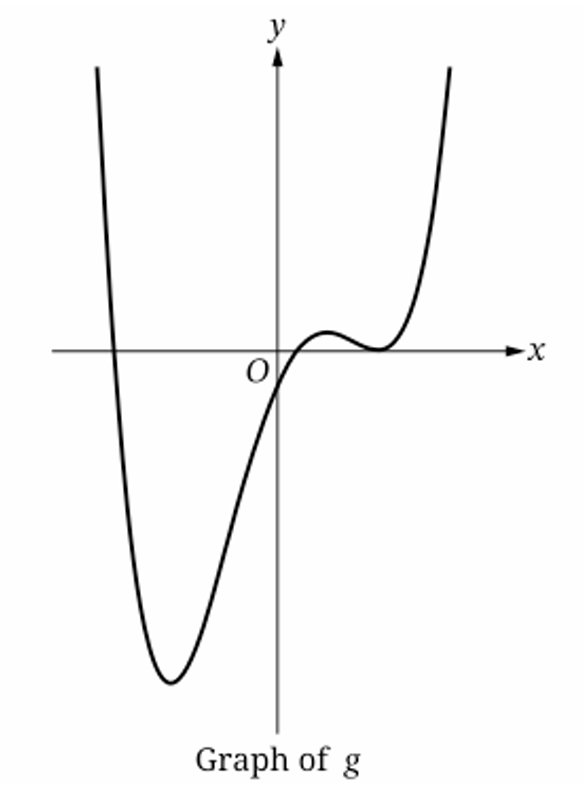
Step 1: Analyze End Behavior
The graph goes upwards to \( +\infty \) on both the far left and far right sides. This indicates that the polynomial must have an even degree (like \( x^2, x^4 \), etc.) and a positive leading coefficient. Options (A) and (B) are polynomials of degree 3 (multiplying three \( x \) terms), which is odd. Therefore, (A) and (B) are incorrect.
Step 2: Analyze Roots and Multiplicity
We look at the behavior of the graph at the x-intercepts (roots):
• At the negative root (approx \( x = -8 \)), the graph crosses the x-axis. This corresponds to a linear factor, \( (x+8) \).
• At the smaller positive root (approx \( x = 1 \)), the graph crosses the x-axis. This corresponds to a linear factor, \( (x-1) \).
• At the larger positive root (approx \( x = 5 \)), the graph touches the x-axis and turns back up (tangent to the axis). This indicates a root with an even multiplicity, usually 2. This corresponds to a squared factor, \( (x-5)^2 \).
Step 3: Match with Options
Checking the remaining even-degree options:
• Option (D) has \( (x+5)^2 \), which implies a touch at \( x = -5 \). The graph crosses at the negative value, so this is incorrect.
• Option (C) is \( 0.25(x-5)^2(x-1)(x+8) \). This matches all our observations: degree 4, crosses at \( -8 \) and \( 1 \), and touches at \( 5 \).
Conclusion
The correct expression is (C).
▶️ Answer/Explanation
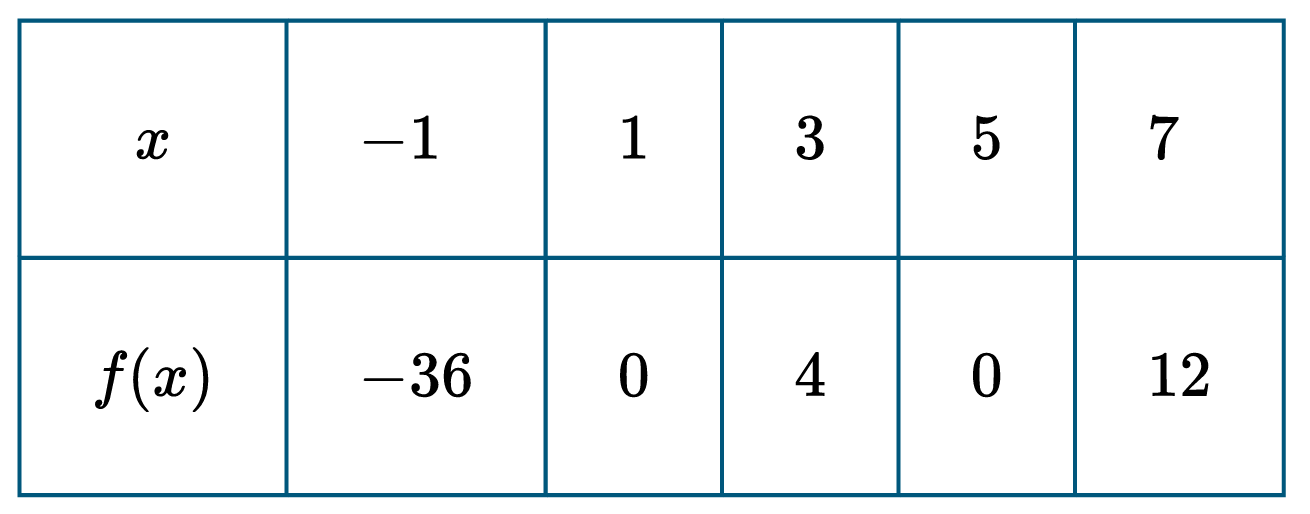
The zeros of the polynomial are \(x=1\) and \(x=5\). Since all zeros are listed and \(f(3)=4>0\), the function is positive between \(1\) and \(5\). Also, \(f(-1)=-36<0\) and \(f(7)=12>0\), so the sign changes at \(x=1\) and at \(x=5\). Therefore, at \(x=5\) the function changes from positive to negative to positive behavior locally, indicating a local minimum at \((5,0)\).
1. From the table, zeros occur at \(x=1\) and \(x=5\).
2. Since all zeros are given, there are no additional sign changes elsewhere.
3. \(f(-1)=-36<0\) and \(f(3)=4>0\), so the sign changes at \(x=1\).
4. \(f(3)=4>0\) and \(f(7)=12>0\), so the function remains positive after \(x=5\).
5. Thus near \(x=5\), the graph must touch the \(x\)-axis and turn upward.
6. Therefore, \((5,0)\) is a local minimum.
▶️ Answer/Explanation
(B) Four
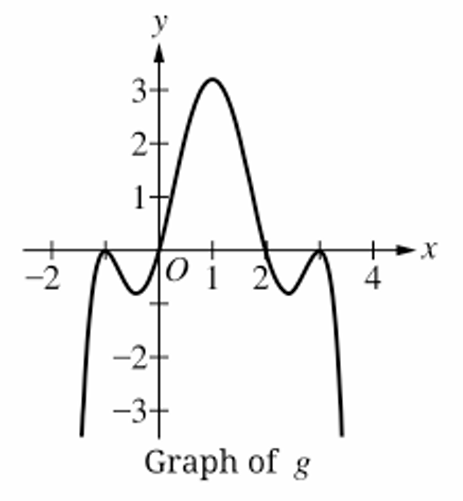
Since \(f(x)=g(x)\) only on the closed interval \(0 \le x \le 3\), we consider extrema within this restricted domain. From the graph on \(0 \le x \le 3\):
- There is one local maximum near \(x \approx 1\).
- There is one local minimum near \(x \approx 2.3\).
- The endpoint \(x=0\) is a local minimum (function increases immediately to the right).
- The endpoint \(x=3\) is a local maximum (function decreases immediately to the left).
Therefore, total local extrema \(= 2\) interior \(+\;2\) endpoints \(=\;4\).
1. Restrict the graph to \(0 \le x \le 3\).
2. Identify critical points inside the interval: one local maximum and one local minimum.
3. Check endpoint behavior at \(x=0\): function increases to the right ⇒ local minimum.
4. Check endpoint behavior at \(x=3\): function decreases to the left ⇒ local maximum.
5. Total extrema \(= 1 + 1 + 1 + 1 = 4.\)
6. Hence, the correct answer is \(\boxed{4}\).
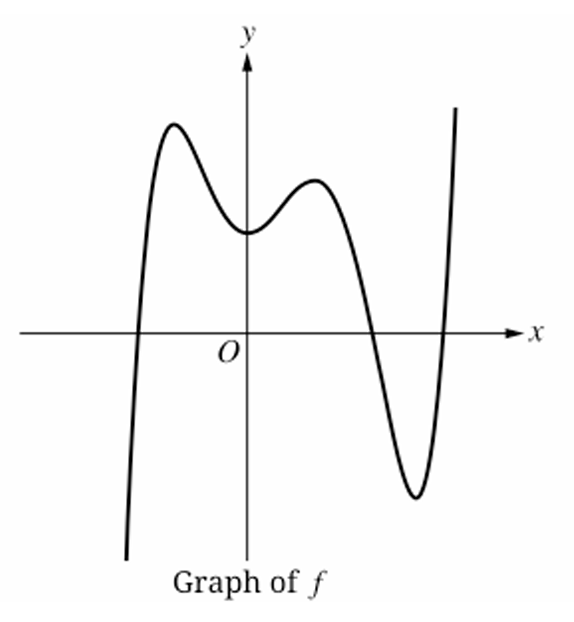
▶️ Answer/Explanation
(B) Three
A point of inflection occurs where the concavity of \( f \) changes, that is, where \( f”(x) \) changes sign. Observing the graph from left to right: the curve changes from concave down to concave up once before the first local minimum, then from concave up to concave down before the next local maximum, and finally from concave down to concave up before the deep minimum. Thus, there are exactly \( 3 \) changes in concavity.
1. A point of inflection occurs where \( f”(x) \) changes sign.
2. The graph shows two local maxima and two local minima.
3. Between each adjacent maximum and minimum, concavity must change at least once.
4. From the first maximum to the first minimum: one change in concavity.
5. From the first minimum to the second maximum: one change in concavity.
6. From the second maximum to the second minimum: one change in concavity.
7. No additional visible concavity changes occur on the shown interval.
8. Therefore, the graph has \( \boxed{3} \) points of inflection.
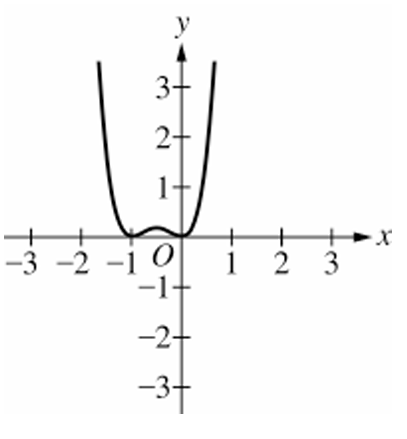
▶️ Answer/Explanation
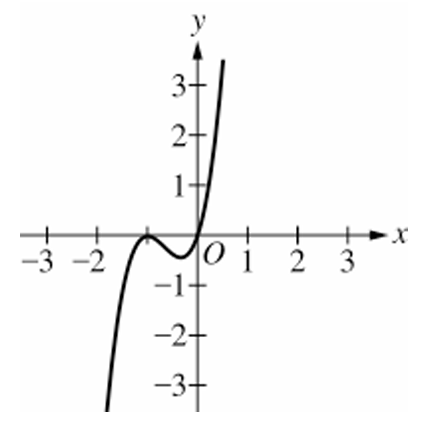
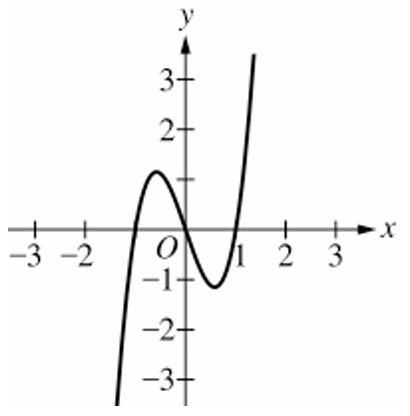
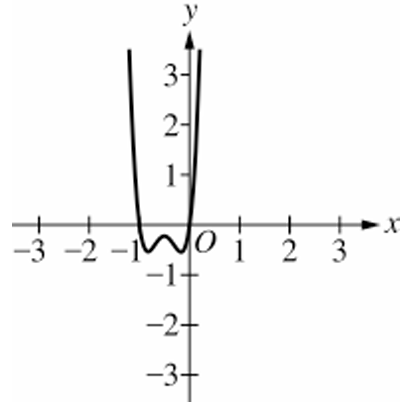
Option (B)
The polynomial is \[ P(x)=3x(x+1)^2(x-a). \] Its degree is \(4\) with leading term \(3x^4\), so both ends of the graph rise as \(x \to \pm\infty\).
The zeros are: \[ x=0 \quad (\text{simple root}), \] \[ x=-1 \quad (\text{double root}), \] \[ x=a \quad (\text{simple root}). \]
A double root at \(x=-1\) means the graph touches and turns at \(x=-1\). Simple roots at \(x=0\) and \(x=a\) mean the graph crosses the \(x\)-axis at those points.
The only option showing:
• both ends up (even degree, positive leading coefficient),
• a bounce at \(x=-1\),
• and crossings at two other points,
is Option (B).
1. Degree \(=4\) since factors are \(x(x+1)^2(x-a)\).
2. Leading term \(=3x^4\Rightarrow\) both ends rise.
3. Root \(x=-1\) has multiplicity \(2\Rightarrow\) graph touches and turns.
4. Roots \(x=0\) and \(x=a\) have multiplicity \(1\Rightarrow\) graph crosses.
5. Total possible real intercepts \(=3\).
6. Only graph (B) matches this behavior.
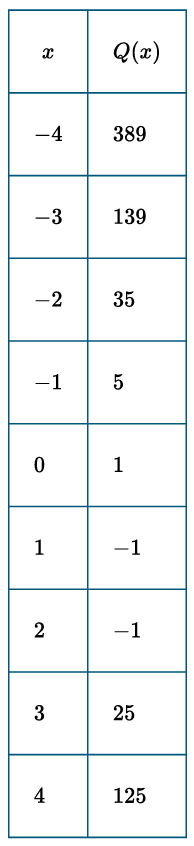
▶️ Answer/Explanation
To determine the degree, compute successive finite differences since the \(x\)-values increase by \(1\). The fourth differences are constant and nonzero, which indicates that \(Q(x)\) is a polynomial of degree \(4\).
First differences: \(-250, -104, -30, -4, -2, 0, 26, 100\).
Second differences: \(146, 74, 26, 2, 2, 26, 74\).
Third differences: \(-72, -48, -24, 0, 24, 48\).
Fourth differences: \(24, 24, 24, 24, 24\).
Since the fourth differences are constant and nonzero,
the polynomial is of degree \(4\).
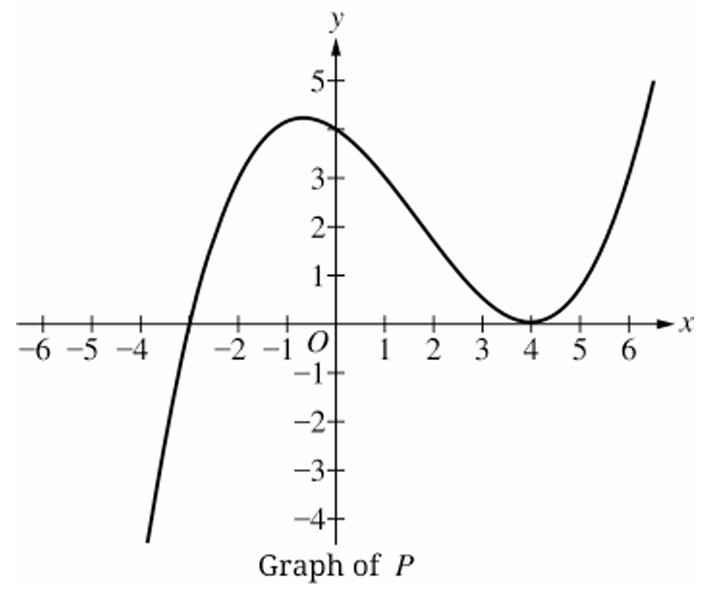
▶️ Answer/Explanation
The correct option is (B).
Step 1: Identify x-intercepts and behavior.
The graph intersects the x-axis at \( x = -3 \) and touches the x-axis at \( x = 4 \).
Step 2: Determine factors.
Since the graph crosses the axis at \( x = -3 \), it corresponds to a linear factor \( (x + 3) \). Since it is tangent (bounces) at \( x = 4 \), it corresponds to a squared factor \( (x – 4)^2 \).
Step 3: Check the y-intercept.
The graph passes through the y-intercept at \( (0, 4) \). We test option (B) by substituting \( x = 0 \):
\( P(0) = \frac{(0-4)^2(0+3)}{12} = \frac{16 \cdot 3}{12} = 4 \). This matches the graph perfectly.