
AP Precalculus -1.6 Polynomial Functions and End Behavior- MCQ Exam Style Questions - Effective Fall 2023
AP Precalculus -1.6 Polynomial Functions and End Behavior- MCQ Exam Style Questions – Effective Fall 2023
AP Precalculus -1.6 Polynomial Functions and End Behavior- MCQ Exam Style Questions – AP Precalculus- per latest AP Precalculus Syllabus.
Question
(B) The degree of \( f \) is even, and the leading coefficient is positive.
(C) The degree of \( f \) is odd, and the leading coefficient is negative.
(D) The degree of \( f \) is odd, and the leading coefficient is positive.
▶️ Answer/Explanation
End behavior: as \( x \to -\infty \), \( f(x) \to \infty \) (up to the left); as \( x \to \infty \), \( f(x) \to -\infty \) (down to the right).
For odd degree polynomials: ends go in opposite directions.
Leading coefficient negative ⇒ up-left, down-right. Leading coefficient positive ⇒ down-left, up-right.
Given up-left, down-right ⇒ odd degree, negative leading coefficient.
✅ Answer: (C)
Question
(B) The sign of the leading term of \( p \) is negative, and the degree of the leading term of \( p \) is odd; therefore, \( \lim_{x \to -\infty} p(x) = \infty \) and \( \lim_{x \to \infty} p(x) = -\infty \).
(C) The sign of the leading term of \( p \) is positive, and the degree of the leading term of \( p \) is odd; therefore, \( \lim_{x \to -\infty} p(x) = -\infty \) and \( \lim_{x \to \infty} p(x) = \infty \).
(D) The sign of the leading term of \( p \) is negative, and the degree of the leading term of \( p \) is odd; therefore, \( \lim_{x \to -\infty} p(x) = -\infty \) and \( \lim_{x \to \infty} p(x) = \infty \).
▶️ Answer/Explanation
Leading term: \( -4x^5 \) → negative coefficient, degree 5 (odd).
For odd degree, negative leading coefficient: up-left, down-right.
So \( \lim_{x \to -\infty} p(x) = \infty \) and \( \lim_{x \to \infty} p(x) = -\infty \).
This matches option (B).
✅ Answer: (B)
Question
(B) \( f \) is a polynomial of degree 2 with a leading coefficient of 9.
(C) \( f \) is a polynomial of degree 3 with a leading coefficient of 3.
(D) \( f \) is a polynomial of degree 3 with a leading coefficient of 9.
▶️ Answer/Explanation
Factor \( (3x – 1)^2 \) has degree 2, factor \( (x – 4) \) has degree 1 ⇒ total degree = 3.
Leading term from expanding: \( (3x)^2 \cdot x = 9x^3 \) ⇒ leading coefficient 9.
✅ Answer: (D)
Question
(B) \( j = 2k \) and \( k \) is even.
(C) \( j + k \) is even.
(D) \( j \cdot k \) is even.
▶️ Answer/Explanation
Even function means \( p(-x) = p(x) \).
This requires \( j \) and \( k \) both even, because \( (-x)^n = x^n \) only if \( n \) is even.
Check options:
(A) \( k=0 \) (0 is even) but \( j \) could be odd ⇒ not guaranteed even.
(B) \( j = 2k \) and \( k \) even ⇒ \( j \) even (since even × integer = even). Both exponents even ⇒ \( p \) even.
(C) \( j+k \) even: e.g., \( j=1, k=3 \) ⇒ both odd ⇒ \( p \) not even.
(D) \( j \cdot k \) even: e.g., \( j=1, k=2 \) ⇒ \( j \) odd ⇒ not even.
Thus only (B) guarantees both exponents even.
✅ Answer: (B)
Question
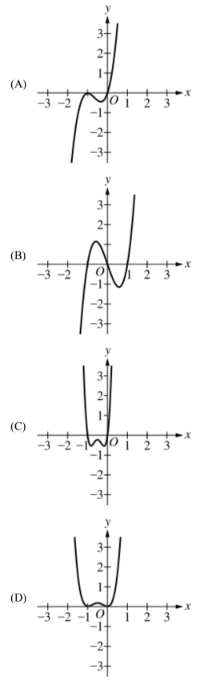
▶️ Answer/Explanation
Given \( P(x) = 3x(x + 1)^2(x – a) \).
For both \( x = -1 \) and \( x = 0 \) to have even multiplicity (graph tangent to x-axis at both), \( x = 0 \) must be multiplicity 2 ⇒ \( a = 0 \) makes \( P(x) = 3x^2(x + 1)^2 \), so both zeros multiplicity 2.
The correct graph must show tangency at \( x = 0 \) and \( x = -1 \), no crossing there, and degree 4, positive leading coefficient 3 ⇒ ends up.
Match to the option with that shape.
✅ Answer: (D)
Question
(B) \( f \) has either a global maximum or a global minimum, but not both.
(C) \( f \) has neither a global maximum nor a global minimum.
(D) The nature of a global maximum or a global minimum for \( f \) cannot be determined without more information about \( b, c, d, \) and \( k \).
▶️ Answer/Explanation
\( f \) is a quartic polynomial (degree 4, even).
For even-degree polynomials with leading coefficient \( a \neq 0 \):
– If \( a > 0 \), as \( x \to \pm\infty \), \( f(x) \to +\infty \) ⇒ global minimum exists, no global maximum.
– If \( a < 0 \), as \( x \to \pm\infty \), \( f(x) \to -\infty \) ⇒ global maximum exists, no global minimum.
Thus \( f \) has either a global max or a global min, but not both.
✅ Answer: (B)
Question
(B) \( \displaystyle \lim_{x \to -\infty} f(x) = \infty \) and \( \displaystyle \lim_{x \to \infty} f(x) = \infty \)
(C) \( \displaystyle \lim_{x \to -\infty} f(x) = -\infty \) and \( \displaystyle \lim_{x \to \infty} f(x) = \infty \)
(D) \( \displaystyle \lim_{x \to -\infty} f(x) = \infty \) and \( \displaystyle \lim_{x \to \infty} f(x) = -\infty \)
▶️ Answer/Explanation
The end behavior of a polynomial is determined by its leading term when the degree is even or odd and the leading coefficient is positive or negative.
For \( f(x) = 5x^6 – 2x^3 – 3 \):
• Degree = 6 (even).
• Leading coefficient = 5 (positive).
For even degree and positive leading coefficient:
As \( x \to \pm\infty \), \( 5x^6 \to +\infty \).
Thus:
\[ \lim_{x \to -\infty} f(x) = \infty \] \[ \lim_{x \to \infty} f(x) = \infty \]
This matches option (B).
✅ Answer: (B)
Question
▶️ Answer/Explanation
An odd function satisfies the condition $f(-x) = -f(x)$, which implies symmetry about the origin.
The given limit $\lim_{x \to 3^-} f(x) = -\infty$ describes the behavior as $x$ approaches $3$ from the left.
To find the behavior near $-3$, we substitute $x$ with $-t$, so as $x \to -3^+$, then $t \to 3^-$.
Using the odd property: $f(x) = f(-t) = -f(t)$.
Therefore, $\lim_{x \to -3^+} f(x) = \lim_{t \to 3^-} [-f(t)] = -(-\infty) = \infty$.
This matches option d.
Correct Option: d
Question
▶️ Answer/Explanation
The end behavior of a polynomial function is determined by its leading term (the term with the highest degree).
Since \(\lim_{x\to\infty} g(x) = -\infty\) and \(\lim_{x\to-\infty} g(x) = -\infty\), the graph points downwards on both ends.
This behavior indicates that the polynomial must have an even degree and a negative leading coefficient.
(A) simplifies to \(x^2 + 1\): Even degree, positive coefficient (Ends \(\to \infty\)). Incorrect.
(B) \(-x^4 + 2x^3 + 6\): Even degree (4), negative coefficient (-1). Ends \(\to -\infty\). Correct.
(C) \(2x^3 – 7x^2 + 4x\): Odd degree. Ends go in opposite directions. Incorrect.
(D) \(4x^6 + x^3 – 5\): Even degree, positive coefficient (Ends \(\to \infty\)). Incorrect.
Question
▶️ Answer/Explanation
The end behavior of the polynomial \(p(x)\) is determined by its leading term, \(ax^n\).
Since \(\lim_{x \to \infty} p(x) = -\infty\), the leading term must be negative as \(x\) gets large, which implies \(a < 0\).
This condition eliminates options (C) and (D) because \(a\) must be negative.
Since \(\lim_{x \to -\infty} p(x) = \infty\), the function rises to the left. With \(a < 0\), \(x^n\) must be negative.
For \(x^n\) to be negative when \(x\) is negative, the degree \(n\) must be an odd integer.
Looking at the remaining options, only (A) has an odd value for \(n\) (\(n=5\)).
Therefore, the correct choice is \(a = -3\) and \(n = 5\).
Question

(B) $3$
(C) $2$
(D) $0$
▶️ Answer/Explanation
Since $f$ is an odd function, it satisfies the property $f(-x) = -f(x)$ for all $x$ in the domain.
From the table, the minimum value on the positive domain $[0, 4]$ is $f(2) = -3$.
By the odd property, $f(-2) = -f(2) = -(-3) = 3$.
The value $f(4) = 2$ corresponds to $f(-4) = -f(4) = -2$.
In the interval $2 < x < 3$, $f(x)$ increases from $-3$ to $0$, so on $-3 < x < -2$, $f(x)$ decreases from $0$ to $3$.
The maximum value in the positive interval is $f(4) = 2$, while the odd property reveals a higher value of $3$ at $x = -2$.
Comparing all critical points and boundaries, the absolute maximum value is $3$.
Therefore, the correct option is (B).
Question
▶️ Answer/Explanation
The phrase “input values of \(p\) increase without bound” corresponds to the limit as \(x \to \infty\).
The phrase “output values of \(p\) decrease without bound” corresponds to the limit equaling \(-\infty\).
Therefore, the condition is defined as \(\lim_{x \to \infty} p(x) = -\infty\).
Considering the leading term, \(\lim_{x \to \infty} (ax^n + b) = \lim_{x \to \infty} ax^n\).
Since \(n\) is a positive integer, \(x^n \to \infty\) as \(x\) increases.
For the product \(ax^n\) to approach \(-\infty\), the coefficient \(a\) must be negative.
Thus, the correct statement is that \(a\) is negative because \(\lim_{x \to \infty} p(x) = -\infty\).
Question
▶️ Answer/Explanation
The end behavior of a polynomial function is determined by its leading term (the term with the highest degree).
The problem states that as \( x \to -\infty \), \( k(x) \to \infty \) (starts up) and as \( x \to \infty \), \( k(x) \to -\infty \) (ends down).
Since the ends point in opposite directions, the degree of the polynomial must be odd.
Since the function goes to \( -\infty \) as \( x \) approaches positive infinity (right side goes down), the leading coefficient must be negative.
Looking at the options, we analyze the leading terms:
(A) \( 4x^5 \): Odd degree, positive coefficient (Ends: Down/Up). Incorrect.
(B) \( 3x^4 \): Even degree, positive coefficient (Ends: Up/Up). Incorrect.
(C) \( -2x^3 \): Odd degree, negative coefficient (Ends: Up/Down). Correct.
(D) \( -5x^6 \): Even degree, negative coefficient (Ends: Down/Down). Incorrect.
Question
▶️ Answer/Explanation
(C) The degree of \( f \) is odd, and the leading coefficient is negative.
The end behavior of a polynomial is determined by its leading term \( a x^n \). If the limits at \( -\infty \) and \( \infty \) are opposite in sign, the degree must be odd. Since \( f(x) \to -\infty \) as \( x \to \infty \), the leading coefficient must be negative.
Line 2: If \( n \) is even, both ends of the graph go in the same direction.
Line 3: Here, \( \lim_{x \to -\infty} f(x) = \infty \) and \( \lim_{x \to \infty} f(x) = -\infty \), so the ends differ.
Line 4: Therefore, the degree \( n \) must be odd.
Line 5: For an odd degree polynomial, if \( a < 0 \), then \( f(x) \to -\infty \) as \( x \to \infty \).
Line 6: This matches the given condition, so the leading coefficient is negative.
Line 7: Hence, the correct answer is (C).
Question
▶️ Answer/Explanation
(A)
1. The end behavior of a polynomial depends on its highest-degree term.
2. In (A), the leading term is \( -2x^4 \).
3. Since \( x^4 \) is even, \( x^4 \to +\infty \) as \( x \to -\infty \).
4. Multiplying by \( -2 \) gives \( -2x^4 \to -\infty \).
5. In (B) and (C), the leading terms are odd powers with negative coefficients, giving \( +\infty \) as \( x \to -\infty \).
6. In (D), the leading term is \( 2x^4 \), which gives \( +\infty \).
7. Therefore, only option (A) satisfies \( \lim_{x \to -\infty} g(x) = -\infty \).
Question
▶️ Answer/Explanation
(B) \(\displaystyle \lim_{x \to \infty} f(x) = -\infty\)
1. The highest-degree term is \( -2x^{7} \).
2. End behavior of a polynomial is determined by its leading term.
3. As \( x \to \infty \), \( x^{7} \to \infty \).
4. Therefore, \( -2x^{7} \to -\infty \).
5. Lower-degree terms \( 5x^{4}, 6x^{2}, -3 \) become insignificant compared to \( x^{7} \).
6. Hence, \( f(x) \to -\infty \) as \( x \to \infty \).
7. Therefore, the correct answer is option (B).
Question
▶️ Answer/Explanation
(B)
The leading term of the polynomial is \(5x^6\). Since the degree is even (\(6\)) and the leading coefficient \(5\) is positive, the function rises to positive infinity on both ends. Therefore, \[ \lim_{x \to -\infty} f(x) = \infty \quad \text{and} \quad \lim_{x \to \infty} f(x) = \infty. \]
1. The highest-degree term is \(5x^6\).
2. End behavior depends only on the leading term.
3. The degree \(6\) is even.
4. The leading coefficient \(5 > 0\).
5. For even degree with positive coefficient, both ends rise.
6. Thus, \(f(x) \to \infty\) as \(x \to \pm\infty\).
7. Therefore, the correct answer is (B).
Question
\( \displaystyle \lim_{x \to -\infty} p(x) = \infty \) and \( \displaystyle \lim_{x \to \infty} p(x) = \infty \)
\( \displaystyle \lim_{x \to -\infty} p(x) = \infty \) and \( \displaystyle \lim_{x \to \infty} p(x) = -\infty \)
\( \displaystyle \lim_{x \to -\infty} p(x) = -\infty \) and \( \displaystyle \lim_{x \to \infty} p(x) = \infty \)
\( \displaystyle \lim_{x \to -\infty} p(x) = -\infty \) and \( \displaystyle \lim_{x \to \infty} p(x) = \infty \)
▶️ Answer/Explanation
The leading term of the polynomial is \( -4x^5 \). Since the coefficient \( -4 \) is negative and the degree \( 5 \) is odd, the graph rises to \( \infty \) as \( x \to -\infty \) and falls to \( -\infty \) as \( x \to \infty \). Therefore, option (B) correctly describes the end behavior.
1. The given polynomial is \( p(x) = -4x^5 + 3x^2 + 1 \).
2. The leading term is \( -4x^5 \).
3. The coefficient \( -4 \) is negative.
4. The degree \( 5 \) is odd.
5. For an odd degree with negative leading coefficient: left end rises, right end falls.
6. Thus, \( \lim_{x \to -\infty} p(x) = \infty \) and \( \lim_{x \to \infty} p(x) = -\infty \).
7. Hence, the correct statement is (B).
Question
▶️ Answer/Explanation
(D) \( f \) is a polynomial of degree \( 3 \) with a leading coefficient of \( 9 \).
The factor \( (x – 4) \) has degree \( 1 \), and \( (3x – 1)^2 \) has degree \( 2 \). Thus, the total degree is \( 1 + 2 = 3 \). The leading term of \( (3x – 1)^2 \) is \( 9x^2 \). Multiplying by \( x \) from \( (x – 4) \) gives the leading term \( 9x^3 \). Therefore, the leading coefficient is \( 9 \).
1. Given \( f(x) = (x – 4)(3x – 1)^2 \).
2. Degree of \( (x – 4) = 1 \).
3. Degree of \( (3x – 1)^2 = 2 \).
4. Total degree \( = 1 + 2 = 3 \).
5. Leading term of \( (3x – 1)^2 = 9x^2 \).
6. Multiply by leading term \( x \): \( x \cdot 9x^2 = 9x^3 \).
7. Hence, leading coefficient \( = 9 \).
8. Correct option is (D).
Question
▶️ Answer/Explanation
(B)
A function is even if \( p(-x) = p(x) \). For \( p(x) = ax^j + bx^k \), we have \[ p(-x) = a(-x)^j + b(-x)^k. \] This equals \( ax^j + bx^k \) only when both exponents \(j\) and \(k\) are even. Option (B) guarantees this because if \(k\) is even and \(j = 2k\), then \(j\) is also even. Hence both exponents are even, making \(p(x)\) an even function.
1. A function is even if \( p(-x) = p(x) \).
2. Compute \( p(-x) = a(-x)^j + b(-x)^k \).
3. For equality, both \( (-x)^j = x^j \) and \( (-x)^k = x^k \).
4. This occurs only when \( j \) and \( k \) are even integers.
5. In option (B), \( k \) is even and \( j = 2k \Rightarrow j \) is even.
6. Therefore, both exponents are even, guaranteeing an even function.